
Does Applying For A Credit Card Hurt Your Score As A New Immigrant? Complete Guide for USA Immigrants (2026)
Quick Answer: Yes, applying for a credit card triggers a hard inquiry that can temporarily lower your score — but as a new immigrant with little or no U.S. credit history, the strategic benefits of building credit typically outweigh the short-term dip. Timing and card selection matter enormously.
Before they submit their first U.S. credit card application, most immigrants ask the same question: will this hurt my score? The concern is reasonable — you’ve heard that credit inquiries cause damage, your file is thin to begin with, and a rejection feels like it would make things worse. The reality is more nuanced, and more forgiving, than most people expect.
When a lender pulls your credit report in response to a formal application, that’s called a hard inquiry. Under the Fair Credit Reporting Act (FCRA), hard inquiries remain visible on your credit report for two years. But their scoring impact is typically less than five points and fades significantly within six to twelve months. For someone building credit from zero, the more important question isn’t whether the inquiry hurts — it’s whether the account you open will actually generate the positive history you need.
This guide explains exactly what happens to your credit file when you apply for a card, how long the inquiry stays and what it costs in points, how to pre-qualify without triggering a hard pull, and which products make the most sense for someone who is new to U.S. credit and wants to build efficiently without unnecessary risk.
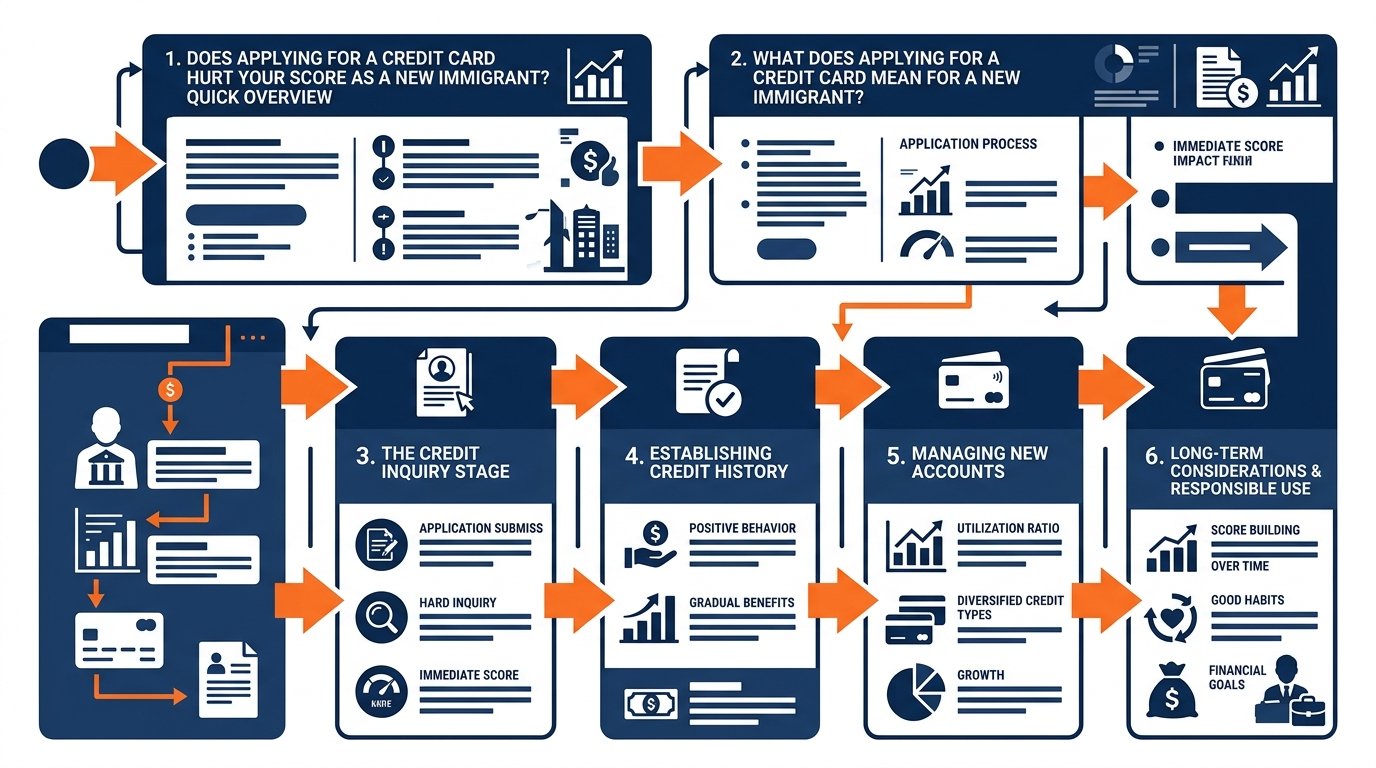
1. Does Applying for a Credit Card Hurt Your Score as a New Immigrant? Quick Overview
For newcomers arriving in the United States, credit applications create an immediate tension: you need credit history to qualify for cards, yet applying for cards triggers the very inquiries that can dent a score you’re still building from zero.
How a Credit Card Application Affects Your Score
According to the CFPB, a hard credit inquiry will impact your credit score, and scoring models specifically consider how recently and how frequently you apply for credit. For most established borrowers, a single hard pull causes only a minor, temporary dip. For a new immigrant with a thin or non-existent file, that same inquiry carries more relative weight because there’s less positive history to offset it.
Five factors shape your credit score — payment history, outstanding balances, length of credit history, applications for new credit, and types of credit accounts — according to USA.gov. “Applications for new credit” is the factor directly triggered by every card application you submit.
Concrete example: A newcomer arrives with no U.S. credit file and applies for three retail cards in their first month hoping one will approve them. Each application generates a separate hard inquiry. Scoring models interpret multiple recent inquiries as potential financial stress, compressing an already thin score further and reducing approval odds on subsequent applications.
The Thin-File Reality for Immigrants
A significant share of U.S. adults are “credit invisible” — meaning they have no scoreable credit file at all — as documented by the CFPB. Immigrants disproportionately fall into this category upon arrival, regardless of their financial standing abroad. Starting with zero history means each action — including each inquiry — is magnified.
How Many Applications Is Too Many?
There is no universal threshold, but the practical guidance from credit professionals is clear: space applications apart when building a thin file. Rate-shopping for a single product type (mortgages, auto loans) within a short window is treated as one inquiry by most scoring models — but separate credit card applications do not receive this treatment and are counted individually.
What Minimizes Score Damage While Still Building Credit
- Secured cards: Require a deposit instead of relying on credit history; typically involve one hard inquiry but offer the highest approval probability for thin-file applicants.
- Becoming an authorized user: No hard inquiry on the new immigrant’s file; leverages the primary cardholder’s history.
- Credit-builder loans: A CFPB study found these products can establish and improve a credit score, especially for people without existing debt — with no card application inquiry required.
Once approved for any product, paying bills on time, every time has the greatest impact on your score, according to the CFPB — outweighing the short-term inquiry effect within a few months of responsible use.
The Bottom Line on Timing
One well-targeted application — a secured card or a card designed for newcomers — causes manageable, temporary score impact and begins building the history you need. Scattershot applications multiply inquiry damage without proportionally increasing approval chances. Strategic, selective applications are the correct approach for immigrants starting from a blank credit slate in 2026.
2. What Does Applying for a Credit Card Mean for a New Immigrant, and Why Does It Matter?
For immigrants arriving in the United States, a credit card is rarely just a payment tool — it is the fastest widely accessible instrument for constructing the credit history that landlords, lenders, and even some employers will eventually check. Yet many newcomers face a compounding problem: they need credit to build a score, but they need a score to get credit.
The Credit-Invisible Starting Point
A significant share of U.S. adults have no usable credit file at all, according to the CFPB’s research on credit-invisible consumers. Immigrants are disproportionately represented in this group — foreign credit histories from countries such as India, Mexico, or Nigeria are not recognized by U.S. bureaus (Equifax, Experian, TransUnion), meaning a newcomer with flawless repayment abroad starts at zero.
This is why the application question carries higher stakes for immigrants than for native-born residents. A hard inquiry on an already-thin file has a proportionally larger short-term impact than the same inquiry on a mature file with dozens of accounts.
Why a Credit Card Specifically
According to USA.gov’s credit score guidance, five factors shape a credit score: payment history, outstanding balances, length of credit history, applications for new credit, and types of credit accounts. A revolving credit card addresses three of those five simultaneously — it contributes to payment history each billing cycle, establishes account age over time, and adds a credit-type dimension. No single financial product activates more scoring levers at once for a thin-file newcomer.
For example, a newcomer who opens one secured card in month one and charges only a small recurring bill — keeping utilization well below the CFPB-recommended 30% ceiling — will begin generating payment history data immediately. After six months of on-time payments, most major scoring models produce a scoreable file, unlocking access to unsecured products.
The Age-of-Majority Requirement
One eligibility constraint worth flagging: applicants under 21 must demonstrate an independent ability to repay or obtain a co-signer over 21, per CFPB rules on age-based card issuance. For younger immigrants — recent international students, for instance — this means income documentation or a creditworthy co-signer is a prerequisite before any application is even submitted.
ITIN as an SSN Alternative
Immigrants without a Social Security Number can apply using an Individual Taxpayer Identification Number, issued by the IRS. Not every issuer accepts an ITIN, but a growing number of major banks and credit unions do — making it worth confirming ITIN acceptance before submitting an application that generates an inquiry with no approval outcome.
The Strategic Takeaway
The core immigrant dilemma — needing credit to get credit — makes card selection and application timing more consequential than for established borrowers. According to the CFPB, scoring models weigh both the recency and frequency of applications, so one well-targeted application to an immigrant-friendly issuer outperforms three speculative applications that generate multiple hard inquiries on a file with little else to offset them.
3. Eligibility Requirements for Immigrants
Qualifying for a credit card as a new immigrant involves more variables than most issuers advertise. Understanding where you stand before applying prevents unnecessary hard inquiries on a file that cannot yet support them.
Immigration Status and Documentation
U.S. credit card issuers are not legally prohibited from serving non-citizens, but each sets its own documentation standards. Most major issuers accept applications from:
- Lawful permanent residents (green card holders) — treated similarly to citizens for underwriting purposes
- Non-immigrant visa holders (H-1B, L-1, F-1 OPT, O-1) — accepted by many issuers, though approval rates vary by visa type and remaining validity
- Conditional residents (EB-5, CR-1) — generally eligible; issuers may request additional documentation
- DACA recipients — accepted by select issuers; options are narrower but exist
Undocumented immigrants cannot obtain an SSN but may use an ITIN (as noted above) with issuers that explicitly accept it—a smaller but growing subset of lenders.
Income and Repayment Ability
The CFPB’s credit card rules require issuers to assess an applicant’s ability to make minimum payments before extending credit. For immigrants, this evaluation typically covers:
- Verifiable U.S.-source income — employment offer letters, recent pay stubs, or bank statements showing direct deposits
- Employment authorization — an Employment Authorization Document (EAD) or visa with work authorization
- Household income — issuers may allow you to include a spouse’s income if you have reasonable access to it
Immigrants on student visas without U.S. work authorization face the steepest hurdles here; issuers may require a co-signer or a secured product.
Credit History Requirements — The Thin-File Gap
Most standard unsecured cards require at least a minimal U.S. credit history. Without it, two practical pathways exist:
- Secured credit cards —require a refundable deposit that becomes your credit limit; approval is predominantly income-based, making them the most accessible first card
- Authorized user status — a U.S.-based family member or employer adds you to an existing account, generating reported history without a separate application
According to the CFPB, a significant share of U.S. adults are credit invisible—disproportionately recent immigrants—meaning standard scoring models return no scoreable result at all. Issuers using alternative underwriting (bank account history, income verification, or international bureau data through programs like Nova Credit) are specifically designed to bridge this gap.
Age and Residency Minimums
Applicants must be at least 18 to apply independently in most states, though as previously covered, those under 21 face additional income verification requirements. There is no minimum U.S. residency period mandated by federal law, but some issuers impose internal policies requiring U.S. address history before processing an application.
A Practical Screening Example
For example, a newcomer on an H-1B visa with three months of U.S. pay stubs, an EAD, and no U.S. credit file is a strong candidate for a secured card from an issuer that uses income-first underwriting—but would likely be declined for a premium travel rewards card requiring an established score. Applying to the premium card first generates a hard inquiry with near-certain rejection; applying to the secured card first costs the same inquiry but builds the file needed to graduate to better products.
Matching your current documentation and credit profile to the right product tier is the single most effective way to minimize score damage while still moving forward.

How Credit Card Applications Compare: Impact, Alternatives & Recovery for New Immigrants
Understanding how a single application stacks up against other credit-building paths — and how long any score damage lingers — helps you sequence your strategy intelligently. The table below maps the key variables newcomers encounter when navigating the U.S. credit system from scratch.
| Factor | Hard-Inquiry Credit Card | Secured Credit Card | Credit-Builder Loan | Becoming an Authorized User |
|---|---|---|---|---|
| Score impact at application | Triggers a hard inquiry; scoring models weigh both recency and frequency of applications (CFPB) | Also triggers a hard pull in most cases | Typically a soft pull only; minimal immediate impact (CFPB study) | No inquiry on your report at all |
| Builds credit history? | Yes, if used responsibly | Yes — often the fastest route for thin-file immigrants | Yes — particularly effective for those carrying no existing debt (CFPB) | Partially — depends on issuer reporting practices |
| Most critical scoring factor addressed | Payment history — on-time payments carry the greatest weight (CFPB) | Payment history + utilization management | Payment history via fixed monthly installments | Payment history inherited from primary cardholder |
| Five score factors engaged | All five: history, balances, account age, new credit, mix (USA.gov) | Four of five (limited account-type diversity) | Three of five (history, balances, new credit) | Primarily history and utilization |
| How long does negative info stay if mismanaged? | Most derogatory marks remain for seven years (CFPB) | Same seven-year window applies (CFPB) | Same retention rules apply | Primary cardholder’s negative history can affect you too |
| Under-21 applicant restriction | varies by provider — confirm directly | Same age-related rules apply | No age co-signer requirement in most cases | No application required — primary holder adds you |
| Dispute rights if errors appear | Bureau must complete its investigation within 30 days (up to 45 in certain circumstances) (FTC) | Same federal dispute timeline applies | Same federal dispute timeline applies | Same federal dispute timeline applies |
| Monitoring your report | Free weekly access to all three bureau reports via AnnualCreditReport.com (FTC) | Same free access available | Same free access available | Same free access available |
Many newcomers arrive as credit-invisible consumers — meaning no scoreable file exists yet. A single well-managed secured card or credit-builder loan typically produces less short-term score friction than multiple unsecured applications filed in quick succession. Experts recommend keeping utilization well below the 30% threshold across any open accounts to accelerate score growth regardless of which product you start with.
Illustrative Scenarios
The following are illustrative scenarios, not real testimonials or case studies of specific individuals.
Illustrative Scenario: Work Visa Holder, Professional Services Sector (Midwest)
A recently arrived work visa holder, employed and salaried, applies for two retail credit cards within weeks of arrival. Each triggers a hard inquiry, and with no prior U.S. credit history, even modest score impacts are felt acutely — underscoring why spacing applications matters from day one.
Expert Recommendation: Best First Credit Cards for New Immigrants
Top Pick: Secured Credit Card from a Major National Bank
For most newcomers arriving without a U.S. credit history, a secured card issued by a federally regulated bank remains the strongest starting point. Because your deposit collateralizes the credit line, issuers apply less stringent underwriting — meaning approval typically does not require an established score, and the hard inquiry that does occur is unlikely to block you.
Why it works for immigrants specifically:
- Major banks (Discover, Bank of America, Capital One) accept ITIN in place of SSN at the application stage, broadening access for visa holders and undocumented residents alike
- On-time payment history begins reporting immediately — and since paying every bill on time, every time carries the greatest weight on your score (CFPB), each month of clean repayment works in your favor from day one
- Keeping your balance well below your credit limit is advisable — the CFPB recommends staying under 30% utilization (CFPB) — and a secured card makes that straightforward given the defined limit
- Many issuers offer an automatic upgrade path to an unsecured card after responsible use, returning your deposit without requiring a new application (and therefore avoiding another hard inquiry)
Best for: F-1, H-1B, L-1, TN visa holders; green card applicants; DACA recipients; anyone currently credit-invisible.
Runner-Up: Credit-Builder Loan (Parallel Strategy)
If a secured card is not immediately accessible — or you want to diversify the types of credit on your file — a credit-builder loan from a credit union or Community Development Financial Institution (CDFI) is a proven complement. Research published by the CFPB found that these products can meaningfully help consumers establish or improve a score, particularly for those carrying no existing debt (CFPB).
Unlike a standard loan, funds are held in a savings account until the loan is repaid — so the primary product is the credit history itself, not the cash. Combined with a secured card, this approach diversifies your account mix, one of the five factors that determine your score (USA.gov), without requiring multiple card applications that would trigger repeated hard inquiries (CFPB).
Best for: Newcomers who prefer installment credit, those turned down for a secured card, or anyone wanting to accelerate file-building through two account types simultaneously.
Frequently Asked Questions
Does a credit card application always trigger a hard inquiry?
Yes — when you formally apply for a credit card, the issuer pulls your credit file through a hard inquiry, which affects your score based on how recently and how frequently you’ve sought new credit. Checking whether you pre-qualify, however, typically uses a soft pull that leaves no mark. As a new immigrant, use pre-qualification tools before submitting any formal application. This lets you gauge approval odds without triggering score damage — a practical first step when your credit history is thin or entirely absent in U.S. bureau records.
How long does a hard inquiry stay on my credit report?
Hard inquiries remain visible on your credit report for two years, though their scoring impact diminishes well before that. Most credit scoring models weigh five factors —including new credit applications —but inquiry weight fades significantly. For immigrants building credit from scratch, this timeline matters: space out applications deliberately so early inquiries lose their bite before you apply for a larger product like an auto loan or apartment lease that also requires a credit check.
What credit score factors should new immigrants prioritize first?
Paying every bill on time, without exception, carries the greatest single impact on your credit score. Beyond that, five factors collectively shape your score: payment history, balances owed, length of history, new credit applications, and credit mix. For a newcomer with no U.S. credit file, on-time payments on even one secured card or a credit-builder product will move the needle faster than applying for multiple cards simultaneously.
Should I apply for multiple credit cards at once to build credit faster?
This strategy typically backfires. Scoring models specifically account for the recency and frequency of credit applications, so multiple hard inquiries in a short window compound the negative effect. For immigrants without an established U.S. file, each rejection also wastes an inquiry. A single, well-researched application — ideally for a secured card or an immigrant-friendly product — followed by responsible use builds history more efficiently than a scatter-shot approach.
Can I check my own credit report without hurting my score?
Absolutely. Checking your own report is a soft inquiry and has zero effect on your score. You can access one free report from each of the three major nationwide bureaus every week through AnnualCreditReport.com, a program now permanently available. As a newcomer, check early and regularly: errors on a thin file are proportionally more damaging, and you have the right to dispute inaccuracies — bureaus must complete their investigation typically within 30 days, or up to 45 days in certain circumstances.
Are there credit-building alternatives that avoid hard inquiries entirely?
Yes. Research from the CFPB found that credit-builder loans can meaningfully help people establish or improve a credit score, particularly those carrying little or no existing debt. Some credit unions and community development financial institutions (CDFIs) offer these products with minimal or no hard-pull requirements. Becoming an authorized user on a trusted person’s account is another route: the primary account’s history can appear on your file without you submitting an independent application.
How does my credit utilization rate affect my score after I’m approved?
Once you have a card, how much of your available credit you use becomes a key variable. Financial regulators advise keeping utilization at or below roughly a third of your total credit limit to protect your score. For immigrants with a single low-limit card, even modest balances can push utilization high — pay down balances before the statement closes when possible, or make multiple small payments throughout the month to keep the ratio low.
What happens if I’m under 21 and applying for my first U.S. credit card as an immigrant?
Federal consumer protection rules impose an additional hurdle: applicants under 21 must demonstrate an independent ability to repay, or have someone over 21 co-sign the account. For young immigrants — international students on F-1 visas, for example — this often means showing proof of income such as a campus job, or finding a creditworthy co-signer. A secured card requiring a deposit can sometimes sidestep this barrier, since the deposit itself mitigates lender risk.
How long does negative information from a rejected application remain visible?
A hard inquiry from a declined application stays on your report for two years but its scoring weight fades over time. Separate negative items — like a missed payment on any account you do open — linger considerably longer: most negative entries remain on a credit report for seven years. This asymmetry matters for immigrants: the short-term sting of a hard inquiry is far less damaging than a single late payment on a newly opened account, reinforcing why on-time payment discipline is non-negotiable.
What if I have no U.S. credit history at all — does that mean I start with a zero score?
Not exactly. Many newcomers are credit-invisible — meaning the major bureaus hold no file on them at all — rather than holding a score of zero. A meaningful share of U.S. adults fall into this credit-invisible category, and recent immigrants are disproportionately represented. Without a file, most standard scoring models simply cannot generate a score. The practical implication: your first application may be assessed on income, residency status, and banking history rather than a traditional score, which is why secured products and lenders experienced with thin-file applicants are the most accessible entry points.
Conclusion
Building credit as a new immigrant in the United States is genuinely challenging, but the core question this guide addresses — whether applying for a credit card hurts your score — has a clear, practical answer: yes, a hard inquiry does affect your score, yet the longer-term benefit of responsible card use far outweighs that short-term dip, provided you apply strategically.
As covered throughout this guide, hard inquiries influence your score based on recency and frequency, so spacing applications thoughtfully reduces unnecessary damage. Your most powerful lever remains consistent, on-time payment — paying every bill on time carries more weight than any other single behaviour. Pair that habit with moderate utilization and a diversified credit mix, and your profile will strengthen over time.
For immigrants who arrive with no U.S. credit history, the path forward typically combines a secured card or credit-builder product with patience. Credit-builder loans, for instance, have demonstrated measurable benefit for those without existing debt, and similar logic applies to secured cards used responsibly.
Monitor your progress by pulling your reports regularly — all three major bureaus offer free weekly access through AnnualCreditReport.com. If errors appear, the bureau is required to investigate within 30 days in most cases.
Your credit score is a long-game asset. Every on-time payment, every dispute resolved, every unnecessary application avoided moves you closer to the financial access and stability that a strong U.S. credit profile unlocks.
Disclaimer
For Informational Purposes Only
The content published on MoneyAbroadGuide.com, including this article, is provided solely for general educational and informational purposes. It does not constitute financial, legal, immigration, or tax advice, and should not be relied upon as a substitute for consultation with a licensed financial advisor, attorney, or qualified immigration professional familiar with your specific circumstances.
Credit products, eligibility criteria, regulatory requirements, and scoring models change over time. Information that is accurate at the time of publication may not reflect subsequent changes in U.S. federal or state law, Consumer Financial Protection Bureau (CFPB) guidance, or issuer policies.
Affiliate Disclosure: MoneyAbroadGuide.com may receive compensation when readers click certain links or apply for financial products featured on this site. This compensation may influence which products appear and how they are presented, but it does not affect our editorial integrity or the accuracy of the information provided. We do not review or endorse every product available in the market.
Links to third-party government sources — including the CFPB, FTC, and USA.gov — are provided for verification and reference. MoneyAbroadGuide.com is not affiliated with, endorsed by, or operated in partnership with any U.S. government agency or regulatory body.
About the Author
Talal Eddaouahiri is the founder of MoneyAbroadGuide.com, an independent financial information platform for immigrants and newcomers in the United States and Canada. Originally from Morocco, he settled in the U.S. in 2015 and built his own credit history and banking relationships from scratch in both countries. His background is in retail banking and customer relations, and he draws on that firsthand experience to write independent, source-based guides — citing regulators including the FCAC, FINTRAC, OSFI, CRA, IRS, and CDIC — to help newcomers navigate financial systems with confidence.
Learn more about our Fact-Checking Process and our How We Test when researching this guide.
Last Updated: July 2026

About Talal Eddaouahiri
Founder & Financial Writer at MoneyAbroadGuide.com. A Moroccan immigrant who settled in the United States in 2015, Talal opened bank accounts and built credit from zero in both the US and Canada. His background is in retail banking and customer relations, and he writes independent, source-based guides (FCAC, FINTRAC, OSFI, CRA, IRS, CDIC) to help newcomers navigate their first financial steps. Read his full profile →
Official Sources — Canada