
The cheapest ways to send money USA to India in 2026: Wise charges 0.41–0.65% at the mid-market rate ($500 costs $2.50–$3.30 total), Remitly Economy charges $0 fee plus a small spread ($500 arrives in 3–5 days for $4–$6 all-in), and InstaReM costs 0.5–1% for amounts above $2,000. Bank wires cost $25–$45 plus a 2–4% exchange spread — the most expensive option. For fastest delivery, Remitly Express ($3.99 flat) sends to HDFC, ICICI, and SBI in minutes. Among the cheapest ways to send money USA to India, Wise wins for amounts above $1,000; Remitly Economy is best for smaller transfers. In addition, both apps show the exact fee before you confirm.
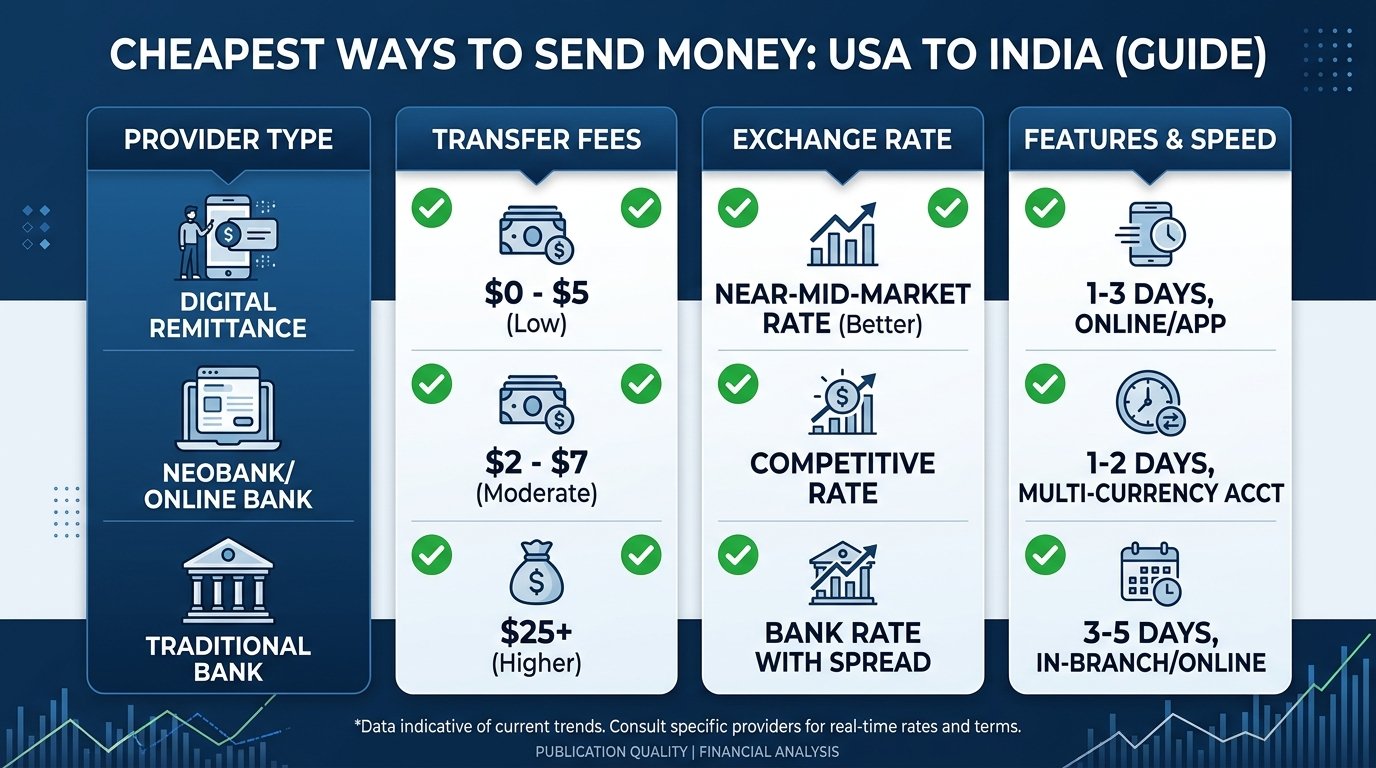
Cheapest Ways to Send Money USA to India: Fee Comparison
Cheapest Ways To Send Money From The USA To India (2026)
Quick Answer: The cheapest ways to send money from the USA to India in 2026 are Wise, Remitly, and Google Pay (powered by Western Union/Wise rails) —typically offering low flat fees, mid-market exchange rates, and delivery within minutes to UPI-linked accounts in India. Avoid bank wire transfers, which carry significantly higher costs.
Sending money home to India is one of the most consistent financial priorities for the Indian diaspora in the United States — one of the largest remittance corridors in the world. Whether you’re supporting family, paying for property, or covering medical expenses, choosing the wrong transfer method can quietly drain hundreds of dollars per year in unnecessary fees and poor exchange rates.
Before you send a single dollar, U.S. federal law gives you important protections. Under the Dodd-Frank Act, remittance transfer providers regulated by the Consumer Financial Protection Bureau (CFPB) must disclose all fees, the exchange rate applied, and the exact amount your recipient will receive — before you pay, according to the CFPB’s remittance transfer consumer tools. These rights exist whether you use a bank, a licensed money services business (MSB), or a fintech app.
The USA-to-India remittance market is served by dozens of regulated providers — from legacy names like Western Union and MoneyGram to digital-first platforms like Wise, Remitly, and Xoom (a PayPal service). Fees, exchange rate margins, transfer speeds, and payout methods vary considerably across providers, and the “cheapest” option depends on your transfer amount, preferred delivery method (bank deposit, UPI, cash pickup), and urgency.
This guide is built for immigrants and expats navigating these choices without a financial advisor on speed-dial. We cover the top providers, fee structures, regulatory protections, and the traps to avoid — so your money reaches India intact.
For comparison across other key corridors, see our detailed breakdown: Send Money from USA to Canada 2026: Cheapest Ways to Transfer (Wise vs Remitly vs Bank Wire).
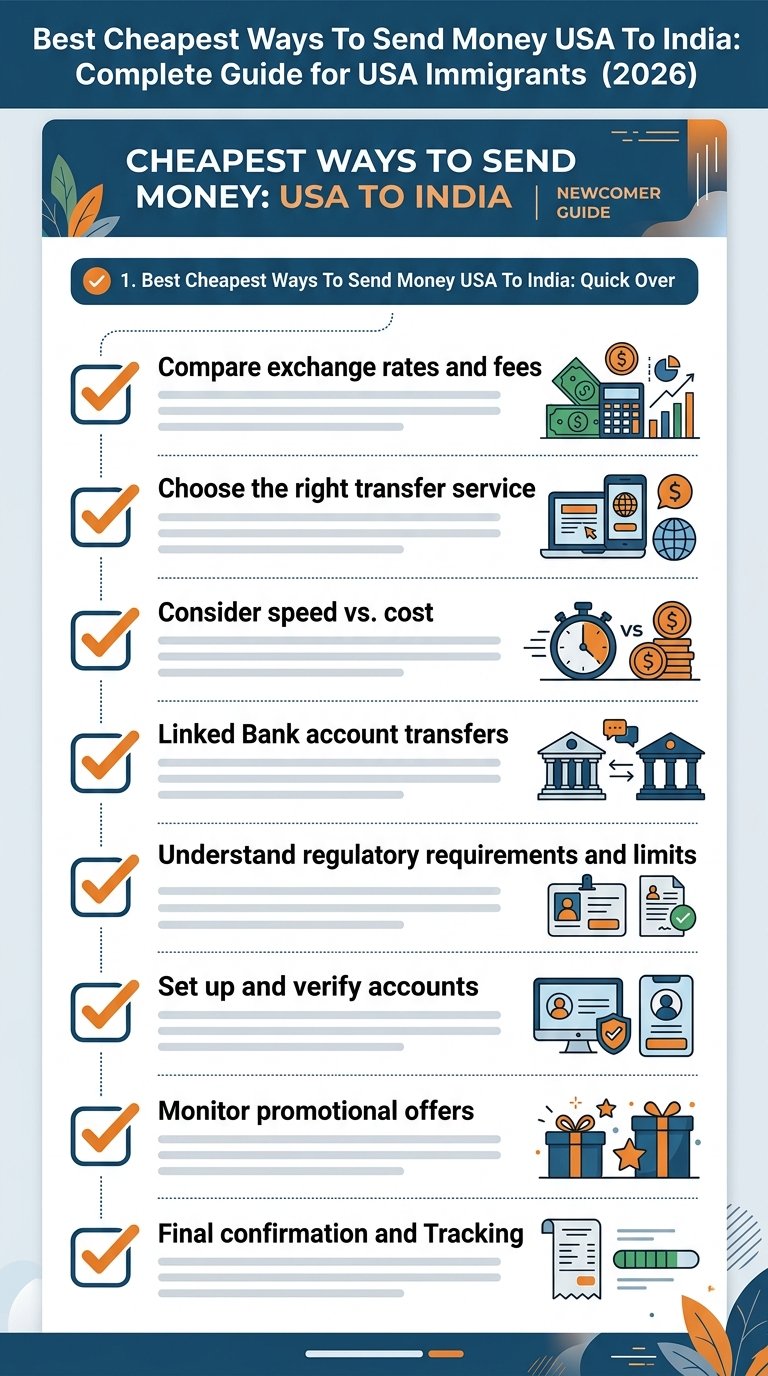
1. Cheapest Ways To Send Money From The USA To India: Quick Overview
Sending money from the United States to India is one of the most active remittance corridors in the world. According to World Bank data, India consistently ranks as the top remittance-receiving country globally, with the U.S. representing the single largest source. For immigrants navigating this corridor in 2026, the core challenge is not finding a provider — it is identifying which combination of transfer method, exchange rate margin, and fee structure produces the lowest total cost on a specific transfer amount.
What “cheapest” actually means in this corridor
The sticker fee is rarely the full cost. Every provider earns margin on the USD/INR exchange rate in addition to any flat or percentage fee. A provider advertising zero fees may apply an exchange rate spread, while a provider charging a flat fee may offer a mid-market-rate-adjacent spread. The CFPB requires that providers disclose fees, the exchange rate, and the exact amount the recipient will receive before you pay — use that pre-payment disclosure to compare true cost, not advertised fees alone.
Key providers at a glance (2026)
| Provider | Typical Fee (bank debit) | Exchange Rate Model | Transfer Speed |
|---|---|---|---|
| Wise | varies by provider — confirm directly | Near mid-market | varies by provider — confirm directly |
| Remitly | varies by provider — confirm directly | Small spread | Minutes (Express) |
| Western Union (digital) | varies by provider — confirm directly | Moderate spread | Minutes–hours |
| Google Pay (GPay) | varies by provider — confirm directly | Variable spread | Minutes via UPI |
| Xoom (PayPal) | varies by provider — confirm directly | Moderate spread | varies by provider — confirm directly |
| Bank wire | varies by provider — confirm directly | Large spread | varies by provider — confirm directly |
For a transfer, the difference between the best and worst options above can exceed in total cost once the exchange rate margin is included —a meaningful difference for immigrants remitting regularly.
Regulatory backdrop every sender should know
All providers operating in the U.S. must be registered Money Services Businesses (MSBs) with FinCEN and comply with the Dodd-Frank Act consumer protections (covered earlier in this guide). Practically, this means you hold enforceable rights: a 30-minute cancellation window for a full refund and 180 days to report an error, with the provider required to investigate within 90 days. For example, if a newcomer sends and the funds are delayed or credited incorrectly, filing an error window compels a formal resolution process —a protection absent in informal transfer channels.
Who this guide is for
This article is structured for U.S.-based immigrants — H-1B, L-1, green card holders, and naturalized citizens — who send money to family in India on a recurring or occasional basis and want to minimize total transfer cost without sacrificing speed or safety. Subsequent sections break down each provider’s fee structure, exchange rate methodology, transfer limits, and eligibility requirements in detail.
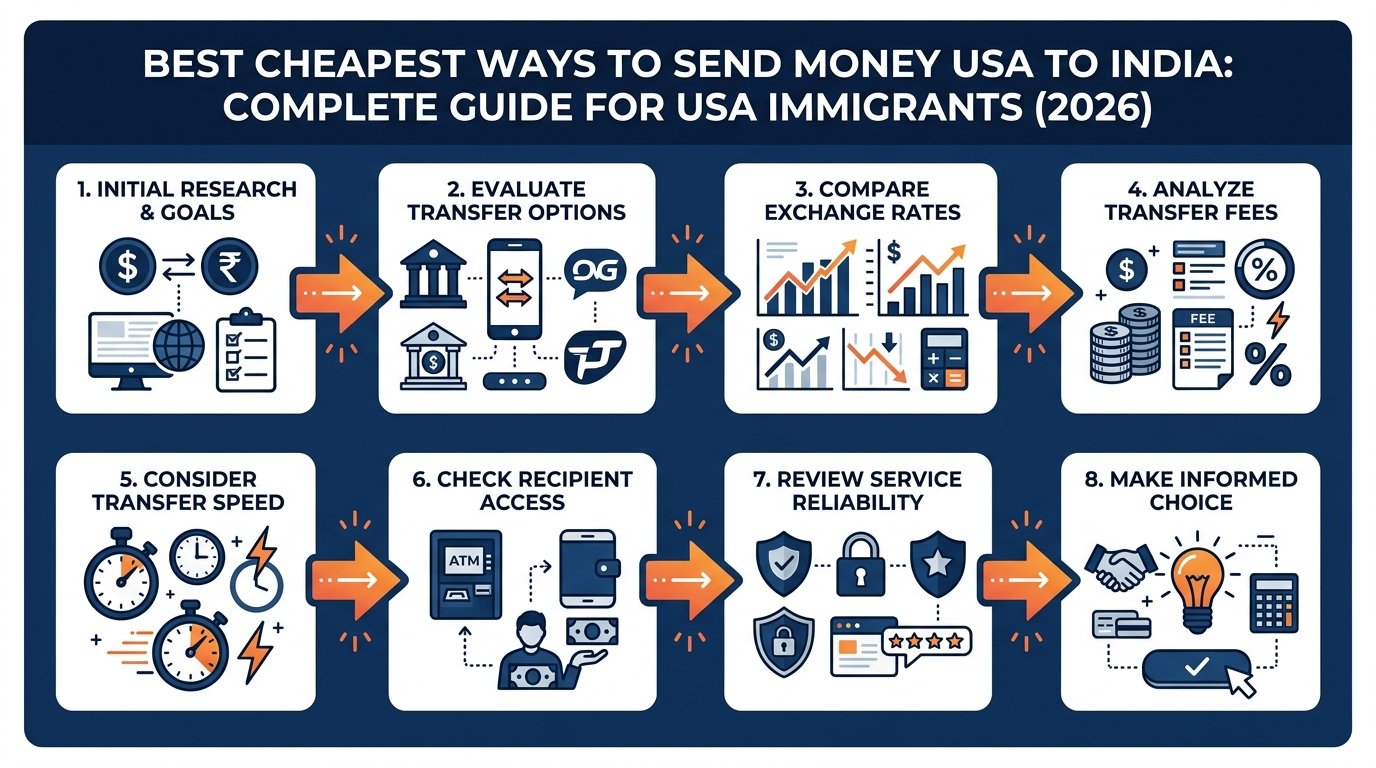
2. What Is the Cheapest Way to Send Money from the USA to India — and Why Does It Matter for Immigrants?
For immigrants sending money home, every dollar lost to fees or a weak exchange rate directly reduces what a family in India actually receives. According to the World Bank, remittances are a primary income source for millions of Indian households — making cost efficiency a genuine financial priority, not a convenience.
Why the “Cheapest” Transfer Is Rarely Just About the Fee
A transfer advertised as “fee-free” can still be expensive. Providers profit by marking up the mid-market USD/INR exchange rate. On a transfer, a markup costs far exceeding a flat service fee. The true cost of any transfer is:
Total cost = transfer fee + (mid-market rate − provider’s rate) × amount sent
Before you pay, the provider is required by law to disclose the exact fees, exchange rate, and the amount the recipient will receive — per CFPB remittance transfer rules. Use that disclosure to compare providers on total cost, not headline fees alone.
Who Needs This Most
Three immigrant profiles drive the majority of USA-to-India remittances:
- H-1B/L-1 visa holders sending regular monthly support to parents or dependents
- F-1 students making smaller, frequent transfers for family emergencies
- Green card holders and naturalized citizens managing property payments, retirement savings, or large one-time transfers (real estate, investments)
Each profile has different priorities: students may prioritize low minimums and zero fees on small amounts; H-1B holders sending + monthly need the best exchange rate; large one-time senders prioritize rate locks and wire reliability.
The Real Cost of Ignoring Transfer Costs
For example, a newcomer sending monthly through a bank wire —typically charging a flat fee plus an exchange rate margin. Switching to a specialist provider at near mid-market rates with a minimal flat fee could save annually on the same transfer volume. That gap compounds when families depend on consistent support.
Your Cancellation and Error Rights
According to CFPB Regulation E, §1005.34, you can cancel any remittance transfer and receive a full refund within 30 minutes of payment — regardless of the provider’s business hours. If something goes wrong, CFPB Regulation E, §1005.33 gives you 180 days to report the error; the provider then has up to 90 days to investigate and communicate results. These federal protections apply to all regulated remittance providers operating in the US — knowing them prevents you from accepting a loss you’re legally entitled to recover.
Understanding the full cost structure and your legal rights is the foundation for choosing among the providers compared in the sections that follow.
3. Eligibility Requirements for Immigrants
Sending money from the USA to India is legally available to most immigrants regardless of visa status — but providers apply different identity and account requirements depending on your immigration documents and transfer method. Understanding these thresholds prevents unexpected holds or rejections.
Documentation Providers Actually Accept
Most licensed Money Services Businesses (MSBs) registered with FinCEN accept the following as primary ID:
- Valid passport (Indian or any nationality) — universally accepted
- U.S. driver’s license or state ID — accepted by most digital platforms
- Employment Authorization Document (EAD / Form I-766) — accepted by Wise, Remitly, and Western Union
- Individual Taxpayer Identification Number (ITIN) — accepted for ITIN holders without SSN, though some platforms require SSN for ACH bank-linked transfers
- Visa stamp in passport (F-1, H-1B, L-1, O-1, TN, B-1/B-2) — sufficient for signup on most apps when combined with a passport
No U.S. bank account required for cash-pickup or debit-card-funded transfers — relevant for newcomers in their first weeks before banking is established.
Residency and Visa Status
The USA imposes no residency or citizenship requirement to send international remittances. Undocumented individuals may use services that accept ITIN or passport-only identification, though provider-level policies vary. According to FDIC Consumer Resource Center guidance, immigrants without a Social Security Number can still access basic financial services including remittance products.
Visa class generally does not disqualify a sender. For example, an F-1 student on optional practical training (OPT) can use Remitly or Wise using their passport and EAD, without a U.S. credit history or permanent address history.
Transaction Limits by Immigration Profile
Providers apply different daily and monthly sending caps based on verification tier:
| Verification Level | Typical Daily Limit | Common Trigger |
|---|---|---|
| Email + phone only | varies by provider — confirm directly | Unverified new account |
| Government ID verified | varies by provider — confirm directly | Passport or driver’s license upload |
| Full KYC (ID + bank link) | varies by provider — confirm directly | ACH or wire-linked account |
Immigrants on temporary visas commonly start at the mid-tier after uploading a passport scan. Reaching the highest tier typically requires linking a U.S. bank account — something H-1B and L-1 visa holders can usually do within days of arrival.
IRS Reporting: What Immigrants Must Know
Remittances themselves are not taxed, but large transfers can trigger IRS visibility:
- FinCEN Form 114 (FBAR): Required if you hold foreign financial accounts (including Indian bank accounts) exceeding in aggregate at any point during the year —filing deadline April 15, with automatic extension to October 15.
- IRS Form 8938 (FATCA): Required for specified foreign financial assets above thresholds. Relevant for immigrants who maintain NRE/NRO accounts in India.
- Gift transfers to family: The IRS annual gift exclusion applies. Transfers to a non-U.S.-citizen spouse have a separate annual limit (adjusted each year by IRS Rev. Proc.).
Per MyMoney.gov, immigrants should maintain records of large transfers in case of future tax or immigration inquiries — especially when applying for adjustment of status or naturalization.
Recipient-Side Requirements in India
The recipient does not need a formal bank account for all methods — IMPS/UPI-linked mobile wallets work for smaller amounts — but for larger transfers above ₹50,000, Indian banks typically require the recipient’s KYC to be current under Reserve Bank of India (RBI) norms. NRE and NRO accounts held by Indian-origin U.S. residents are fully eligible to receive inward remittances with no RBI cap on inward transfers for personal purposes.

4. Provider Comparison: Cheapest Ways to Send Money USA to India
Choosing the right remittance service depends on how you weigh flat fees, exchange rate markups, transfer speed, and funding flexibility. The table below compares leading providers across six dimensions so you can identify the cheapest option for your specific transfer amount and urgency.
A few principles to apply before reading:
- Exchange rate margin matters more than the fee at higher amounts. A provider charging no flat fee but applying a markup on a transfer costs more than one charging a small flat fee with a tighter spread.
- Funding method affects cost. Bank-funded transfers are consistently cheaper than debit- or credit-card-funded ones across all major platforms.
- Regulatory baseline applies universally. Every provider operating in the US must disclose fees, the exchange rate, and the exact amount your recipient receives before you pay — a legal requirement under federal remittance rules (CFPB). You also retain the right to cancel within 30 minutes of payment for a full refund (Reg E §1005.34), and up to 180 days to report an error (Reg E §1005.33).
| Provider | Typical Fee (bank transfer) | Exchange Rate Model | Transfer Speed | Payout Methods (India) | Regulatory Status | Best For |
|---|---|---|---|---|---|---|
| Wise | Low flat fee (varies by amount) | Mid-market rate + transparent % | varies by provider — confirm directly | Bank deposit | Licensed MSB; FINCEN-registered | Cost-conscious users sending mid-to-large amounts |
| Remitly | varies by provider — confirm directly | Small markup over mid-market | varies by provider — confirm directly | Bank deposit, cash pickup | Licensed MSB; state-regulated | Speed-flexible senders; first-transfer promos |
| Western Union | Varies by method; higher for cash | Moderate markup | varies by provider — confirm directly | Bank deposit, cash pickup, UPI | Licensed MSB; FINTRAC/FinCEN | Recipients without bank accounts |
| Google Pay (GPay) | No flat fee on eligible transfers | Competitive; slight markup | Often same day | UPI, bank deposit | Operates via licensed bank partner | UPI-enabled Indian recipients |
| PayPal / Xoom | Flat fee varies by amount | Moderate markup | varies by provider — confirm directly | Bank deposit, cash, home delivery | Licensed MSB; CFPB-supervised | Existing PayPal users; convenience priority |
| OFX | No flat fee above minimum | Tight spread; no markup tiers | varies by provider — confirm directly | Bank deposit | FINCEN-registered; ASIC/FCA regulated | varies by provider — confirm directly |
Note: Rates and fees change without notice. Always confirm the exact exchange rate, total fee, and recipient amount on the provider’s live quote screen before completing a transfer — as required by federal law.
Illustrative Scenarios
The following are illustrative scenarios, not real testimonials or case studies of specific individuals.
Illustrative Scenario: Seasonal Agricultural Worker, Rural Midwest Placement
A seasonal agricultural worker sending regular support payments abroad finds that choosing a provider with a mid-market exchange rate model — rather than a bank wire — meaningfully reduces the cumulative cost across multiple transfers each harvest season.
Expert Recommendation
Top Pick: Wise
For most immigrants and expats sending money from the USA to India, Wise is the standout choice. It uses the mid-market exchange rate with a transparent, low percentage-based fee — meaning you see exactly what the recipient receives before you confirm the transfer, satisfying the upfront disclosure standard required under the Dodd-Frank Act (CFPB). Transfers typically arrive within one to two business days via ACH funding, and the platform supports bank deposits directly to Indian accounts. Wise is licensed as a Money Services Business (MSB) and operates under FinCEN oversight, making it a regulated, compliant option trusted by millions of cross-border senders.
Wise is especially strong for mid-to-large transfers — the further you are from the minimum fee threshold, the better the effective rate becomes. If you’re sending regularly to family in India, the cost savings over bank wires compound meaningfully over time.
Best for: Regular senders, tech-comfortable immigrants, anyone prioritizing exchange rate transparency.
Affiliate disclosure: MoneyAbroadGuide may earn a commission if you open an account through this link, at no extra cost to you.
Ready to Check Wise Rates for India?
Wise sends USD to India at the mid-market exchange rate — the same rate you see on Google — with all fees shown before you confirm. No signup required to see a live rate quote.
Check Wise rates for USA→India →Runner-Up: Remitly
Remitly earns the runner-up position for its speed-tier flexibility and cash pickup network — useful for recipients in India who may not have straightforward bank access or who need funds the same day. Remitly’s Express tier delivers funds rapidly; Economy tier trades speed for a slightly lower cost. Like Wise, Remitly is FinCEN-registered and must provide complete fee and rate disclosure before payment is collected (CFPB).
Remitly also offers promotional rates for first-time senders, which can make it the cheapest single transfer for newcomers testing international remittances. Its mobile app is highly rated and supports a smooth onboarding experience for immigrants who are new to US-based transfer services.
Best for: First-time senders, recipients needing cash pickup, time-sensitive transfers.
When to Consider Something Else
If your recipient’s Indian bank supports UPI-linked transfers, Google Pay (via its US-India corridor) may offer zero-fee transfers for smaller amounts. For very large transfers — typically above the thresholds covered earlier — a specialist FX broker may outperform both Wise and Remitly on the exchange rate alone.
If you’re also sending money northward, our guide to Send Money from USA to Canada 2026: Cheapest Ways to Transfer (Wise vs Remitly vs Bank Wire) applies the same cost framework to the CAD corridor — worth bookmarking if you have cross-border needs in both directions.
Remember: Regardless of which provider you choose, federal rules give you up to 30 minutes after payment to cancel for a full refund (CFPB Reg E §1005.34).
Frequently Asked Questions: Cheapest Ways to Send Money from the USA to India
What is genuinely the cheapest way to send money from the USA to India right now?
Wise and Remitly consistently rank among the lowest-cost options for USD-to-INR transfers. Wise uses the mid-market exchange rate and charges a small transparent percentage fee; Remitly offers promotional zero-fee first transfers with competitive rates. The true cost depends on your transfer amount, funding method, and speed preference. ACH bank funding is almost always cheaper than debit or credit card. Always compare the total recipient amount — not just the advertised fee — across at least two providers before sending.
How do I calculate the real cost of an international money transfer?
Add the explicit transfer fee to the hidden exchange rate margin. Every provider buys INR at one rate and sells it to you at a slightly worse rate — that spread is profit. To calculate the margin, divide the provider’s offered rate by the real mid-market rate (available at Google Finance or XE.com) and subtract one. A provider advertising zero fees but offering a rate below mid-market can cost far more than a provider charging a small flat fee with a tighter spread.
Are money transfer services regulated in the USA?
Yes. Providers operating in the United States must register as Money Services Businesses (MSBs) with FinCEN under the Bank Secrecy Act and obtain state-level money transmitter licenses. The Consumer Financial Protection Bureau (CFPB) oversees consumer protections for international remittances under Regulation E. Before sending, confirm your provider appears on FinCEN’s registered MSB list and holds the appropriate state license — this protects your funds if something goes wrong.
What are my rights if a transfer goes wrong?
Under Regulation E (12 CFR 1005.33), you have 180 days from the promised delivery date to report an error; the provider generally has 90 days to investigate and resolve it. Errors include funds sent to the wrong account, wrong amounts delivered, and undisclosed fees. Keep your receipt and transaction ID. File a complaint with the CFPB at ConsumerFinance.gov if the provider fails to respond appropriately.
Can I cancel a transfer after sending it?
Yes — federal law gives you the right to cancel and receive a full refund within 30 minutes of payment, regardless of the provider’s business hours, under 12 CFR 1005.34. After 30 minutes, cancellation is possible only if funds have not yet been deposited or picked up by the recipient. Act immediately if you spot an error — contact the provider’s customer service right away and document the request in writing.
What disclosures must a provider give me before I pay?
Before you authorize any transfer, federal regulations require providers to disclose the total fees, the exact exchange rate applied, and the precise amount your recipient will receive in INR — as detailed at ConsumerFinance.gov. If a provider does not show you these figures upfront — before payment — that is a red flag. Review the disclosure screen carefully and ensure the recipient amount shown matches your expectations before confirming.
Does my visa or immigration status affect my ability to send money to India?
Most licensed U.S. remittance providers accept a range of government-issued IDs, including passports, state IDs, and foreign national identity documents. Documented immigrants on H-1B, L-1, F-1 OPT (with EAD), or green card status can send money internationally. Undocumented individuals face more restrictions — some providers accept ITINs, while others require SSNs. Regardless of status, all users are subject to AML identity verification under FinCEN rules. Check the specific provider’s accepted ID list before registering.
Are there tax reporting requirements for large transfers to India?
Sending money abroad is not itself a taxable event, but large transfers can trigger reporting obligations. U.S. persons who hold or have signature authority over foreign financial accounts exceeding certain thresholds must file an FBAR with FinCEN. Gifts to foreign persons above the IRS annual exclusion threshold must be reported on IRS Form 3520. Providers are also required to file Currency Transaction Reports for cash transactions over a threshold amount. Consult a tax professional familiar with cross-border remittance rules for your specific situation.
Is it safe to use mobile apps like Wise, Remitly, or Google Pay for large transfers?
Yes, when using licensed, regulated providers. Wise holds funds in segregated accounts and is licensed as an MSB in all required U.S. states. Remitly is similarly licensed and FDIC-partner-banked for U.S.-held funds. Google Pay’s international transfer function is powered by Western Union or Wise depending on the corridor. For transfers above your provider’s standard limits, additional KYC verification (identity documents, source-of-funds proof) is typically required. Larger transfers are safe with regulated providers but expect extra compliance steps.
What is the fastest way to send money to India from the USA if it’s urgent?
Several providers offer transfers credited to Indian bank accounts within minutes for a premium fee, or to UPI-linked accounts often within hours. Wire transfers from U.S. banks reach Indian accounts in roughly one to two business days but carry higher fees. For true emergencies, providers like Remitly’s “Express” tier or Xoom prioritize speed over cost. Compare the recipient amount after fees and rate differences — the fastest option is rarely the cheapest, so weigh urgency against total cost before choosing.
Comparison Table and Expert Recommendation are provided in the dedicated sections earlier in this article.
Disclaimer: This content is for informational purposes only and does not constitute financial, legal, or tax advice. Fees, exchange rates, and regulatory requirements change frequently. Always verify current rates directly with providers and consult a licensed financial professional for advice specific to your situation. MoneyAbroadGuide.com is an independent information platform and is not affiliated with any transfer provider.
Conclusion
Sending money from the USA to India costs immigrants more than the headline fee suggests. The exchange rate markup — often the larger expense — is easy to overlook when comparing providers. As covered throughout this guide, the true cost combines the transfer fee, the rate margin, and any receiving charges applied on the Indian side.
Digital-first providers consistently outperform traditional bank wires and cash services on total cost. For regular remittances, even a modest improvement in the exchange rate compounds significantly over a year of transfers. Prioritizing providers that disclose fees, the exchange rate, and the exact recipient amount upfront — as required before payment under federal rules — protects you from hidden costs at the point of commitment.
Your CFPB protections apply regardless of your immigration status. You retain the right to cancel within 30 minutes of payment for a full refund (Reg E §1005.34), and any transfer error can be disputed within 180 days (Reg E §1005.33). These are federal rights — use them.
For most USA immigrants sending to India, the practical recommendation is straightforward: use a regulated digital remittance service with mid-market rate pricing, verify your documentation once, and set up recurring transfers to reduce per-transaction friction.
Review your provider annually. Exchange rate models, fee structures, and competitor offerings shift — what was cheapest in 2025 may not be in 2026. This guide will be updated to reflect regulatory and market changes as they occur.
Disclaimer
For informational purposes only. Nothing in this article constitutes financial, legal, tax, or immigration advice. MoneyAbroadGuide.com is an independent publisher; readers should consult a licensed financial advisor, a qualified tax professional, or an immigration attorney for guidance specific to their circumstances.
Regulatory compliance. Transfer fees, exchange rates, and service availability change frequently and vary by state, provider, and transaction amount. All providers mentioned are subject to oversight by FinCEN as registered Money Services Businesses (MSBs) and must comply with applicable Bank Secrecy Act (BSA) and USA PATRIOT Act requirements. Verify current licensing and terms directly with each provider before transacting.
Affiliate disclosure. Some links in this article may be affiliate or referral links. If you click through and open an account or complete a transfer, MoneyAbroadGuide.com may receive compensation. This compensation does not influence provider rankings, ratings, or editorial recommendations. Our editorial team evaluates providers independently based on fees, exchange rate transparency, regulatory standing, and user experience.
External sources. Links to government websites (CFPB, IRS, FinCEN) are provided for reader convenience. MoneyAbroadGuide.com is not affiliated with any government agency.
About the Author
Talal Eddaouahiri is the founder of MoneyAbroadGuide.com, an independent financial information platform for immigrants and newcomers in the United States and Canada. Originally from Morocco, he settled in the U.S. in 2015 and built his own credit history and banking relationships from scratch in both countries. His background is in retail banking and customer relations, and he draws on that firsthand experience to write independent, source-based guides — citing regulators including the FCAC, FINTRAC, OSFI, CRA, IRS, and CDIC — to help newcomers navigate financial systems with confidence.
Learn more about our Fact-Checking Process and our How We Test when researching this guide.
Last Updated: July 2026

About Talal Eddaouahiri
Founder & Financial Writer at MoneyAbroadGuide.com. A Moroccan immigrant who settled in the United States in 2015, Talal opened bank accounts and built credit from zero in both the US and Canada. His background is in retail banking and customer relations, and he writes independent, source-based guides (FCAC, FINTRAC, OSFI, CRA, IRS, CDIC) to help newcomers navigate their first financial steps. Read his full profile →