
Best Payday Loans Vs Credit Builder Loans: Complete Guide for USA Immigrants (2026)
Quick Answer: For most USA immigrants, credit builder loans are the smarter choice — they build credit history while you save, with low fees and no debt trap. Payday loans carry extremely high costs and can damage your financial standing. If you have no Social Security Number, an ITIN may qualify you for either product.
Introduction
The scenario is common: you’ve been in the country for a few weeks or months, your credit file is thin or nonexistent, and you need cash now — for a deposit, a car repair, or to cover rent while your first paycheck clears. A payday lender will approve you in minutes. A credit builder loan won’t give you a dollar until you’ve finished paying it.
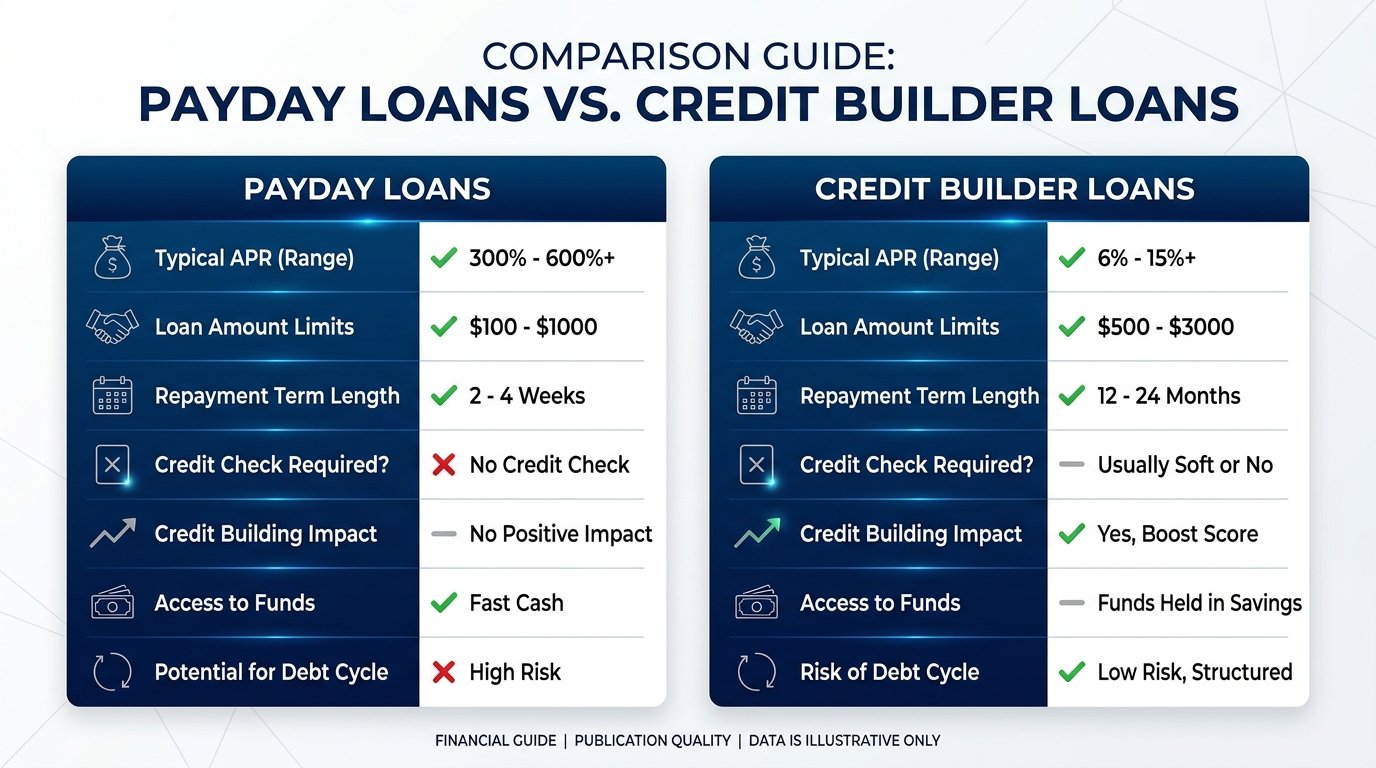
These are not two versions of the same product. A payday loan is short-term, high-cost debt — the Consumer Financial Protection Bureau (CFPB) has documented average APRs above 391% for a standard two-week loan. Most payday lenders do not report to the credit bureaus, meaning the loan costs you money and builds you nothing. A credit builder loan is the opposite: you make fixed monthly payments, the lender holds the funds, and every on-time payment is reported to Equifax, Experian, and TransUnion, building the credit history you need.
This guide compares both products on every dimension that matters for immigrants — ITIN eligibility, bureau reporting, APR, access without a U.S. credit history, and the real cost of each option over time. The goal is to help you identify which one solves your actual problem.
1. Best Payday Loans Vs Credit Builder Loans for USA Immigrants in 2026: Quick Overview
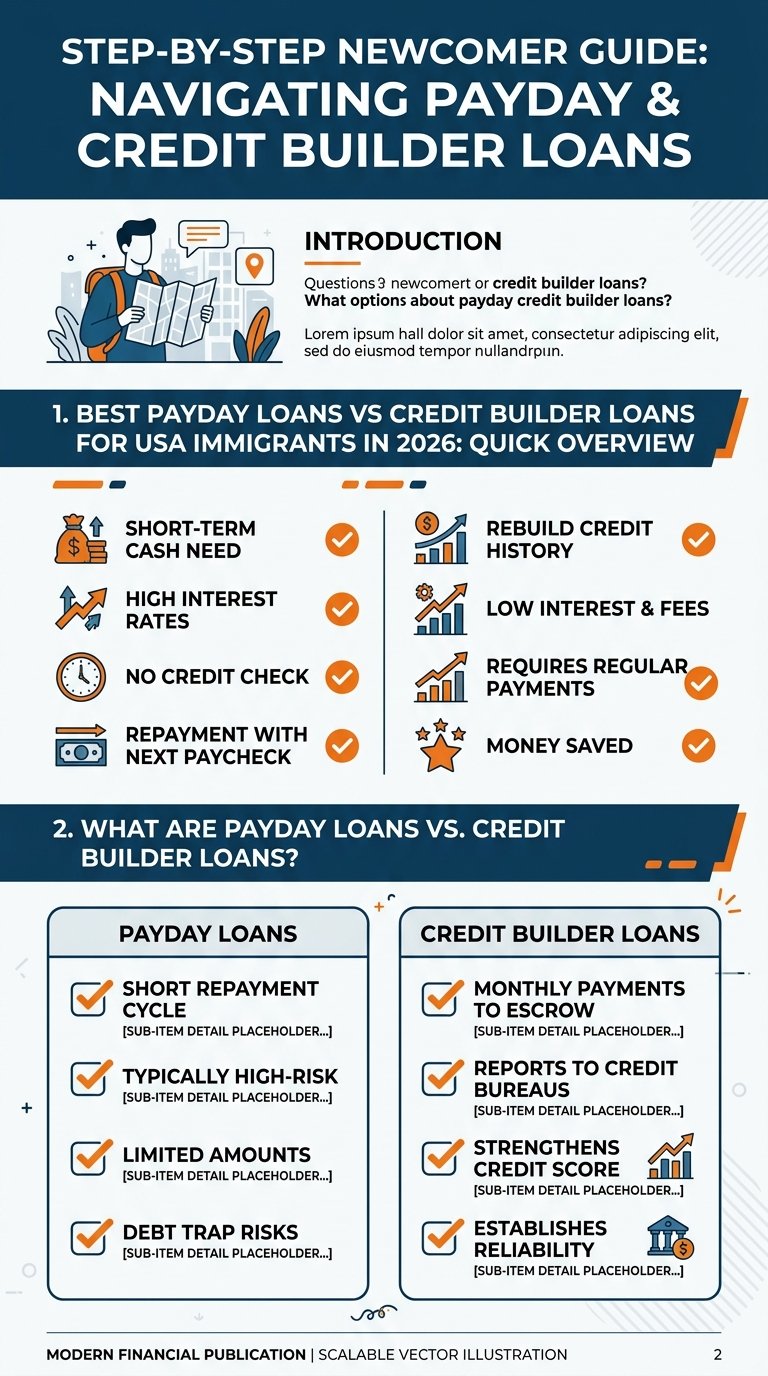
Two borrowing products dominate conversations among immigrants building financial lives in the United States — payday loans and credit builder loans. They serve fundamentally different purposes, carry dramatically different costs, and produce opposite long-term outcomes for your credit profile.
What separates them at a glance:
- Payday loans deliver cash immediately, typically repaid in full on your next payday. Fees routinely translate to extremely high APRs, according to the CFPB. Most traditional payday lenders do not report on-time payments to the three major credit bureaus (Equifax, Experian, or TransUnion), meaning responsible repayment rarely builds your credit score — but defaults can damage it, according to CFPB research.
- Credit builder loans work in reverse: you make monthly payments first; the lender holds funds in a locked account and releases them after you complete the repayment term. According to CFPB research, credit builder loans can help establish and improve a credit score, especially for people without existing debt — a direct advantage for newly arrived immigrants with no U.S. credit history.
Why this comparison matters specifically for immigrants in 2026:
A significant share of U.S. adults remain credit invisible — meaning credit bureaus hold no file or an unscorable file on them. Immigrants are disproportionately represented in this group. Without a scorable credit file, accessing affordable mainstream credit is difficult, creating pressure to turn to high-cost short-term products.
The core trade-off illustrated:
a newcomer facing an unexpected expense might use a payday loan, pay a steep fee two weeks later, and end the transaction with zero credit score improvement. That same money directed into a credit builder loan instead builds a track record of on-time payment history —and paying bills on time, every time, has the greatest impact on your credit score, according to the CFPB. The credit builder route costs less overall and produces a durable asset: a scorable credit file.
Key eligibility distinction for immigrants:
Most credit builder loans are available with an ITIN, making them accessible to immigrants who do not yet hold a Social Security Number. Payday lenders vary widely — some accept ITINs, others require SSNs or valid government-issued ID meeting state licensing standards.
2026 regulatory context:
State-level payday lending laws remain highly fragmented. Sixteen states and the District of Columbia have effectively banned triple-digit annual percentage rates (APR). For example, a two-week loan of $100 with a $15 fee carries an APR of approximately 391 percent, according to the CFPB payday lending through rate caps, while others impose minimal restrictions, per ongoing FTC guidance on payday and car title loans. Credit builder loans face no comparable rate-cap controversy, as their cost structure is transparent and their credit-building function aligns with CFPB consumer protection priorities.
The sections below examine each product’s mechanics, costs, eligibility requirements, and strategic fit for immigrants at different stages of their U.S. financial journey.
2. What Are Payday Loans vs. Credit Builder Loans and Why Do Immigrants Need Them?
Two Products, Opposite Financial Destinations
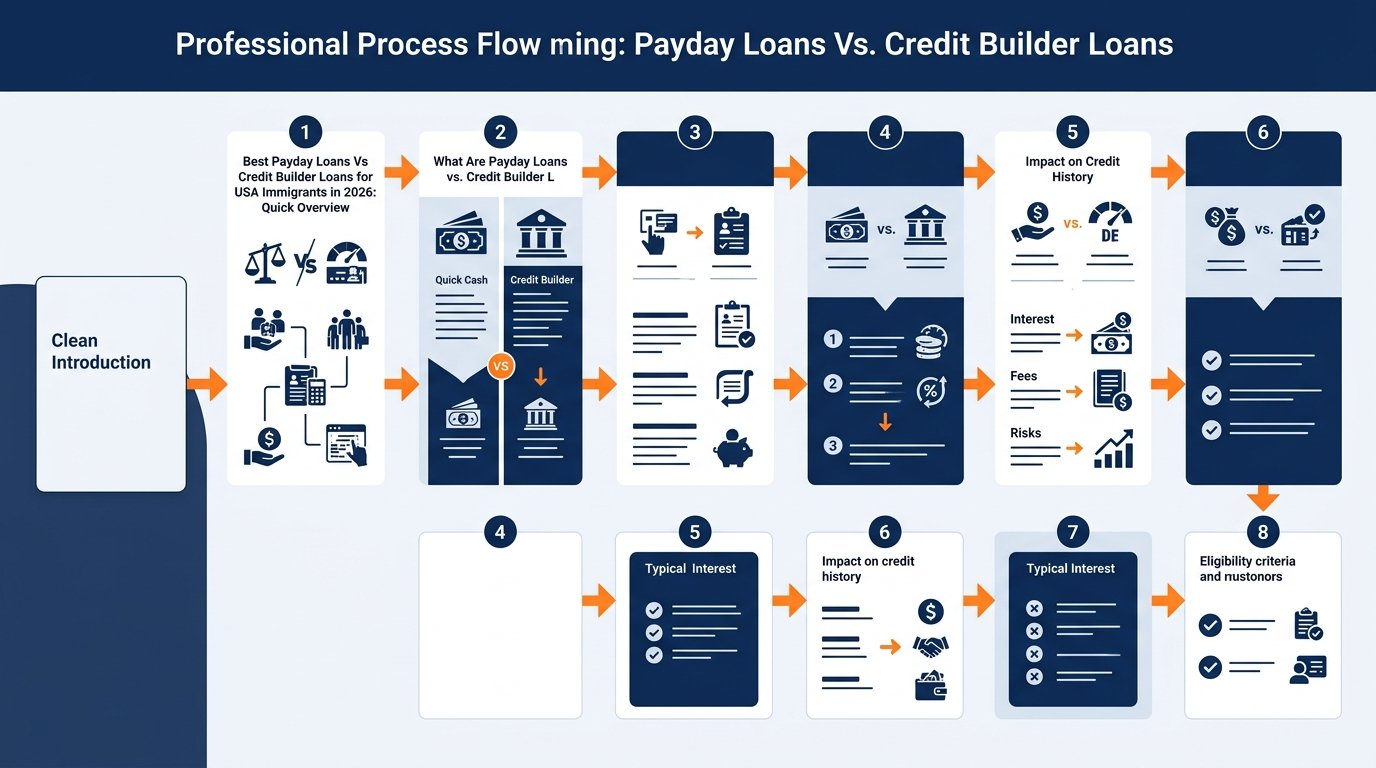
These two loan types share a name but serve fundamentally different purposes — and choosing the wrong one can either trap an immigrant in a debt cycle or block them from building the credit history U.S. life depends on.
Payday loans are short-term, high-cost cash advances secured against an upcoming paycheck. As covered above, their costs are severe. According to the CFPB’s payday loan resource center, most traditional payday lenders do not report on-time payments to the three major credit bureaus (Equifax, Experian, or TransUnion), meaning payday loan repayments typically do not help build your credit score, according to CFPB research. Defaults, however, frequently get reported.
Credit-builder loans run in reverse: the lender holds the loan funds in a locked account while the borrower makes monthly payments. Only after completing the loan term does the borrower receive the money. According to a CFPB study, credit-builder loans can help establish and improve a credit score, especially for people without existing debt — precisely the situation most immigrants face on arrival.
Why Immigrants Face a Structural Credit Disadvantage
A significant share of U.S. adults are effectively “credit invisible” — meaning credit bureaus hold no scoreable file on them — according to CFPB research. Immigrants disproportionately fall into this category. Foreign credit histories from home countries — regardless of how strong — are not transferred to U.S. bureaus. An experienced professional who maintained a flawless credit record abroad arrives in the U.S. as a financial blank slate.
This invisibility has tangible consequences: landlords deny rental applications, employers in financial sectors run credit checks, and cell phone carriers demand large deposits. Building a scoreable profile quickly is not optional — it is a practical necessity.
According to USA.gov, five factors affect your credit score: payment history, outstanding balances, length of credit history, new credit applications, and types of credit accounts. The CFPB confirms that paying bills on time, every time carries the greatest impact. Credit-builder loans are engineered specifically to generate exactly that — a consistent, on-time payment record.
a newcomer who takes out a credit-builder loan through a credit union and makes 12 consecutive on-time payments creates a payment history that directly feeds the most heavily weighted scoring factor — without needing a Social Security Number in every case, since some lenders accept an ITIN as noted above.
The Core Trade-Off
| Dimension | Payday Loan | Credit-Builder Loan |
|---|---|---|
| Immediate cash | ✅ Yes | ❌ No |
| Credit score benefit | ❌ Rarely | ✅ Primary purpose |
| Cost direction | High cost to borrower | Low cost; savings returned |
| Default risk | High; can damage thin file | Low; structured repayment |
Immigrants who need emergency cash and have no alternatives may encounter payday products as their only visible option — but most negative information, including defaults, remains on a credit report for 7 years, making a single payday loan default disproportionately damaging to a file that is just beginning to form. Understanding this asymmetry before applying is the first decision that matters.

3. Eligibility Requirements for Immigrants
Qualifying criteria differ sharply between the two products — and for immigrants without an established U.S. credit file, understanding exactly what each lender checks determines which door is actually open.
Payday Loan Eligibility
Payday lenders advertise minimal requirements, but each criterion carries a practical catch for newcomers:
Documentation typically required:
- Government-issued photo ID (passport, state ID, or foreign consulate-issued ID accepted by some lenders)
- Active U.S. checking account in the applicant’s name
- Proof of recurring income (pay stubs, benefits statements, or bank deposit history)
- U.S. address verification
Immigration status: Most payday lenders do not verify visa category or immigration status. An ITIN (as noted above) is accepted as a tax identification number by many storefront and online lenders in place of an SSN.
Credit check: Most payday lenders run a soft check through specialty consumer reporting agencies — ChexSystems for banking history or Teletrack — rather than a traditional hard pull through Experian, Equifax, or TransUnion. This means no credit history is required, but a history of bounced checks or bank account closures can disqualify an applicant. According to the CFPB’s payday loan resources, lenders are not required to assess a borrower’s ability to repay in most states, making approval accessible but financially risky.
State restrictions: Payday lending is banned or heavily restricted in states (including New York, New Jersey, and Pennsylvania). Immigrants in those states have no legal access to payday products regardless of documentation status.
Credit Builder Loan Eligibility
Credit unions, community banks, and CDFIs (Community Development Financial Institutions) are the primary issuers of credit builder loans. Their requirements are structured differently — and more favorably — for immigrants starting from zero.
Documentation typically required:
- ITIN or SSN
- Proof of U.S. address
- Active checking or savings account
- No minimum credit score; some issuers require no existing loan defaults
Immigration status: Credit unions with community charters often serve mixed-status communities. Many explicitly accept ITIN holders, including undocumented immigrants, because their regulatory mandate centers on community financial inclusion rather than immigration enforcement.
Credit check: Most credit builder loan issuers do not run a hard credit inquiry at application. According to the CFPB, credit builder loans are especially effective for people without existing debt — precisely the profile of a newly arrived immigrant. A hard inquiry at application would impact your score, but as noted in the verified CFPB guidance on credit inquiries, scoring models weigh both recency and frequency — making lenders who skip hard pulls meaningfully better for thin-file applicants.
Side-by-Side Eligibility Snapshot
| Requirement | Payday Loan | Credit Builder Loan |
|---|---|---|
| SSN required | Often no — ITIN accepted | Often no — ITIN accepted |
| Minimum credit score | None | None |
| Bank account required | Yes — checking | Yes — savings or checking |
| Immigration status verified | Rarely | Rarely |
| Hard credit pull | Usually no | Usually no |
| Income verification | Yes | Sometimes |
| State availability | varies by provider — confirm directly | Available in nearly all states |
a newcomer on an H-1B visa who has opened a credit union account but holds no U.S. credit history qualifies more cleanly for a credit builder loan than any payday product — and without triggering a hard inquiry that would appear on the thin file they are trying to build.
4. Payday Loans vs. Credit Builder Loans: Full Comparison
Understanding how these two products differ across every key dimension helps immigrants avoid costly missteps. The table below covers the factors that matter most when you’re building a financial foundation in the U.S. — cost, credit impact, repayment structure, risk exposure, and regulatory protections.
A critical distinction that often goes unnoticed: payday loans can damage your credit profile (through collections, defaults, and the hard inquiries that scoring models weigh against you), while credit builder loans are specifically designed to strengthen it. A CFPB study confirmed that credit builder products are particularly effective for borrowers who carry no existing debt — a profile that describes many newly arrived immigrants. Since on-time payment history carries the greatest weight in your score, a credit builder loan’s structured monthly schedule directly targets the most impactful scoring factor.
| Feature | Payday Loan | Credit Builder Loan |
|---|---|---|
| Primary Purpose | Short-term emergency cash | Building or establishing credit history |
| Cost / APR | Typically triple-digit APR; varies by state | Generally low; often single- or double-digit APR |
| Funds Access | Cash upfront, immediately | Funds held in escrow; released after repayment |
| Repayment Term | Typically due at next paycheck (very short) | Typically several months to a few years |
| Credit Bureau Reporting | Usually not reported unless sent to collections | Reported monthly to one or more major bureaus |
| Credit Score Impact | Neutral at best; harmful if defaulted — negative marks can remain for up to seven years | Positive when paid on time; builds payment history, credit mix, and history length |
| Risk to Borrower | High — rollover fees can compound rapidly | Low — structured payments with a defined end date |
| ITIN Accepted? | Varies by lender | More commonly accepted; CDFIs often ITIN-friendly |
| Regulatory Oversight | State-level caps and bans vary widely; CFPB oversight applies | CFPB-regulated; many providers are NCUA- or FDIC-supervised |
| Best For | Genuine last-resort emergencies only | Immigrants with thin or no U.S. credit file |
For immigrants who are currently credit invisible — meaning no scoreable U.S. credit history exists — the credit builder loan addresses the structural problem directly. The payday loan does not.
Illustrative Scenarios
The following are illustrative scenarios, not real testimonials or case studies of specific individuals.
Illustrative Scenario: Recent Arrival, Limited U.S. Credit History
A newcomer without prior U.S. credit—potentially credit-invisible—faces an urgent expense. A payday loan covers the shortfall immediately but builds no credit history. A credit builder loan, supported by CFPB research, offers the opposite: delayed access to funds, but a foundation for future credit health.
Expert Recommendation
Top Pick: Credit Builder Loan
For most immigrants and newcomers working to establish financial footing in the United States, a credit builder loan is the clear top pick — and it isn’t particularly close.
The structural advantage is straightforward: a credit builder loan is purpose-built for people navigating the credit-invisible challenge that affects a meaningful share of U.S. adults with limited or no credit history (CFPB). A CFPB study confirmed that these products can genuinely help establish and improve a credit score, with the strongest results seen among borrowers who carry no existing debt — precisely the profile of a newly arrived immigrant (CFPB). Because consistent, on-time payment carries the greatest weight in determining your credit score (CFPB), the monthly repayment cadence of a credit builder loan directly targets the most impactful credit-building behavior available.
Fees and interest costs are typically modest compared to short-term emergency lending. Any missed payments would remain on your report for seven years (CFPB), so borrowers should only commit if the monthly amount is comfortably manageable. Credit unions, community banks, and CDFIs are the most accessible starting points — many accept an ITIN in place of an SSN.
Best for: Immigrants with stable income who want to build a U.S. credit profile methodically and avoid high-cost debt.
Runner-Up: Payday Loan (Narrow Circumstances Only)
A payday loan earns a reluctant runner-up position — not as a credit tool, but as an emergency cash mechanism of last resort when no other option exists and the borrower has a clear, immediate repayment source. These products do not report to credit bureaus in most cases, so they build nothing. Triple-digit APRs are typical, and any defaults can trigger collection activity, which does appear negatively on credit reports. Availability also varies by state, with several states prohibiting them outright.
If you find yourself considering a payday loan, first check your credit report for free at AnnualCreditReport.com — understanding your current standing may open access to better alternatives you weren’t aware of.
Best for: Only where a genuine, short-term cash emergency exists, no credit builder loan or personal loan is accessible, and full repayment by the next pay date is certain.
Frequently Asked Questions: Payday Loans vs. Credit Builder Loans (USA)
Are payday loans or credit builder loans better for building a credit score?
Credit builder loans are specifically designed for this purpose. A CFPB study confirmed that credit builder loans can help establish and improve credit scores, particularly for borrowers who carry no existing debt. Most traditional payday lenders do not report on-time payments to the three major credit bureaus (Equifax, Experian, or TransUnion) — meaning responsible repayment goes unrecognized. If credit-building is your primary goal, a credit builder loan is the structurally superior choice.
Do payday loans show up on my credit report?
Generally, payday loans do not appear on your credit report when taken out or repaid on time — most payday lenders skip routine bureau reporting. However, if you default and the lender sells your debt to a collections agency, that collection account will likely appear. Most negative entries, including collections, remain on your credit report for up to 7 years, per CFPB guidance. This asymmetry — no upside reporting, full downside reporting — makes payday loans particularly unfavorable for credit building.
Can immigrants without a Social Security Number qualify for a credit builder loan?
Many credit unions and Community Development Financial Institutions (CDFIs) accept an Individual Taxpayer Identification Number (ITIN) in place of an SSN for credit builder loan applications. Acceptance varies by lender and state. Payday lenders also often accept ITINs, though their products carry significantly higher costs. Immigrants are encouraged to contact ITIN-friendly institutions directly and confirm reporting policies before applying, since bureau reporting practices differ even among lenders who market to ITIN holders.
How does applying for either loan affect my credit score?
According to the CFPB, a hard credit inquiry does impact your score, and scoring models weigh both the recency and frequency of credit applications. Many credit builder loan providers perform only a soft pull, minimizing this risk. Payday lenders vary — some skip a credit check entirely. If you are in an early stage of building credit history, prioritize lenders who use soft inquiries and confirm this before submitting a formal application.
What happens if I miss a payment on a credit builder loan?
Missing a payment can meaningfully damage the credit profile you are trying to build. The CFPB notes that paying bills on time, consistently, has the greatest impact on your credit score among all scoring factors. A late payment reported to the bureaus can set back months of positive payment history. Some credit builder loan providers offer a short grace period — confirm this policy with your lender upfront. Autopay enrollment is strongly recommended to avoid accidental missed payments.
Which credit score factors do these loans actually affect?
USA.gov identifies five factors that influence your credit score: payment history, outstanding balances, length of credit history, new credit applications, and types of credit accounts. Credit builder loans positively engage several of these — they build payment history, add to credit mix, and lengthen your history over time. Payday loans, because they typically go unreported, affect none of these factors positively — yet can damage payment history through collections if mismanaged.
How can I check my credit report to track progress from a credit builder loan?
You are entitled to a free credit report from each of the three nationwide bureaus every week through AnnualCreditReport.com, a program now made permanent. Monitoring your report regularly lets you verify that your credit builder loan payments are being accurately reported and that no errors have appeared. If you spot an inaccuracy, you have the right to dispute it — the bureau must investigate typically within 30 days, and up to 45 days in certain circumstances, as outlined by the FTC.
Are there immigrants who are “credit invisible,” and does this affect which product they should choose?
A meaningful portion of U.S. adults are considered “credit invisible” — meaning they have no scoreable credit file with the major bureaus. Newly arrived immigrants disproportionately fall into this category because foreign credit histories are not transferred to U.S. bureaus. For credit-invisible individuals, a credit builder loan is the more logical starting point: it creates a bureau-recognized file through structured, reported payments. A payday loan, by contrast, typically contributes nothing to establishing that file.
Is there a risk of a payday loan debt cycle that damages long-term financial health?
Yes — and this risk is well-documented by regulators. Payday loans carry very high APRs and short repayment windows, and borrowers who cannot repay in full often roll over or re-borrow. Each rollover extends cost accumulation without building credit. The CFPB advises keeping credit utilization below 30% of available limits — but a payday loan cycle can drain income that would otherwise support on-time payments across other accounts, indirectly harming your broader credit profile.
Can a young immigrant under 21 access these products without a co-signer?
For credit cards specifically, CFPB rules require applicants under 21 to demonstrate independent income or obtain a co-signer over 21. Credit builder loans are generally governed by different rules — many lenders do not impose an age-based co-signer requirement beyond standard legal adulthood (18). Payday loans are available to adults 18 and older in most states, though state-level regulations vary considerably. Young immigrants are advised to verify both age and documentation requirements directly with their target lender.
Conclusion
Choosing between a payday loan and a credit builder loan ultimately comes down to what you need most right now — and what you are building toward.
For newly arrived immigrants navigating a thin or invisible credit file, the evidence clearly favors credit builder loans as a long-term strategy. A CFPB study found these products can meaningfully establish and strengthen a credit score, particularly for borrowers who carry no existing debt — a situation that describes many newcomers. Because paying bills on time carries the greatest weight in how your score is calculated, the structured monthly payment discipline a credit builder loan enforces directly attacks your most important scoring factor from day one.
Payday loans, by contrast, offer speed but at a structural cost. The high fees, short repayment windows, and limited credit-reporting upside mean they rarely advance an immigrant’s financial integration — and a missed payment can introduce negative information that typically lingers on your report for seven years.
Before borrowing anything, monitor your standing: weekly free reports from each of the three major bureaus are available permanently at AnnualCreditReport.com. If you spot inaccuracies, bureaus are legally required to investigate disputes within 30 days in most cases.
The path to financial inclusion in the United States is incremental. Select the tool that matches your timeline, protect your payment history obsessively, and let your credit file grow alongside your life here.
Disclaimer
For Informational Purposes Only. The content published on MoneyAbroadGuide.com is intended as general financial education and does not constitute legal, tax, immigration, or licensed financial advice. Individual circumstances — including visa status, state of residence, income, and credit history — vary widely and materially affect your options. Always consult a licensed financial advisor, attorney, or accredited credit counselor before making borrowing decisions.
Regulatory Context. Financial products discussed on this site are subject to federal oversight by bodies including the Consumer Financial Protection Bureau (CFPB) and the Federal Trade Commission (FTC), as well as applicable state-level regulators. Payday lending laws, rate caps, and licensing requirements differ by jurisdiction. Readers are responsible for verifying that any lender they engage is duly licensed in their state.
Affiliate Disclosure. MoneyAbroadGuide.com may receive compensation when readers click certain links or apply for financial products featured on this site. This compensation may influence which products are presented and their placement, but it does not influence our editorial assessments or factual reporting. We maintain a strict separation between sponsored content and independent editorial content.
Accuracy. We make reasonable efforts to keep information current; however, lending regulations, product terms, and eligibility rules change frequently. Verify all details directly with the provider and relevant regulatory authority before proceeding.
About the Author
Talal Eddaouahiri is the founder of MoneyAbroadGuide.com, an independent financial information platform for immigrants and newcomers in the United States and Canada. Originally from Morocco, he settled in the U.S. in 2015 and built his own credit history and banking relationships from scratch in both countries. His background is in retail banking and customer relations, and he draws on that firsthand experience to write independent, source-based guides — citing regulators including the FCAC, FINTRAC, OSFI, CRA, IRS, and CDIC — to help newcomers navigate financial systems with confidence.
Learn more about our Fact-Checking Process and our How We Test when researching this guide.
Last Updated: July 2026

About Talal Eddaouahiri
Founder & Financial Writer at MoneyAbroadGuide.com. A Moroccan immigrant who settled in the United States in 2015, Talal opened bank accounts and built credit from zero in both the US and Canada. His background is in retail banking and customer relations, and he writes independent, source-based guides (FCAC, FINTRAC, OSFI, CRA, IRS, CDIC) to help newcomers navigate their first financial steps. Read his full profile →