
How to Get a Driver’s License in Canada as a Newcomer (2026 Guide)
Quick Answer: Yes — most newcomers can drive in Canada right away on a valid foreign licence, but only for a limited window that depends entirely on your province (as short as 60 days in Ontario, as long as 6 months in Quebec). Some countries’ licences can be exchanged directly for a provincial one with no road test; others require the full graduated-licensing process. Your first move should always be your province’s official licensing authority — the rules below vary more by where you land than any federal standard.
In this guide, we cover the exchange process province by province, including which countries have reciprocal agreements with Canada. Furthermore, the timeline and required documents vary significantly between Ontario, BC, Alberta, and Quebec. However, most newcomers from non-reciprocal countries must pass both a written test and a road test. In addition, an International Driving Permit (IDP) is accepted for up to 60 or 90 days in most provinces.
Obtaining a Canadian driver’s licence is one of the most practical milestones a newcomer can reach. It unlocks employment options, simplifies daily errands, and signals to landlords, employers, and financial institutions that you are building roots in the country. Yet the process consistently surprises immigrants: unlike passports or Social Insurance Numbers, driver’s licensing in Canada is governed entirely at the provincial and territorial level — not federally — meaning the rules you follow in Ontario can differ substantially from those in British Columbia, Alberta, or Nova Scotia.
According to Immigration, Refugees and Citizenship Canada (IRCC), licensing authority rests with each province and territory, so your first step is always to identify the rules of your specific jurisdiction. That same IRCC settlement guidance notes that newcomers planning to drive immediately after arrival should obtain an International Driving Permit (IDP) in their home country before departing, since it supplements your foreign licence during the recognition period.
Beyond the driving rules themselves, a provincial licence also functions as everyday photo ID — useful when building your Canadian credit history or opening accounts. Budget for the associated fees (knowledge test, road test, and eventually the licence itself) as part of your broader settlement costs.
Whether you arrived last week or have been navigating Canadian roads on a foreign licence for several months, this guide gives you a clear, province-by-province roadmap to getting fully licensed.
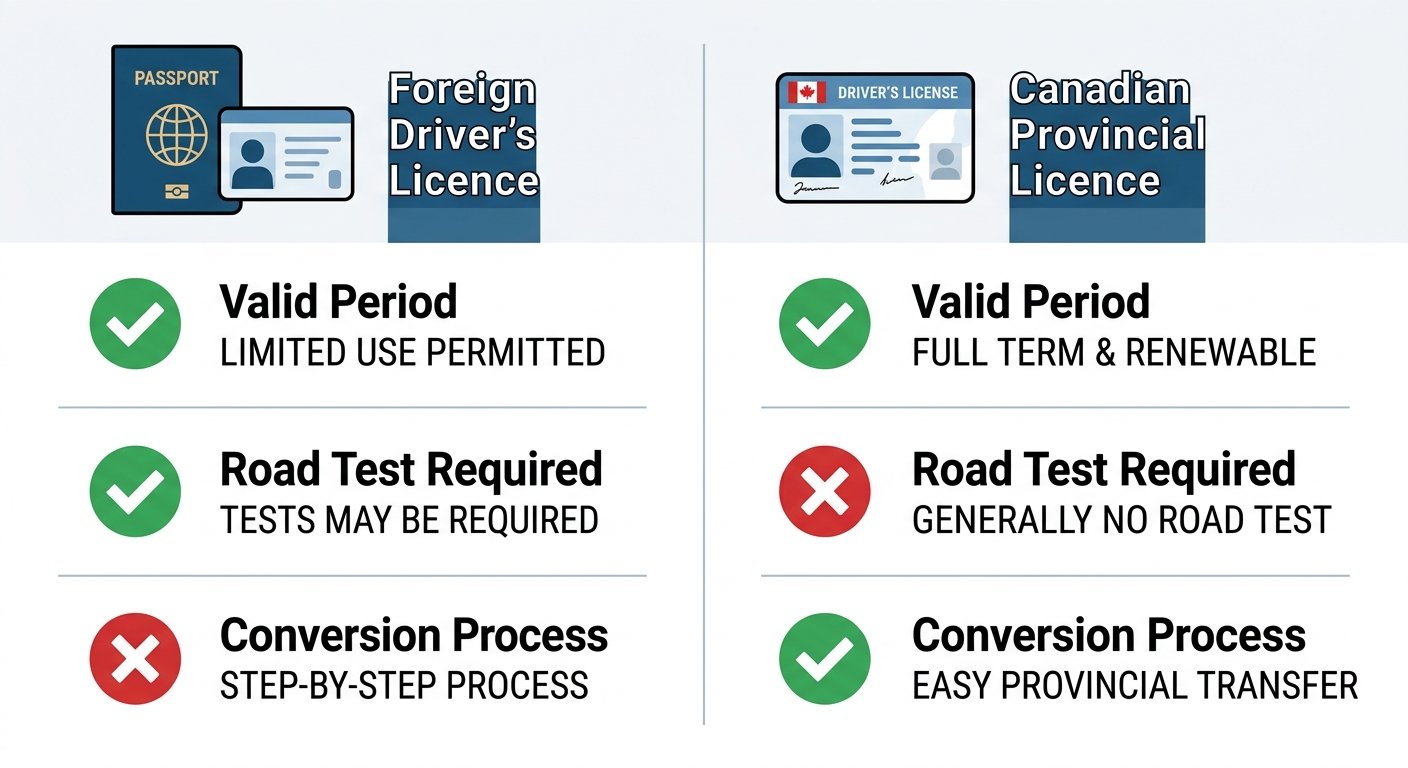
Quick Overview: What Changes by Province
Driving in Canada falls under provincial and territorial jurisdiction — not federal — meaning there is no single national licence. Each province sets its own grace period, exchange agreements, fees, and graduated-licensing stages. According to IRCC, newcomers should obtain an IDP before leaving their home country if they plan to drive on a foreign licence after arrival.
Why This Matters Immediately After Landing
Most provinces allow newcomers to drive on a valid foreign licence for a limited window before requiring a local licence — but that window ranges from 60 days (Ontario) to 6 months (Quebec). Missing your province’s deadline means driving unlicensed, which carries fines and can jeopardize an insurance claim. The clock typically starts on the date you become a resident, not the date you first drive — check the full breakdown by province below.
Reciprocal Exchange Depends on Your Country, Not Just Your Province
Several provinces let you exchange a foreign licence directly — skipping the road test — for a specific list of countries. Ontario’s list, for example, includes South Korea, Japan, Australia, most of the EU and UK, and every U.S. state (Ontario.ca). Saskatchewan’s SGI recognizes many of the same countries, including South Korea, following a 2023 expansion (SGI) — so which countries qualify usually depends more on your country of origin than on which of these two provinces you land in. Always verify your own country’s status directly with your destination province, since these lists change.
What You Need to Start
Across provinces, the core documents typically required include:
- Proof of identity (passport, permanent resident card, or work/study permit)
- Proof of residency (lease, utility bill, or official mail)
- Foreign driving record (some provinces require an official translated abstract, or the original licence itself if you’re claiming experience credit)
- Application fee (paid at the provincial licensing office or online)
Status documents issued by IRCC — such as your Confirmation of Permanent Residence (COPR) or work permit — are commonly accepted as identity proof at licensing offices.
The Graduated Licensing Reality
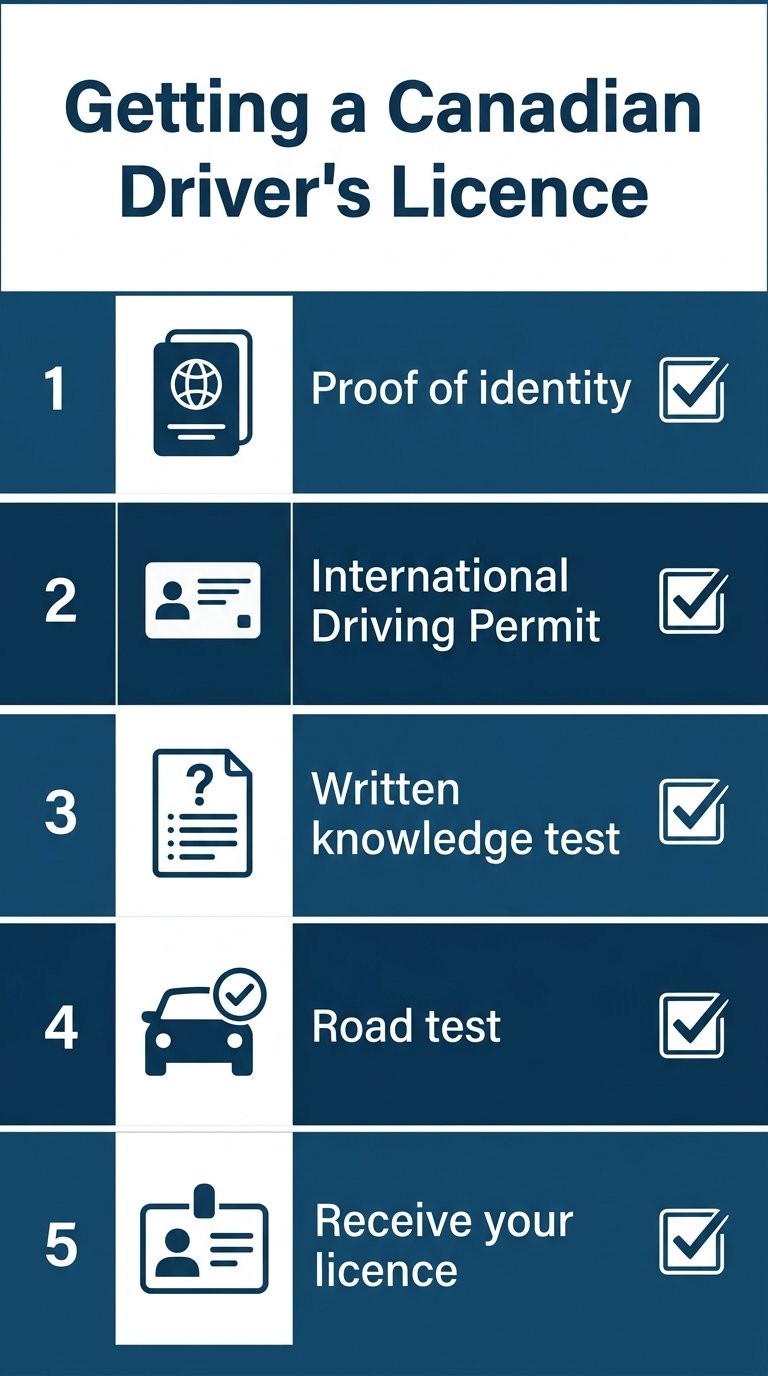
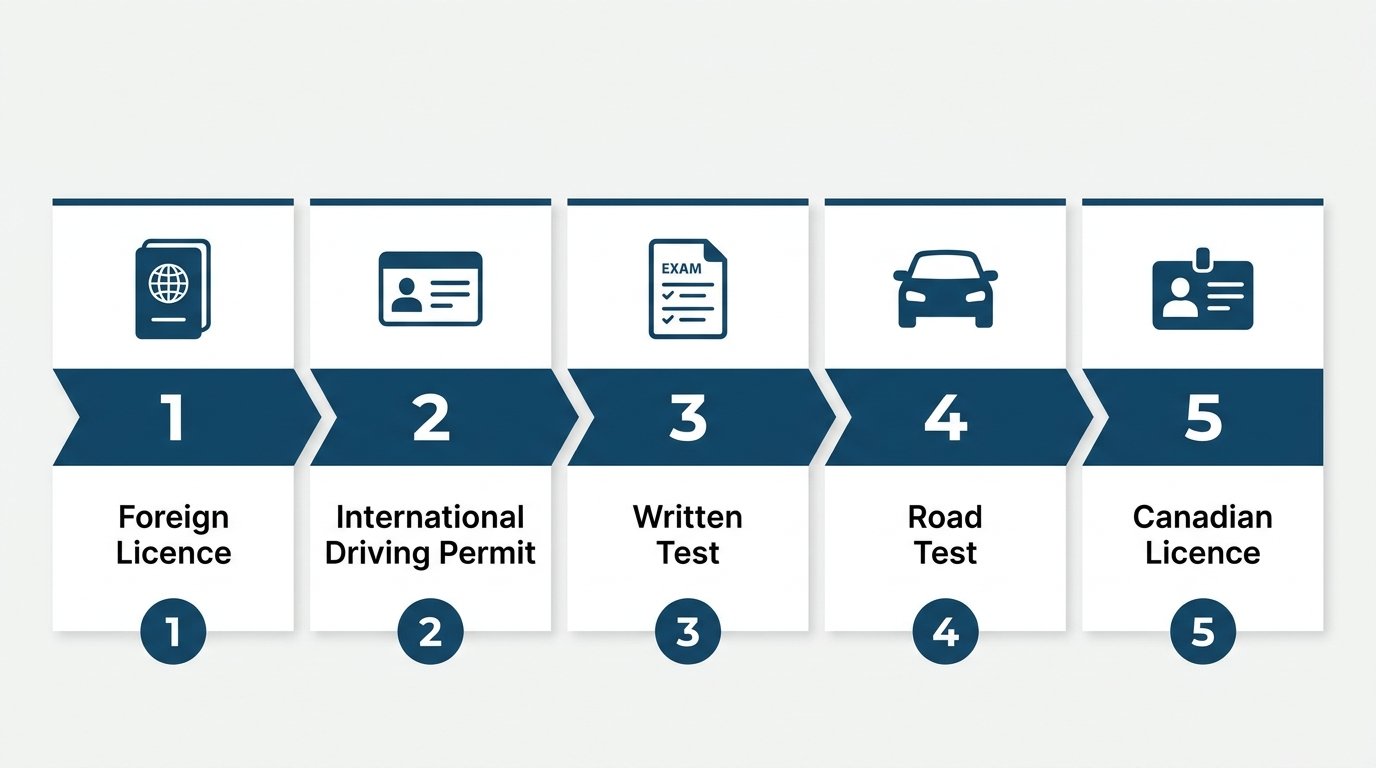
Newcomers without a reciprocal exchange or credited experience enter a graduated licensing system designed for new drivers. Across the provinces covered in this guide, that typically means:
- Knowledge test → Learner’s stage (restricted driving, supervised only)
- Road test → Intermediate or probationary licence
- Second road test (required in some provinces, e.g. Ontario) → Full unrestricted licence
Depending on the province, the full sequence can take a year or more — several provinces require two or more years of combined stages. Planning around this timeline affects everything from insurance costs to whether you can accept a job that requires a vehicle.
Insurance Implications
Insurers treat graduated licences differently from full licences. Newcomers at the learner or novice stage typically pay higher premiums. Some provinces — notably British Columbia through ICBC and Manitoba through MPI — operate a government-run insurer with published rate structures, while others use a private market where rates vary between providers.
Why Newcomers Need a Driver’s Licence in Canada
Driving in Canada is governed at the provincial and territorial level — not federally. According to IRCC, each province sets its own licensing rules, testing standards, and reciprocity agreements with foreign countries. This decentralized structure is why a newcomer’s experience in Alberta can look entirely different from one in Ontario or Quebec.
A Canadian Licence Is a Practical Necessity
For most immigrants settling outside major urban centres — and even within cities like Calgary, Edmonton, or Mississauga — a Canadian driver’s licence functions as a foundational settlement document, not merely a driving permit. Employers frequently request it as a standard form of government-issued photo ID. Landlords, financial institutions, and service providers accept it where a foreign passport may raise questions. Beyond identification, access to employment, childcare, medical appointments, and grocery stores in lower-density areas is often impractical without a personal vehicle.
Newcomers working in trades, healthcare support, or delivery sectors report that employers will delay a start date — or withdraw an offer — if a candidate cannot provide a valid provincial licence within a defined timeframe.
The Identity Layer
Canada’s financial system also intersects with licensing in ways that affect newcomers quickly. According to the Financial Consumer Agency of Canada, you have the right to open a personal bank account regardless of employment status — but banks request government-issued photo ID at account opening. A provincial driver’s licence satisfies this requirement immediately, while a foreign passport sometimes triggers additional document requests. See our guide to the best banks for newcomers in Canada for what to expect when you open your first account.
The Jurisdictional Gap Most Newcomers Miss
Because licensing is provincial rather than federal, IRCC’s settlement guidance sets the general framework, but the rules that actually govern your timeline, fees, and test requirements come from your province’s transport authority. Official federal pages describe the system in general terms, while province-specific portals (ServiceOntario, ICBC, SAAQ, and others) hold the binding operational details — so a reciprocal exchange available in one province never automatically applies in another.
Who Is Eligible to Apply
Eligibility to apply for a Canadian driver’s licence depends on immigration status, province of residence, and the documents you carry — not on citizenship.
Immigration Status That Qualifies
Most non-citizen immigration categories are accepted. The following statuses are eligible in virtually every province:
- Permanent Residents — eligible immediately upon landing
- Protected Persons — eligible from the date status is granted
- Convention Refugees — same as protected persons
- Temporary Foreign Workers — eligible for the duration of their work permit
- International Students — eligible while a valid study permit is held
- Refugee Claimants — eligible in most provinces, though some require an asylum-seeker document as proof of authorized stay
Visitor status is different: in every province checked for this guide (Ontario, BC, Alberta, Quebec), a visitor may drive temporarily on a valid foreign licence during that province’s grace-period window, but cannot obtain a full provincial licence until they establish residency. This is a provincial residency requirement, not a single federal rule — check your own province’s exact definition of “resident” for licensing purposes.
According to IRCC, driver licensing falls under provincial and territorial jurisdiction — IRCC sets no national eligibility rule, and each province administers its own requirements within that framework.
Identity Documents Required
| Document Type | Accepted? |
|---|---|
| Passport + COPR or PR Card | Yes — all provinces |
| Work or Study Permit | Yes — with valid passport |
| Refugee Protection Claimant Document | Yes — most provinces |
| Visitor Record alone | No — insufficient for a full licence |
Some provinces also request proof of local address, such as a utility bill or bank statement.
Residency Requirement
You must be resident in the province where you apply — not merely present. For example, a newcomer living in Calgary cannot apply through ICBC; they must apply through Alberta’s provincial system. Provinces define residency by your primary place of dwelling, not the length of your stay.
Minimum Age
Minimum age for the learner’s stage ranges from 14 in Alberta (with parental consent if under 18) to 16 in most other provinces covered here. Confirm your specific province’s threshold, as it can differ from these two.
Vision and Medical Standards
All applicants must meet minimum vision standards set by the provincial licensing authority. Commercial licence applicants (Class 1–3 in most provinces) face additional medical screening requirements under provincial highway traffic acts.
What Does NOT Disqualify You
- Lack of a Social Insurance Number (a SIN is not required for a licence application)
- Having no Canadian credit history
- Employment status — unemployed newcomers apply on the same basis as employed ones
For newcomers whose home country has a reciprocal licence exchange agreement with their destination province (see the province-by-province breakdown below), the eligibility pathway above still applies — but the testing requirements at the provincial counter will differ.
Foreign Driver’s Licence Rules by Province
Driver’s licensing in Canada falls under provincial and territorial jurisdiction rather than federal authority (IRCC). The table and province breakdowns below summarize the grace period, exchange agreements, and foreign-experience credit for the six provinces most newcomers settle in. Reciprocal exchange lists change periodically — verify your own country’s current status directly with the provincial authority linked in each section before visiting a licensing office.
| Province | Foreign Licence Grace Period | Exchange Agreement (Skip Road Test) | Foreign Experience Credit | Must Surrender Foreign Licence? | Licensing Authority |
|---|---|---|---|---|---|
| Ontario | 60 days (new residents) | Yes — South Korea, Japan, Australia, most EU/UK, all U.S. states, all Canadian provinces | Up to 12 months for non-exchange countries (new rule, effective July 1, 2026) | Depends on country/licensing history — verify with the MTO | MTO |
| British Columbia | 90 days (new residents); visitors up to 6 months | Yes — verify the current country list directly with ICBC | 2+ years’ verified experience exempts you from the Graduated Licensing Program | Yes | ICBC |
| Alberta | 90 days (new residents); visitors up to 1 year | Yes — most of the EU, Australia, Japan, South Korea, Taiwan, New Zealand, all U.S. states | GDL Exemption Program credits verified prior experience | Yes | Transportation and Economic Corridors |
| Quebec | 6 months (residents and visitors); students: full study/placement period | Yes — Canada/U.S., Austria, Belgium, France, Germany, UK, Japan, Netherlands, South Korea, Switzerland, Taiwan | Yes, with 1+ year held — knowledge and road test required | Depends on country/licensing history — verify with the SAAQ | SAAQ |
| Manitoba | 3 months (some exemptions, e.g. full-time students) | Yes — roughly 40 jurisdictions incl. 26 European countries, Japan, Australia, Ukraine | GDL may be waived with a verified equivalent full licence | Yes (except temporary foreign workers, who can have it held and returned) | MPI |
| Nova Scotia | 180 days | Yes — verify the current country list directly with Access Nova Scotia | Not offered outside the exchange list | Yes | Access Nova Scotia |
Important: International Driving Permits (IDPs) should be obtained in your home country before arriving, as they cannot be issued in Canada, per IRCC’s settlement guidance. An IDP supplements but does not replace your provincial conversion process.
Ontario
Ontario gives new residents 60 days to exchange a valid foreign or out-of-province licence for an Ontario one (Ontario.ca). If your licence is from a listed exchange jurisdiction — South Korea, Japan, Australia, Taiwan, most of the EU/UK, and every U.S. state are on the current list — you can trade it directly with a vision test only (under 2 years’ experience gets a G2, not a full G, until you cross that threshold). Starting July 1, 2026, applicants from non-exchange countries can get credit for up to 12 months of authenticated foreign driving experience (an official letter from the issuing government confirming it) to skip straight to the G2 road test — the mandatory 12-month wait before the final G road test still applies. Without either path: G1 (knowledge test, minimum 12 months, or 8 with an approved course) → G2 (road test, minimum 12 months) → G (second road test). Authority: Ministry of Transportation (MTO), tested at DriveTest centres.
British Columbia
New BC residents have 90 days to exchange a foreign or out-of-province licence; visitors may drive on a foreign licence for up to 6 months without exchanging at all (ICBC). ICBC maintains its own list of exchange-eligible jurisdictions — confirm your country’s status directly with ICBC, since the list isn’t published as a simple static page. Separately, if you can document 2 or more years of non-learner driving experience with original or officially certified records, you can skip the Graduated Licensing Program entirely. Without either path: Learner (L, minimum 12 months) → Novice (N, minimum 24 months, or 18 with approved training) → Full — though starting October 19, 2026, ICBC will replace the second road test with a Driving Record Assessment plus a 12-month restriction period for eligible clean-record N drivers (24 months’ safe driving if under 25, or 12 months if 25 or older, with no prohibitions or excessive-speed/device-use convictions). ICBC requires you to surrender any licence you currently hold when you apply. Authority: ICBC.
Alberta
Alberta gives new residents 90 days to exchange a foreign licence; visitors may drive on a valid foreign licence for up to 1 year (Alberta.ca). Reciprocal exchange agreements cover most of the EU, plus Australia, Japan, South Korea, New Zealand, Taiwan, Ukraine (specific classes), and every U.S. state. If your country isn’t listed, Alberta’s GDL Exemption Program lets you apply to have genuine prior driving experience verified and credited — potentially skipping straight to a road test. Without either path: Class 7 Learner (knowledge and vision test, minimum 12 months) → Class 5-GDL Probationary (road test, minimum 24 months, reducible by 6 with approved training) → full Class 5 (the advanced road test was dropped in 2023). Alberta requires surrender of any out-of-province licence. Authority: Transportation and Economic Corridors, via registry agents.
Quebec
Quebec gives both visitors and new residents 6 consecutive months to drive on a valid foreign licence; students and trainees whose primary residence stays outside Quebec can drive on it for their entire study or placement period (SAAQ). SAAQ’s exchange list (no road test) includes Canada, the U.S., Austria, Belgium, France, Germany, the UK, Japan, the Netherlands, South Korea, Switzerland, and Taiwan. If your licence isn’t on that list, you can still apply for testing if you’ve held it for at least 1 year: passing both the knowledge and road test gets you a regular licence if SAAQ recognizes 24+ months of experience, or a probationary one if it recognizes less. Without any prior licence recognized, the standard path is a driving course, Learner’s Licence (minimum 12 months), knowledge test, road test, then a 24-month Probationary Licence before the full Class 5. Authority: SAAQ.
Manitoba
Manitoba gives new residents 3 months to exchange a foreign licence — full-time students, NATO members, and a few other categories are exempt from this deadline entirely (MPI). MPI’s exchange list has grown substantially: 26 European countries were added in December 2024, joining earlier agreements with Japan, Australia, and Ukraine, for roughly 40 reciprocal jurisdictions in total. If your country isn’t listed, MPI can still waive the graduated-licensing requirement if your foreign licence is verified as equivalent to a full Manitoba licence. MPI keeps your original foreign licence when you exchange it (temporary foreign workers can request it be held and returned when they leave instead). Without an exchange: Learner (5L, minimum 9 months) → Intermediate (5I, minimum 15 months) → Full (5F). Authority: Manitoba Public Insurance (MPI).
Nova Scotia
Nova Scotia gives you 180 days to exchange a foreign or out-of-province licence, whether you’re a new resident or a longer-term visitor (Nova Scotia). A vision-test-only exchange is available for a list of countries that includes South Korea, Japan, Australia, the UK, and most of Western Europe — confirm the current list directly with Access Nova Scotia. Outside that list, no credit is given for foreign experience: you’ll need to pass the full knowledge and road tests, and surrender your foreign licence when your Nova Scotia licence is issued. The graduated system runs through a Learner’s stage, a Newly Licensed Driver stage, and a Restricted stage before a full licence — confirm exact minimum durations for each stage directly with the Registry of Motor Vehicles, as published figures for Nova Scotia varied across sources at the time of writing. Authority: Registry of Motor Vehicles, via Access Nova Scotia.
Illustrative Scenario
The following is an illustrative scenario, not a real testimonial or case study of a specific individual.
Temporary Foreign Worker, Rural Agricultural Placement
A temporary foreign worker placed on a rural farm finds public transit unavailable. Their home-country licence permits driving for a limited window under their province’s rules, making early licence conversion a practical priority before that period lapses.
Expert Recommendation
Top Pick: Begin the Conversion Process in Your First Month
The single most consequential step a newcomer can take is to visit their provincial licensing authority within the first few weeks of arrival — before the window to drive on a foreign licence closes. Because licensing falls entirely under provincial and territorial jurisdiction (IRCC), the rules, exchange agreements, and timelines vary meaningfully from one province to the next, as the breakdown above shows. That variability is exactly why early action matters: a 60-day window (Ontario) disappears much faster than a 6-month one (Quebec), and graduated licensing programs in most provinces require months of progression before a full licence is issued.
Practical path: Arrive with a valid foreign licence and, where available, an International Driving Permit obtained before departure (IRCC). In your first week, identify your province’s licensing body — ICBC in British Columbia, SAAQ in Québec, ServiceOntario/MTO in Ontario, and so on — and confirm whether your home country qualifies for a knowledge-test exemption or full licence exchange. If it does, book that appointment immediately. If it does not, book the knowledge test anyway. Every week of delay adds to the overall timeline before you hold a full Canadian licence.
💡 Newcomer Tip: Set Up Your Canadian Banking Early
Licensing fees, knowledge-test bookings, and eventual road-test costs all need to be paid, and a Canadian bank account makes that far easier than relying on foreign cards. You’re eligible for a no-cost account in your first year under the FCAC’s low-cost banking commitment (FCAC), and the bank card and statement it produces can also help verify your identity at the licensing office. See our guide to the best banks for newcomers in Canada to compare options before you land.
Frequently Asked Questions
Can I drive in Canada immediately after arriving with my foreign licence?
Generally, yes — but the permitted period and conditions depend on the province or territory. Among the six provinces covered in this guide, the grace period varies significantly: 60 days in Ontario, 90 in British Columbia and Alberta, 3 months in Manitoba, 6 months in Quebec, and 180 days in Nova Scotia. Obtaining an International Driving Permit (IDP) from your home country before departure is advisable, per the IRCC settlement page. Check your specific province’s current deadline on arrival, since driving beyond it without a local licence can result in fines.
Which government body issues Canadian driver’s licences?
No federal authority issues driver’s licences. Licensing is exclusively a provincial and territorial matter, as confirmed by IRCC’s settlement guidance. Each province runs its own agency — the MTO in Ontario, ICBC in BC, Alberta’s Transportation and Economic Corridors ministry, the SAAQ in Quebec, MPI in Manitoba, and the Registry of Motor Vehicles in Nova Scotia. Transport Canada does not handle individual licensing.
Do I need a Social Insurance Number to apply for a driver’s licence?
No. A SIN is not required to apply for a provincial driver’s licence. It is, however, essential for employment and government benefits — and for a non-interest-bearing bank account, you may decline to provide it as ID, per FCAC guidance. For licensing, provinces generally accept immigration documents such as a PR Card, Confirmation of Permanent Residence, study permit, or work permit as primary identification.
Will my years of driving experience abroad count toward Canada’s graduated licensing system?
It depends on your province and your country of origin. Several provinces credit foreign experience even outside a full exchange agreement: British Columbia exempts drivers with 2+ verified years from its Graduated Licensing Program, Alberta runs a dedicated GDL Exemption Program, Ontario will credit up to 12 months of experience for non-exchange countries starting July 1, 2026, and Manitoba can waive graduated stages for a verified equivalent licence. Where no such credit exists — as in Nova Scotia for non-exchange countries — you’ll need to progress through the standard graduated system regardless of your experience abroad.
Can international students and temporary foreign workers get a driver’s licence?
Yes. International students holding a valid study permit and temporary foreign workers holding a valid work permit are generally eligible to apply in every province covered in this guide, provided they can demonstrate legal status and provincial residency. Manitoba specifically exempts full-time students and certain worker categories from its standard exchange deadline; other provinces apply the same timeline to all new residents regardless of status. Confirm current requirements with your provincial transport authority before your appointment.
What documents do newcomers typically need to present at the licensing office?
Most provinces require proof of identity, proof of legal status in Canada, and proof of provincial residency. Acceptable identity documents typically include a passport plus your immigration document — PR Card, COPR, study permit, work permit, or Refugee Protection Claimant Document, depending on your status. A Visitor Record alone is not sufficient for a full licence. Some provinces also require proof of address such as a utility bill or bank statement. Verify the current list with your provincial transport authority before your appointment.
How does the graduated licensing process work for newcomers without a reciprocal agreement?
Newcomers who cannot transfer their foreign licence directly enter a graduated system with two to three stages, depending on the province. The first stage involves a knowledge test and a learner’s licence that restricts solo driving. After a mandatory supervised period, you progress to a road test for an intermediate or probationary licence, then — in provinces like Ontario — a second road test for the full licence. The total timeline varies by province but commonly spans a year or more when no experience credit applies; see the province-by-province breakdown above for exact minimum periods.
Does getting a Canadian driver’s licence affect my taxes or CRA obligations?
No, a driver’s licence itself has no direct tax implication. Newcomers become Canadian tax residents from the date of arrival and may need to file a return for their first partial year, as detailed on the CRA newcomers page. If you use a vehicle for self-employment or business, vehicle-related expenses may become relevant to your tax filing — consult a licensed tax professional for guidance specific to your situation.
Can I open a bank account to pay licensing fees without a Canadian licence for ID?
Yes. You have the right to open a personal bank account even without a job or an initial deposit, per FCAC, using alternative identity documents such as a passport and immigration paperwork. Newcomers within their first year are also eligible for no-fee bank accounts under the FCAC low-cost account commitment, which can help cover licensing fees, insurance deposits, and related costs from day one.
What happens to my foreign licence once I obtain a Canadian provincial licence?
In British Columbia, Alberta, Manitoba, and Nova Scotia, you’re required to surrender your foreign licence when your provincial licence is issued (Manitoba makes an exception for temporary foreign workers, who can have it held and returned when they leave). For Ontario and Quebec, this guide could not independently confirm a surrender requirement through an official government source — verify directly with the MTO or SAAQ before your appointment. Keep a certified copy of your foreign licence record for your own documentation before surrendering the original where required.
Conclusion
Getting your Canadian driver’s licence is one of the most consequential administrative steps you’ll take after landing. Each province and territory controls its own licensing system, which means your timeline, costs, and credit for prior driving experience all depend on where you settle — not on a single national standard.
The graduated licensing structure catches many newcomers off guard. Even with years of foreign driving experience, most provinces without a full exchange agreement still require you to progress through graduated stages before earning full privileges. Starting that process early — ideally within your first weeks of arrival — compresses the total timeline meaningfully.
Your foreign licence and any International Driving Permit obtained before departure give you a temporary window to drive legally, but that window is finite and varies by province. Driving after that window closes — without a valid provincial licence — can expose you to fines, and several provinces’ insurers (including ICBC and MPI, per their own published policies) can deny a claim if the driver wasn’t legally authorized to drive at the time. Check both your provincial licensing rules and your insurer’s policy terms well before your deadline arrives.
The knowledge test, vision screening, and road test each require preparation specific to your province’s driver’s handbook. Translated study materials exist in most major settlement centres and through provincial licensing portals.
Beyond mobility, your Canadian licence functions as government-issued photo ID accepted across virtually every institution — banks, employers, landlords, and healthcare providers. Use your province’s official licensing authority website, linked throughout this guide, as your primary reference, and verify current fees and timelines directly, since both change regularly.
Disclaimer
General Information Only
The content on MoneyAbroadGuide.com is provided for informational purposes only and does not constitute legal, immigration, or licensed financial advice. Driver’s licensing rules, fees, timelines, and eligibility criteria are set by individual provincial and territorial governments and are subject to change without notice. Always verify current requirements directly with your province or territory’s official licensing authority before taking action.
No Professional Relationship
Reading this article does not create a client relationship between you and MoneyAbroadGuide.com or any affiliated contributor. For advice specific to your immigration status, driving history, or insurance situation, consult a licensed professional in your jurisdiction.
Affiliate Disclosure
This article may contain links to third-party products or services. MoneyAbroadGuide.com may receive compensation when you click certain links or complete qualifying transactions. This compensation does not influence editorial content, rankings, or recommendations. We only reference providers and resources we believe are genuinely useful to newcomers navigating Canadian financial and administrative systems.
Accuracy
We make reasonable efforts to keep information current, but we cannot guarantee that all details reflect the most recent regulatory changes. Official sources — including provincial licensing authorities and IRCC’s settlement guidance — take precedence over any information published here.
About the Author
Talal Eddaouahiri is the founder of MoneyAbroadGuide.com, an independent financial information platform for immigrants and newcomers in the United States and Canada. Originally from Morocco, he settled in the U.S. in 2015 and built his own credit history and banking relationships from scratch in both countries. His background is in retail banking and customer relations, and he draws on that firsthand experience to write independent, source-based guides — citing regulators including the FCAC, FINTRAC, OSFI, CRA, IRS, and CDIC — to help newcomers navigate financial systems with confidence.
Learn more about our Fact-Checking Process and our How We Test when researching this guide.
Last Updated: August 2026

About Talal Eddaouahiri
Founder & Financial Writer at MoneyAbroadGuide.com. A Moroccan immigrant who settled in the United States in 2015, Talal opened bank accounts and built credit from zero in both the US and Canada. His background is in retail banking and customer relations, and he writes independent, source-based guides (FCAC, FINTRAC, OSFI, CRA, IRS, CDIC) to help newcomers navigate their first financial steps. Read his full profile →