
Does My Home Country Credit Score Transfer: Complete Guide for USA Immigrants (2026)
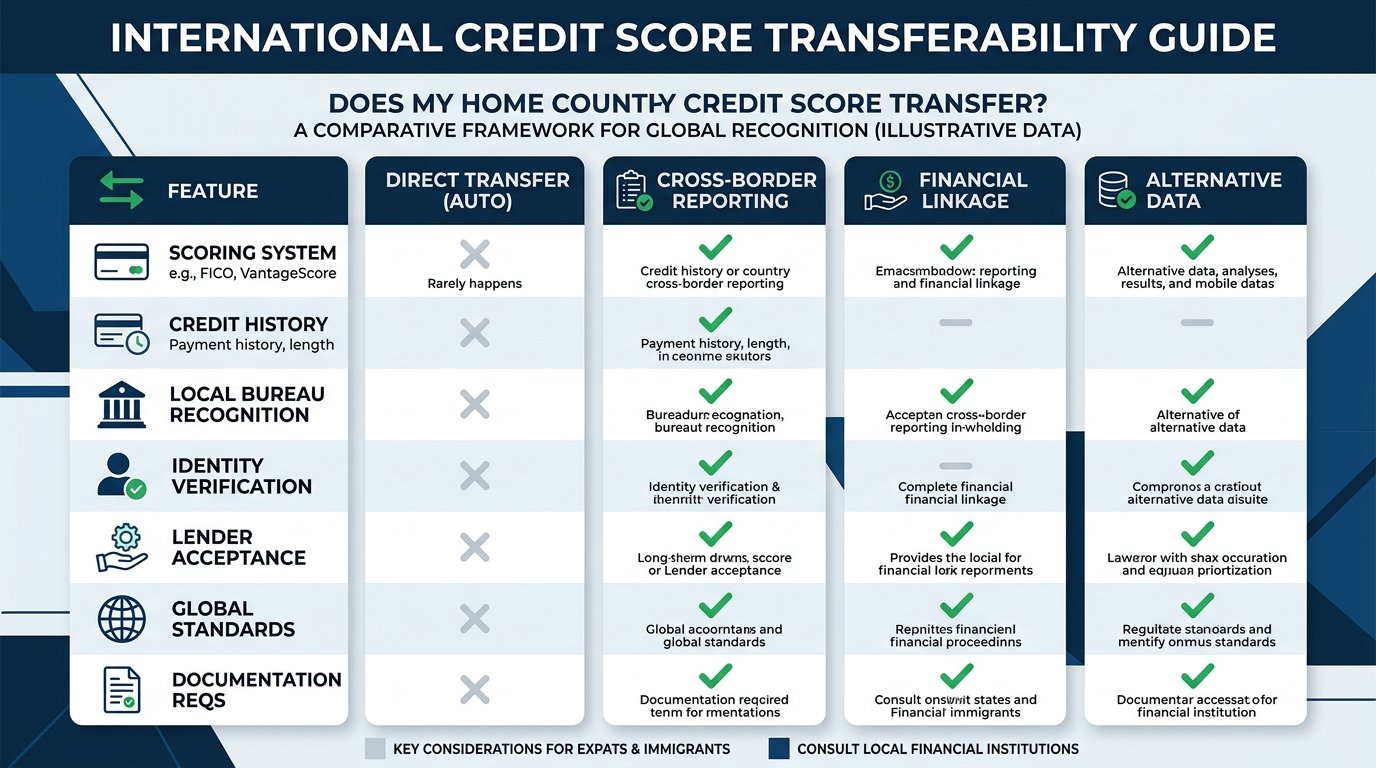
Quick Answer: No — your home country credit score does not transfer to the United States. U.S. credit bureaus (Equifax, Experian, TransUnion) operate independently from foreign credit systems and hold no record of your overseas credit history. As a new arrival, you typically start with no U.S. credit file at all, requiring you to build credit from scratch using U.S.-based products and accounts.
Moving to the United States is a significant financial reset — and for many immigrants, one of the most frustrating discoveries is that a strong credit history built over years or even decades back home counts for nothing here. Whether you arrived from India, Mexico, the Philippines, Nigeria, or the United Kingdom, the U.S. credit reporting system has no mechanism to import or recognise foreign credit data.
The three major U.S. credit bureaus — Equifax, Experian, and TransUnion — each maintain independent databases governed by U.S. law, specifically the Fair Credit Reporting Act (FCRA). As the Consumer Financial Protection Bureau (CFPB) explains, your credit report reflects only credit accounts, payment histories, and public records established within the U.S. system. Foreign creditors do not report to these bureaus, and no international data-sharing framework currently bridges this gap at scale.
This means many newly arrived immigrants join the sizeable population of credit-invisible U.S. adults — those with no scoreable credit file — as described by the CFPB’s research on credit invisibility. Starting without a credit file affects your ability to rent an apartment, qualify for a car loan, or get approved for a credit card at competitive rates.
The good news: the situation is not permanent. With the right strategy — secured cards, credit-builder loans, and responsible account management — immigrants can establish a functional U.S. credit profile within about six months. Before you apply for your first U.S. credit card, it’s worth understanding how credit applications affect your score as a new immigrant, since hard inquiries do carry scoring consequences from the start.
This guide covers exactly why foreign scores don’t transfer, what limited exceptions exist, and the fastest compliant path to building U.S. credit as a newcomer.
1. Does My Home Country Credit Score Transfer for USA Immigrants in 2026: Quick Overview
Your credit history built in India, Mexico, the Philippines, Nigeria, or anywhere else outside the United States does not transfer to the U.S. credit system. When you arrive, the three major U.S. bureaus — Equifax, Experian, and TransUnion — have no record of you. In credit reporting terms, you become what the Consumer Financial Protection Bureau describes as “credit invisible,” a category affecting a meaningful share of U.S. adults, particularly recent immigrants (CFPB, Who Are the Credit Invisible?).
Why the Systems Don’t Communicate
Credit bureaus operate under national regulatory frameworks. U.S. bureaus report under the Fair Credit Reporting Act (as covered earlier in this guide). Foreign bureaus report under their own national laws — for example, the UK’s Credit Reference Agencies operate under the Financial Conduct Authority’s oversight. There is no international treaty, data-sharing agreement, or technical standard connecting these systems. A spotless credit history in your home country carries zero weight in a U.S. underwriting decision.
What This Means in Practice
For a newcomer arriving in 2026, the practical consequences are immediate:
- Apartment applications — landlords running standard tenant screening see a blank file and may demand larger deposits or a co-signer.
- Credit card approvals — most mainstream issuers rely on bureau data. Without a U.S. file, standard unsecured cards are typically unavailable at first.
- Auto financing — dealers quoting rates will price you as a high-risk borrower or decline altogether.
- Smartphone contracts — postpaid plans often involve a soft or hard credit pull; a thin file can push you to prepaid options.
According to USA.gov’s credit reports guidance, your credit report is the foundational document lenders, landlords, and some employers use to assess financial responsibility. Without one, every financial decision costs more or takes longer.
The 2026 Partial Exception: Nova Credit
One narrow exception exists. Nova Credit, a fintech firm, has built cross-border data pipelines with bureaus in a limited set of countries — including India, Mexico, Australia, Canada, and several others. Certain U.S. lenders (American Express and a handful of others) accept Nova Credit’s translated “Credit Passport.” This is not a universal solution: it applies only to participating lenders, only for supported origin countries, and the translated score is not added to your U.S. credit file. It helps with a single application, not with building a U.S. record.
Your Starting Point
Paying every U.S. bill on time, every time, is — according to the CFPB’s credit score guidance — the single highest-impact action for building a strong credit score. That clock starts the moment your first U.S. tradeline opens. The sections that follow explain exactly how to open that first account and build a score efficiently from zero.
2. What Does My Home Country Credit Score Transfer and Why Do Immigrants Need It?
How U.S. Credit Scoring Actually Works
Understanding why your foreign credit history doesn’t transfer requires understanding what U.S. credit scores measure — and who controls that data.
Three private bureaus — Equifax, Experian, and TransUnion — each maintain independent files on U.S. credit activity. They do not receive data feeds from foreign bureaus. Your FICO or VantageScore is computed solely from what these three bureaus have on file about your behavior within the United States.
According to USA.gov, five factors from your credit report affect your credit score: payment history, outstanding balances, length of credit history, applications for new credit, and types of credit accounts. For a newly arrived immigrant, every one of those factors reads as zero or blank — not low, but absent. A blank file is algorithmically treated much like a poor one.
The Practical Stakes for Newcomers
Credit invisibility is not a minor inconvenience. The CFPB documents a meaningful share of U.S. adults who are “credit invisible” — carrying no scoreable file — and immigrants are disproportionately represented in this group. Without a score, lenders treat an application as high-risk by default.
a newcomer with a decade of on-time mortgage payments in India or Brazil arrives in the U.S. and cannot qualify for a basic apartment lease, a car loan at a standard rate, or an unsecured credit card — not because of poor financial behavior, but because no domestic record exists yet.
The downstream costs are real:
- Housing: Landlords run bureau checks. No score often means a larger security deposit or a co-signer requirement.
- Auto financing: Subprime rates apply by default, frequently adding thousands of dollars over the loan term.
- Employment: Certain regulated industries — finance, security, government contracting — include credit checks as part of background screening.
- Utilities: Providers may demand deposits from applicants without a bureau file.
What Your Foreign Score Actually Represents
Your home-country credit file does carry meaningful behavioral data — repayment discipline, debt management, credit utilization habits. The obstacle is not the quality of that data; it’s that U.S. bureaus have no standardized mechanism to ingest it.
Nova Credit (referenced above) bridges this gap for supported countries by translating foreign bureau data into a U.S.-equivalent report that some lenders, including American Express, will accept. Where that pathway is unavailable, the data essentially sits dormant until a U.S. credit profile is independently established.
according to the CFPB, paying bills on time, every time, has the greatest impact on your U.S. credit score once you begin building one — meaning the disciplined habits that built your foreign score will transfer in practice, even if the file itself does not.
3. Eligibility Requirements for Immigrants
Knowing which immigrants can actually access U.S. credit-building tools—and under what conditions—determines how quickly you can establish a functional credit profile after arrival.
Immigration Status and Credit Access
U.S. credit bureaus do not require citizenship to open a credit file. What lenders and bureaus require is a reliable identifying number. Your options:
- Social Security Number (SSN): Available to lawful permanent residents, most work visa holders (H-1B, L-1, O-1, TN, etc.), and certain other visa categories.
- Individual Taxpayer Identification Number (ITIN): Issued by the IRS to individuals who are not eligible for an SSN but have a U.S. tax filing obligation. According to the IRS, an ITIN does not authorize work in the U.S. or provide eligibility for Social Security benefits—but it does allow you to open certain bank accounts and apply for ITIN-accepting credit products. Several credit unions and community banks explicitly accept ITINs for secured card applications.
- Passport + foreign address: Accepted by a small number of fintech lenders as a temporary bridge, though product availability is narrow.
Visa Category Matters More Than You Expect
Lenders apply their own internal overlays beyond bureau eligibility. Common patterns immigrants report:
| Status | Typical Credit Product Access |
|---|---|
| Green Card holder | Full access — treated near-identically to citizens |
| H-1B / L-1 / O-1 | Broad access; some lenders request visa expiry date |
| F-1 / J-1 student | Limited; secured cards and credit-builder products most accessible |
| DACA recipient | Varies by state and lender; ITIN-based products most reliable |
| Undocumented + ITIN | Secured cards, credit-builder loans, ITIN mortgages at select lenders |
Lenders are legally permitted to ask about visa expiration as part of creditworthiness assessment—they want assurance of continued U.S. presence through the loan term.
The Under-21 Rule
If you arrive as a student or young professional under age 21, according to the CFPB, a card issuer can require proof of an independent ability to repay or a co-signer over 21. For newcomers in this group without U.S.-based co-signers, secured cards funded by your own deposit typically bypass this barrier entirely.
Credit-Builder Loans as an Entry Path
For immigrants who cannot yet qualify for unsecured credit, a CFPB study found credit-builder loans can help establish and improve a credit score, particularly for those without existing debt—a profile that describes nearly every recent arrival. Credit unions and Community Development Financial Institutions (CDFIs) are the primary providers; most accept SSNs or ITINs.
Starting Your File: The Practical Threshold
Five factors affect your score according to USA.gov: payment history, outstanding balances, length of credit history, new credit applications, and types of credit accounts. You cannot influence any of these factors until you have an open, reporting account. That means eligibility to open an account—via SSN or ITIN—is the true prerequisite. Once a single account reports to a bureau, your file exists and scoring can begin, typically within one to three billing cycles.
For newcomers who are credit-invisible upon arrival—a population the CFPB identifies as a significant share of U.S. adults—this first reporting account is the critical unlock, regardless of what your home-country history showed.

How Home Country Credit History Compares to U.S. Credit-Building Alternatives
Most newcomers arrive in the U.S. facing the same structural problem: their foreign credit history is invisible to American lenders, yet building a U.S. profile from zero takes time. The table below maps the realistic options available to immigrants across four critical dimensions — how quickly each method starts building your U.S. file, what documentation you need, the cost involved, and which immigration statuses qualify.
Understanding these trade-offs is especially important because five distinct factors shape your U.S. credit score — payment history, current balances, account age, new credit applications, and credit mix — and different strategies address each at different speeds.
| Credit-Building Method | Time to First U.S. Credit Record | Documentation Required | Typical Cost | Immigration Status Eligibility |
|---|---|---|---|---|
| Nova Credit passport transfer | Near-immediate (days) | Foreign credit report + SSN/ITIN | Varies by lender | Varies; currently select countries only |
| Secured credit card | varies by provider — confirm directly | SSN or ITIN | Security deposit (often qualitative; varies by issuer) | Most statuses including ITIN holders |
| Credit-builder loan | varies by provider — confirm directly | SSN or ITIN; income proof | Low fees; interest applies | Most statuses; CDFIs often flexible |
| Authorized user on existing account | Can appear within 1–2 billing cycles | No SSN required in some cases | Potentially free | Any status; depends on primary cardholder |
| Retail/store credit card | varies by provider — confirm directly | SSN or ITIN | Varies; often higher APR | Most lawful statuses |
| Foreign national mortgage programs | Longer-term; months to years | Extensive documentation; large down payment | Significant fees | Primarily visa holders with income history |
A CFPB study found credit-builder loans are particularly effective for people with no existing debt, making them a strong default choice for immigrants starting completely fresh. Whichever path you choose, keeping your credit utilization under roughly 30% of available limits accelerates scoring progress once accounts are open.
Illustrative Scenarios
The following are illustrative scenarios, not real testimonials or case studies of specific individuals.
Illustrative Scenario: Skilled Worker Visa Holder, Relocating for Tech Employment (California)
A visa holder with a strong home-country credit history arrives and finds no U.S. credit file exists — landlords, lenders, and carriers each assess them as entirely new borrowers, regardless of prior financial conduct abroad.
Expert Recommendations: Building U.S. Credit When Your Home Country Score Doesn’t Transfer
Top Pick: Secured Credit Card + Credit-Builder Loan Combination
For most newcomers arriving without a transferable credit history, pairing a secured credit card with a credit-builder loan is the most efficient dual-track strategy available in 2026.
Here’s why this combination outperforms single-product approaches: a secured card immediately gives you a revolving credit account — one of the five factors (alongside payment history, balances, credit history length, and new applications) that shape your U.S. score according to USA.gov. Meanwhile, a credit-builder loan adds an installment account to your file. Research from the CFPB found that credit-builder products are particularly effective at establishing scores for people who have no existing U.S. debt — precisely the situation most immigrants face CFPB study.
Execution priorities:
- Keep your secured card balance well below the general expert guidance of 30% of your available limit to protect your utilization ratio (CFPB)
- Never miss a payment — consistent on-time payment carries the greatest weight of any single scoring factor (CFPB)
- Space out credit applications, since scoring models penalize frequent recent inquiries (CFPB) — a point covered in depth in our guide on whether applying for a credit card hurts your score as a new immigrant
Many Community Development Financial Institutions offer credit-builder loans with minimal documentation requirements — worth prioritizing if you haven’t yet obtained an SSN or are working with an ITIN.
Runner-Up: Nova Credit Passport (Eligible Countries Only)
If you’re arriving from one of Nova Credit’s partner countries (check the current list of supported countries at novacredit.com — the list expands periodically) — the Credit Passport program is worth pursuing before you apply for any U.S. product. Rather than starting from zero, eligible applicants can translate their foreign bureau data for participating U.S. lenders, including American Express.
The limitation is real: Nova Credit’s country coverage remains selective, and lender participation outside Amex is still limited. Treat this as an accelerant, not a replacement for building a U.S. file. Even with a successful Credit Passport application, actively managing your new U.S. accounts remains essential — negative information can linger on a U.S. report for typically up to seven years (CFPB), so early habits matter enormously.
Claim your free weekly reports from AnnualCreditReport.com (FTC) once accounts open — monitoring your file early catches errors fast, and bureaus must investigate disputes within 30 days in most cases (FTC).
FAQ: Does My Home Country Credit Score Transfer to the USA?
Does my foreign credit score automatically appear in the U.S. credit system?
No. Credit bureaus in different countries operate as entirely separate, closed systems with no cross-border data sharing infrastructure. Your credit history built in the Philippines, Nigeria, India, Mexico, or anywhere else does not flow into Equifax, Experian, or TransUnion’s U.S. databases. When you arrive in the United States, you are effectively credit-invisible to American lenders — a situation affecting a meaningful share of U.S. adults, as described by the CFPB here. Your foreign score is not transferred, converted, or even acknowledged by most U.S. lenders.
Which countries have partial credit history transfer arrangements with the USA?
Currently, Nova Credit’s “Credit Passport” program supports a limited set of countries — available in select countries — visit novacredit.com for the current list, which expands regularly — allowing applicants to share a translated foreign credit report with participating U.S. lenders like American Express. Outside these arrangements, no formal bilateral credit data-sharing treaties exist. If your home country is not supported by Nova Credit or a similar service, your foreign history is inaccessible to U.S. lenders regardless of how strong your record was abroad.
What credit score will I have when I first arrive in the USA?
You will typically have no U.S. credit score at all — not a zero, but simply no scoreable file. Scoring models like FICO and VantageScore require a minimum credit history before generating a score. Until you open U.S. credit accounts and establish several months of activity, lenders will treat you as a thin-file or no-file applicant. The five core factors shaping your eventual score — including payment history, balances owed, and length of history — all start from scratch upon U.S. arrival, as outlined by USA.gov.
Can I use my Social Security Number or ITIN to access credit faster?
Having an SSN or Individual Taxpayer Identification Number (ITIN) is necessary for most lenders to open a file with the credit bureaus, but it doesn’t automatically generate a positive score. An SSN simply allows the system to track your new U.S. credit activity going forward. An ITIN, issued by the IRS, serves the same identification function for non-SSN holders. Possessing either identifier is a prerequisite, not an accelerant — your score still builds based on responsible account management over time.
How long does it typically take to build a usable U.S. credit score from zero?
Most newcomers can generate a FICO score within six months of opening their first U.S. credit account. VantageScore, another widely used model, may generate a score sooner. Timeline varies by the scoring model used by your lender. of opening their first U.S. credit account. However, building a score that lenders consider “good” (typically 670 or higher on the FICO scale) depends on your payment history, credit utilization, and account mix. There is no official standard timeline — CFPB and FICO recommend monitoring your progress through free annual credit reports at AnnualCreditReport.com. The single most impactful action you can take during this period is paying every bill on time, every time, as the CFPB identifies on-time payment as the most influential factor in your credit score.
What are the fastest legitimate ways to start building U.S. credit as an immigrant?
Several proven strategies can accelerate credit establishment:
- Secured credit cards — funded by a deposit you control, reported to bureaus monthly
- Credit-builder loans — a CFPB study found these particularly effective for people without existing debt, especially thin-file individuals (CFPB)
- Becoming an authorized user on a trusted person’s established account
- CDFI products — Community Development Financial Institutions often serve newcomers with limited history
Keeping balances well below your credit limit — experts recommend staying under 30% of available credit — also supports faster score growth.
Will applying for multiple credit products hurt my new U.S. credit score?
Yes. Each formal credit application typically triggers a hard inquiry, and the CFPB confirms that scoring models weigh both the recency and frequency of such applications. For newcomers with thin files, the relative impact of each inquiry is proportionally greater than it would be for someone with a long credit history. Apply strategically — space out applications and prioritize products designed for limited-history applicants, such as secured cards or credit-builder products, to minimize unnecessary score drag.
How do I check my U.S. credit report once I’ve started building history?
Once you have at least one open U.S. account, you can access your reports for free. All three major bureaus — Equifax, Experian, and TransUnion — are required to provide one free report weekly through AnnualCreditReport.com, a program made permanent by federal regulators. Review your reports regularly to catch errors early. If you find inaccuracies, the bureau must investigate your dispute within 30 days — or up to 45 days in certain circumstances — per FTC guidance.
How long will negative information affect my U.S. credit report if I make mistakes early on?
Most negative marks — missed payments, collections, charge-offs — remain on your U.S. credit report for up to 7 years, as the CFPB explains. Bankruptcy carries an even longer shadow, potentially staying visible for up to 10 years (CFPB). This asymmetry — where positive history builds slowly but negative history lingers — makes early, careful credit management especially important for newcomers establishing their U.S. financial foundation.
Are there any credit rules that apply specifically because of my age as a newcomer?
If you are under 21, additional restrictions apply to credit card applications regardless of immigration status. Federal rules require applicants under 21 to demonstrate an independent ability to repay, or to have a co-signer aged 21 or older, before a card can be issued — as outlined by the CFPB. Younger newcomers facing this barrier often find credit-builder loans or secured products more accessible starting points, since these typically have less restrictive approval criteria than unsecured credit cards.
Conclusion
Your home country credit score does not transfer to the United States — not automatically, and not in full. What you built abroad stays abroad, at least in the conventional sense. Arriving in the U.S. means starting a credit file from scratch, a reality that affects housing applications, auto financing, phone contracts, and even some employment background checks.
the path forward is more structured than it may first appear. Nova Credit’s Cash Passport program offers a partial bridge for immigrants from a growing list of countries, allowing select lenders to translate foreign credit data into a format U.S. underwriters can use. Beyond that program, secured cards, credit-builder loans, and responsible use of any ITIN-linked products are the practical tools available to most newcomers.
The five factors that shape a U.S. credit score — payment history, outstanding balances, length of credit history, new credit applications, and account mix — are outlined by USA.gov, and each one starts accumulating only once you open U.S.-based accounts. Consistent on-time payments carry the greatest single weight in that calculation, according to the CFPB, making early bill discipline especially important.
Immigration status, visa category, and lender policy each influence which products you can access first. The strategies that work fastest are the ones matched to your specific situation — not a one-size-fits-all approach. Use the free weekly credit reports available at AnnualCreditReport.com to monitor your file from the moment it opens, and dispute any errors promptly within the 30-day investigation window.
Disclaimer
For Informational Purposes Only
The content published on MoneyAbroadGuide.com, including this article, is intended solely for general informational and educational purposes. It does not constitute financial, legal, immigration, or tax advice, and should not be relied upon as such. Readers are strongly encouraged to consult a licensed financial advisor, immigration attorney, or qualified tax professional before making decisions related to credit products, banking, or immigration-related financial matters.
Regulatory Context
Credit reporting in the United States is governed by the Fair Credit Reporting Act (FCRA) and overseen by the Consumer Financial Protection Bureau (CFPB) and the Federal Trade Commission (FTC). Rules, eligibility requirements, and product availability change over time. While we make reasonable efforts to keep information current, MoneyAbroadGuide.com makes no warranty — express or implied — regarding the accuracy, completeness, or timeliness of any content on this site.
Affiliate Disclosure
This article may contain affiliate links or referral arrangements with financial product providers, including credit card issuers, credit-builder platforms, or banking services. If you apply for or purchase a product through such a link, MoneyAbroadGuide.com may receive compensation. This compensation does not influence our editorial recommendations or product coverage. We evaluate products independently based on their relevance and potential benefit to immigrant and newcomer audiences.
About the Author
Talal Eddaouahiri is the founder of MoneyAbroadGuide.com, an independent financial information platform for immigrants and newcomers in the United States and Canada. Originally from Morocco, he settled in the U.S. in 2015 and built his own credit history and banking relationships from scratch in both countries. His background is in retail banking and customer relations, and he draws on that firsthand experience to write independent, source-based guides — citing regulators including the FCAC, FINTRAC, OSFI, CRA, IRS, and CDIC — to help newcomers navigate financial systems with confidence.
Learn more about our Fact-Checking Process and our How We Test when researching this guide.
Last Updated: August 2026

About Talal Eddaouahiri
Founder & Financial Writer at MoneyAbroadGuide.com. A Moroccan immigrant who settled in the United States in 2015, Talal opened bank accounts and built credit from zero in both the US and Canada. His background is in retail banking and customer relations, and he writes independent, source-based guides (FCAC, FINTRAC, OSFI, CRA, IRS, CDIC) to help newcomers navigate their first financial steps. Read his full profile →
Official Sources — Canada