
How to Build US Credit With ITIN: Complete Guide for USA Immigrants (2026)
Quick Answer: Yes, you can build US credit with ITIN, the Individual Taxpayer Identification Number, instead of a Social Security Number. Start with a secured credit card or credit-builder loan, pay every bill on time, and most immigrants can generate a FICO score within six months of opening their first U.S. credit account, provided the account has been open for at least six months and appears on their credit report. VantageScore, another widely used model, may generate a score sooner. Timeline varies by the scoring model used by your lender.
Here is the question that matters: can you build US credit with ITIN alone, and can it actually generate a credit score? The answer is yes — but only if the financial product you use reports to the three major bureaus (Equifax, Experian, TransUnion) under your ITIN. Not all do. Some secured cards report under the account number only. Some credit-builder loans link the account to the SSN of the institution rather than your personal file. The mechanism matters.
An ITIN is a nine-digit number issued by the IRS for tax purposes. It is not a substitute for an SSN in every context, but it is recognized by Equifax and TransUnion as a valid identifier for building a credit file. Experian is more restrictive — which is one reason your score may differ across bureaus in the early months.
This guide explains how the ITIN-to-credit-bureau pipeline actually works, which types of products reliably generate tradelines under your ITIN, and the realistic timeline from zero to a scoreable file — including what FICO and VantageScore each require before they can produce a number at all.
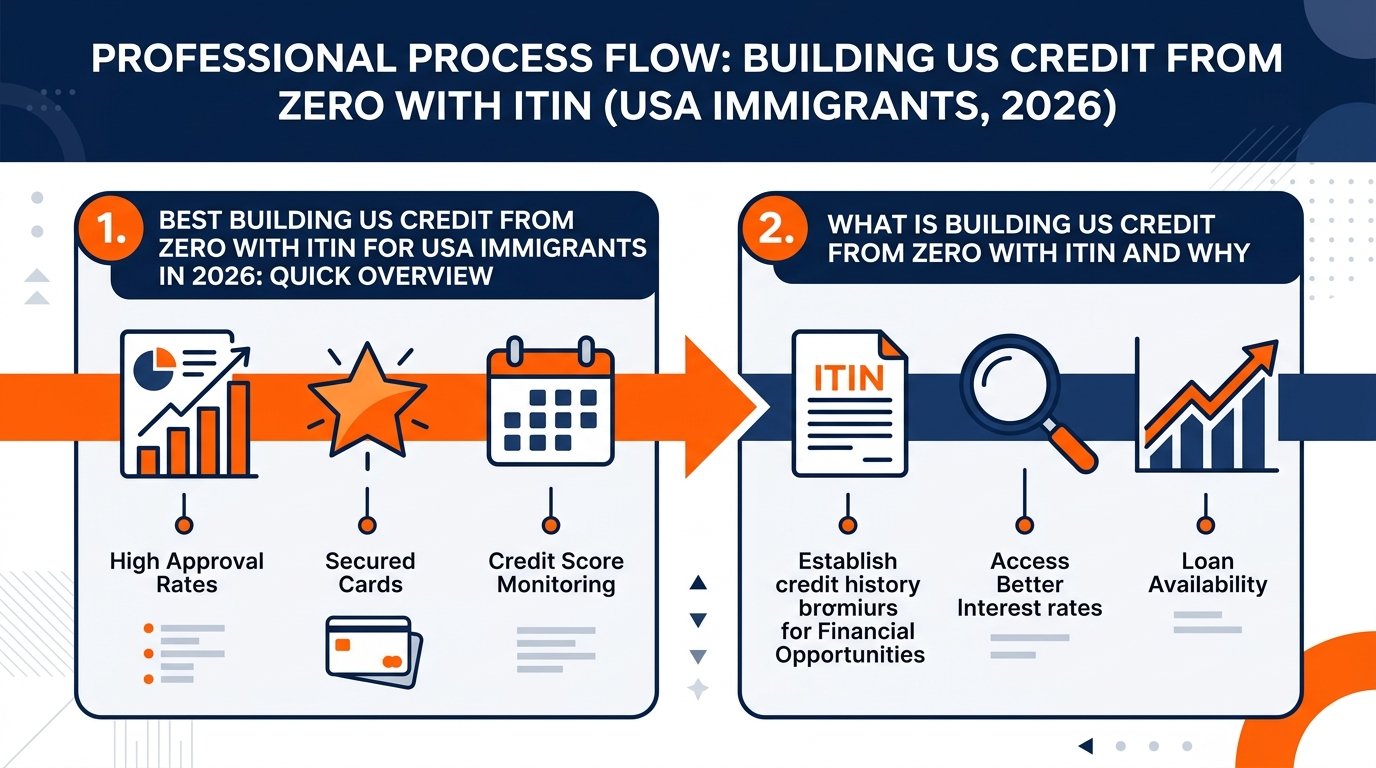
1. How to Build US Credit With ITIN in 2026: Quick Overview
Starting a credit file without a Social Security Number places millions of newcomers among what the CFPB describes as the “credit invisible” population — adults whose thin or nonexistent credit histories make mainstream financial products effectively inaccessible. The good news: ITIN holders have a clear, legally recognized path to a scoreable credit profile.
Why 2026 Is a Pivotal Year
Lender acceptance of ITIN-based applications has expanded materially since 2022. A growing number of credit unions, community development financial institutions (CDFIs), and fintech lenders now explicitly underwrite secured cards, credit-builder loans, and even entry-level auto financing using ITIN in place of SSN. Regulatory clarity from the Consumer Financial Protection Bureau on non-discriminatory credit access has accelerated this shift.
The Core Stack to Build US Credit With ITIN
Three instruments form the foundation that most licensed credit counselors recommend for ITIN holders starting from zero:
- Secured credit card — your own deposit secures the credit line; responsible use is reported to the major bureaus
- Credit-builder loan — according to CFPB research, these products are especially effective for people without existing debt, helping both establish and improve a credit score
- Becoming an authorized user — a trusted family member or employer adds you to an existing account, transferring some of their credit history to your file
a newly arrived immigrant with an ITIN but no prior US credit history might open a secured card in month one, add a credit-builder loan in month three, and reach a scoreable file well within a year —assuming consistent on-time payments throughout.
The Single Most Important Variable
According to the CFPB, paying bills on time, every time, carries the greatest impact on your credit score. Everything else — utilization, account mix, inquiry management — is secondary. Newcomers who automate minimum payments from day one sidestep the most common early credit mistake.
What This Guide Covers
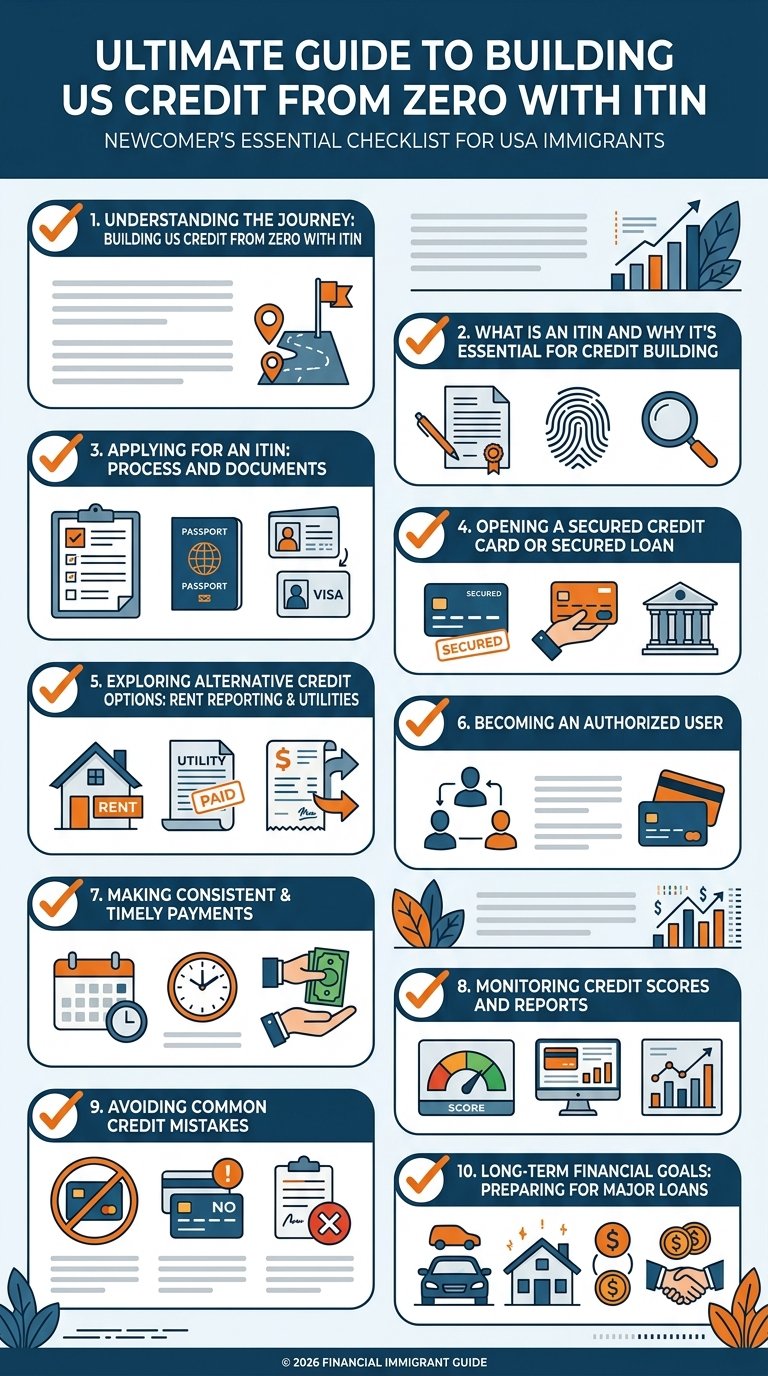
The sections that follow address every decision point in sequence:
- Which ITIN-accepting issuers and lenders are available in 2026
- How to structure accounts to maximize score velocity
- Credit utilization targets, hard inquiry strategy, and dispute rights
- How to monitor your file using free weekly credit reports from AnnualCreditReport.com
The five factors that shape your score — payment history, outstanding balances, length of credit history, new credit applications, and types of credit accounts — are identified by USA.gov without a fixed percentage weighting, which means no single shortcut dominates; consistent, multi-instrument behavior is the proven strategy.
Immigrants who follow the structured approach outlined in this guide typically achieve a scoreable, lender-visible credit profile faster than those who open accounts reactively and without a strategy.
2. What Is Building US Credit From Zero With ITIN and Why Do Immigrants Need It?
The Structural Problem ITIN Holders Face
Most immigrants arrive in the United States financially capable — they hold savings, overseas credit histories, and stable employment — yet they are effectively invisible to American lenders. According to the CFPB’s research on credit-invisible consumers, a significant share of US adults lack a scoreable credit file, and recent immigrants account for a disproportionate portion of that group. Without a domestic credit file, landlords reject applications, auto lenders demand large cash deposits, and employer background checks can raise flags — regardless of actual financial responsibility.
Building US credit from zero with an ITIN means deliberately constructing a domestic credit file using an Individual Taxpayer Identification Number as the identifier, rather than waiting for an SSN. It is the structured process of opening accounts that report to Equifax, Experian, and TransUnion, then managing those accounts in ways that satisfy the scoring algorithms used by FICO and VantageScore.
Why the Scoring System Requires Active Management
According to USA.gov, five factors drawn from your credit report determine your credit score: payment history, outstanding balances, length of credit history, applications for new credit, and types of credit accounts. None operates passively. Every factor requires deliberate action — opening the right account types, paying on schedule, and managing balances carefully.
The CFPB confirms that paying bills on time, every time, carries the greatest individual impact on your score. For an immigrant starting from zero, this means a single missed payment in the first year carries outsized damage precisely because the file is thin and there is no long positive history to absorb it.
a newcomer who opens a secured card and pays the full statement balance every month will begin generating positive payment history immediately — whereas an identical newcomer who opens the same card but carries a balance above 30% of the credit limit will see scoring benefits partially offset by utilization penalties, per CFPB guidance on keeping credit use below 30% of total limit.
Why Immigrants Cannot Simply Import Foreign Credit
No bilateral data-sharing treaty exists between US credit bureaus and foreign bureaus in countries such as Mexico, India, the Philippines, or Nigeria. A decade of spotless credit history with HSBC UK or Scotiabank Mexico is legally irrelevant to a US lender pulling a TransUnion report. Some banks have implemented internal programs to recognize international credit for existing customers, but these are discretionary exceptions — not a reliable substitute for building a domestic file from scratch.
The Long-Term Cost of Delaying
Negative information, once it enters a credit file, remains for up to 7 years according to the CFPB, and bankruptcy for up to 10 years. Immigrants who delay credit-building and instead rely on high-cost alternatives — payday loans, rent-to-own contracts, or predatory installment lenders — risk entering the credit system with derogatory marks already attached, creating a hole that takes years to exit. Starting with ITIN-accessible, bureau-reporting products from day one avoids that trap entirely.
3. Eligibility Requirements for Immigrants
Eligibility for ITIN-based credit products is broader than many newcomers assume — but specific conditions apply depending on immigration status, age, and product type.
Who Qualifies to Build Credit With an ITIN
The ITIN itself does not restrict credit access by immigration category. Undocumented immigrants, DACA recipients, visa holders (F-1, H-1B, L-1, O-1), permanent residents awaiting their SSN, and treaty aliens can all obtain credit products using an ITIN as the primary identifier. What lenders actually evaluate is the combination of:
- A valid, unexpired ITIN issued by the IRS
- A verifiable U.S. address (P.O. boxes are typically rejected)
- Proof of income or ability to repay — pay stubs, tax returns, or bank statements
- Age of majority — applicants must be 21 or older, or demonstrate independent income, to obtain a credit card; according to the CFPB, applicants under 21 require either an independent ability to pay or a co-signer over 21
A useful illustration: a newcomer on an F-1 student visa with campus employment income and a valid ITIN can apply for a secured credit card immediately — no SSN, no permanent residency required.
Product-Specific Eligibility Thresholds
Different credit-building instruments carry different eligibility gates:
Secured credit cards: Most ITIN-accepting issuers (several community banks and credit unions) require a refundable deposit and proof of income. No minimum credit score is required when starting from zero, but some issuers run a hard inquiry that will impact your score — worth confirming before applying.
Credit-builder loans: These are specifically designed for thin-file or no-file applicants. A CFPB study found credit-builder loans help establish and improve credit scores, particularly for people without existing debt — making them well-suited to ITIN holders arriving with no U.S. credit history. Many credit unions offer these without an SSN requirement.
Retail and store cards: Approval criteria vary widely. Some do not accept ITINs; others do but report only to one bureau. Confirm bureau reporting before applying.
Authorized user status: No ITIN or SSN required on the authorized user’s part — the primary cardholder assumes legal liability. This remains one of the fastest eligibility-free entry points for immigrants.
What Disqualifies an Application
Several factors commonly trigger denials unrelated to immigration status:
- ITIN expired and not renewed (IRS ITINs issued before 2013 require renewal)
- No U.S. banking relationship to verify identity
- Income below the issuer’s internal minimum
- Recent address instability —multiple moves within raises lender fraud flags
Many immigrants described as “credit invisible” by the CFPB — a significant share of the U.S. adult population with no scoreable credit file — fall into this category not because of ineligibility, but because no one explained which products accept their documentation. Meeting baseline eligibility is step one; the strategic sequencing of products is covered in the sections ahead.

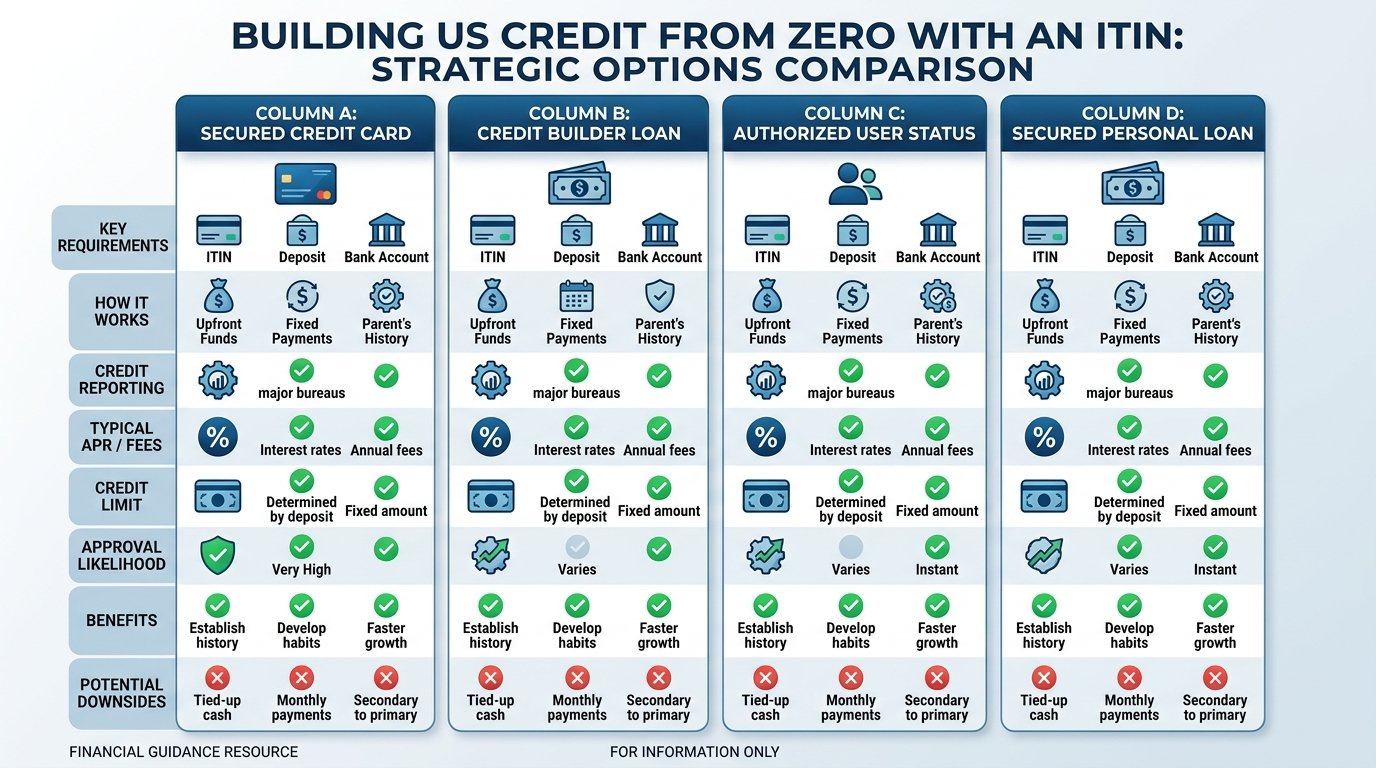
Comparing Credit-Building Methods for ITIN Holders
Choosing the right entry point matters when you have no U.S. credit history. The table below evaluates four primary strategies across dimensions that directly affect how quickly and safely an ITIN holder can establish a scoreable profile. Because several factors shape your score — including payment history, outstanding balances, account age, new applications, and credit mix — the ideal approach stacks multiple methods rather than relying on one.
Timing is equally important: hard inquiries from new credit applications influence your score, so sequencing your applications thoughtfully reduces unnecessary score drag during the critical first year.
| Dimension | Secured Credit Card | Credit-Builder Loan | Becoming an Authorized User | ITIN-Friendly Unsecured Card |
|---|---|---|---|---|
| ITIN Accepted | Widely, varies by issuer | Yes, via credit unions and CDFIs | Yes — primary cardholder applies | Limited issuers; typically requires prior U.S. banking relationship |
| Upfront Cost | Security deposit required (amount varies by issuer) | Typically low monthly payments held in escrow | None | None, though some charge annual fees |
| Time to First Score | varies by provider — confirm directly | CFPB research indicates credit-builder loans are particularly effective for those with no existing debt; scoring typically begins within a few months | Depends on primary holder’s account age and standing | Similar to secured card timeline |
| Credit Mix Benefit | Adds revolving credit | Adds installment credit | Adds revolving credit (reflected on your report) | Adds revolving credit |
| Utilization Control | Full control; keep usage well under one-third of your limit | Not applicable — installment product | Dependent on primary holder’s spending behaviour | Full control |
| Risk of Negative Impact | Missed payments; on-time payment is the single most influential scoring factor | Same payment-history risk applies | Primary holder’s late payments appear on your report | Same as secured card |
| Upgrade Path | Many issuers convert to unsecured after demonstrated history | Funds released at loan term end; improves savings simultaneously | No direct upgrade — must open independent account next | May increase limit over time |
Monitor your progress weekly using the free reports available at AnnualCreditReport.com from all three major bureaus at no cost.
Illustrative Scenarios
The following are illustrative scenarios, not real testimonials or case studies of specific individuals.
Illustrative Scenario: Temporary Work Visa Holder, Technology Sector (California)
A visa holder obtains an ITIN, opens a secured card with a modest deposit, and adds a credit-builder loan. Consistent on-time payments across both accounts establish a payment history and diversify account types within several months.
Expert Recommendation
Top Pick: Secured Credit Card (ITIN-Accepting Issuer)
For most ITIN holders starting from zero, a secured credit card from an issuer that explicitly accepts ITIN applications remains the strongest first move. Here is why it outperforms alternatives at the starting line.
A secured card establishes a revolving credit account — one of the five factors that influence your score (USA.gov) — while giving you direct, monthly control over the two variables that matter most: on-time payment and utilization. Paying on time, every time carries the greatest single impact on your score (CFPB), and a secured card makes that habit straightforward to execute. Keep your monthly balance well below the commonly cited ceiling of no more than 30% of your available limit (CFPB) and the card becomes a predictable score-building engine.
Practical note: apply selectively. Each application triggers a hard inquiry, and scoring models weigh both timing and frequency of those applications (CFPB). Research ITIN-friendly issuers thoroughly before submitting a single form — one well-chosen card beats three hasty applications.
Once you have roughly six months of on-time history, check your report weekly at no cost via AnnualCreditReport.com (FTC) to confirm the account is reporting correctly. Dispute any errors promptly; bureaus are required to investigate within 30 days, or up to 45 days in certain circumstances (FTC).
Runner-Up: Credit-Builder Loan
If a secured card deposit is not immediately accessible, a credit-builder loan offered by a credit union or community bank is a sound alternative. Research from the CFPB indicates these products can meaningfully help establish and improve a score, particularly for people carrying no existing debt (CFPB). The mechanics differ from a card — you make fixed monthly payments that are reported to the bureaus, and you receive the funds at the end — but the credit-building outcome is comparable.
The runner-up label reflects one practical limitation: credit-builder loans add an installment account but not a revolving account. Since scoring models reward holding multiple account types (USA.gov), combining a credit-builder loan with a secured card eventually produces a stronger profile than either product alone. Start with whichever is accessible first, then layer in the other once your budget allows.
Bottom line: Begin with an ITIN-accepting secured card if you can fund the deposit. Add a credit-builder loan once your cash flow permits. That two-product stack addresses payment history, utilization discipline, and account diversity — the core variables you can actually control.
Frequently Asked Questions: Building US Credit From Zero With an ITIN
Can I build a US credit history without a Social Security Number?
Yes. An ITIN (Individual Taxpayer Identification Number) is accepted by many lenders, credit unions, and secured card issuers as a valid identifier for credit applications. While an SSN remains the standard, a growing number of financial institutions — particularly community banks and credit unions — have expanded ITIN-based lending programs to serve immigrant communities. Your credit file at Equifax, Experian, and TransUnion is indexed by name, address, and date of birth, not exclusively by SSN, meaning ITIN holders can establish and grow a legitimate credit profile through consistent, responsible account management.
Which credit factors matter most when starting from zero?
Five elements drawn from your credit report shape your score: payment history, outstanding balances, length of credit history, new credit applications, and the mix of account types — as outlined by USA.gov. For ITIN holders building from scratch, consistent on-time payments carry the heaviest practical weight; the CFPB confirms that paying every bill on time, without exception, has the greatest single impact on your score. Prioritize payment reliability before optimizing any other variable.
How do I monitor my credit file once accounts appear?
You are entitled to a free weekly credit report from each of the three major bureaus through AnnualCreditReport.com — a program the FTC confirms has been made permanent. Pull reports on a rotating schedule — one bureau per month — so you maintain continuous visibility at no cost. Check that your ITIN is correctly associated with your file and that no unauthorized accounts have appeared. Early detection of errors or fraud is especially important for new credit files, where a single incorrect entry represents a disproportionately large share of your thin history.
What is a credit-builder loan and should ITIN holders use one?
A credit-builder loan holds borrowed funds in a locked savings account while you make fixed monthly payments; the lender releases the balance once the loan is repaid. CFPB research indicates these products are particularly effective at establishing and improving scores for people who carry no existing debt — a profile that fits most ITIN holders precisely. Many credit unions and community development financial institutions (CDFIs) offer credit-builder loans to ITIN holders without requiring an SSN. The loan amount is typically modest, but the payment history generated can meaningfully accelerate profile development.
What happens if there are errors on my credit report?
Dispute errors directly with the reporting bureau in writing. Under federal law, the bureau must complete its investigation — typically within 30 days, though the FTC notes this window can extend to 45 days under certain conditions. For ITIN holders, common errors include name mismatches, duplicate files, or accounts linked to incorrect identification numbers. Submit your dispute with supporting documentation — a copy of your ITIN letter, a government-issued ID, and proof of address. If the bureau does not resolve the issue satisfactorily, you can escalate a complaint to the CFPB at consumerfinance.gov.
How long does negative information affect my ITIN-linked credit file?
Most negative entries — missed payments, collections, charge-offs — remain visible on your report for up to seven years, per CFPB guidance. Bankruptcy carries a longer shadow: it can remain on record for as long as ten years. Because ITIN holders are building from a thin file, avoiding negative marks early is critical — a single late payment on a young account inflicts proportionally more damage than it would on a mature, diversified profile. Prevention is considerably less costly than remediation.
How should I manage credit utilization on a secured card?
The CFPB advises keeping balances below 30% of your available credit limit to support a healthy score. In practice, staying below that threshold — and paying the statement balance in full each month — demonstrates responsible usage while avoiding interest charges. On a secured card with a lower credit limit, even modest purchases can push utilization high quickly, so tracking your balance relative to your limit on a weekly basis is a practical habit. Requesting a credit limit increase after demonstrating consistent payment history is one way to create more headroom within the same spending pattern.
Does applying for multiple credit products at once hurt my score?
Yes. Each application that triggers a lender’s formal review generates a hard inquiry, and the CFPB confirms that scoring models factor in both the recency and frequency of credit applications when calculating your score. For ITIN holders with thin files, multiple hard inquiries in a short window signal elevated risk and can suppress an already-fragile score. A sequenced approach — one product, managed well for several months, before adding the next — builds history more effectively than applying for several accounts simultaneously in the hope that one will be approved.
Are there age restrictions on credit card applications that ITIN holders should know?
Federal consumer protection rules apply regardless of immigration status or identification type. The CFPB notes that applicants under age 21 must demonstrate an independent ability to repay, or alternatively secure a co-signer who is over 21, before a card issuer may extend credit. For younger ITIN holders — including certain international students or DACA recipients — this rule limits solo applications. A co-signer with an established US credit history can help, but that individual assumes full liability if payments lapse, so the arrangement requires clear communication and reliable follow-through.
Why do some immigrants remain “credit invisible” even after years in the US?
A meaningful share of US adults lack any scoreable credit record — the CFPB has documented this population and the structural barriers that keep them outside the credit system. ITIN holders face compounding barriers: limited access to mainstream bank products, lender unfamiliarity with ITIN-based underwriting, and the absence of any mechanism to import creditworthiness established abroad. Without deliberate action — opening at least one reporting account and maintaining it responsibly — years of financial activity leave no trace in the US scoring system. Credit invisibility is not a permanent condition, but it requires intentional steps rather than passive participation in the economy.
Conclusion
Building U.S. credit from zero with an ITIN is not a workaround — it is a legitimate, fully recognized path that millions of immigrants have used to establish financial standing in the United States. The strategy is straightforward: start with the tools available to ITIN holders, stay consistent, and protect the profile you build.
The five factors that shape your score — payment history, outstanding balances, length of credit history, new credit applications, and types of credit — are all within your control over time (USA.gov). Of these, nothing moves the needle more reliably than paying every obligation on schedule (CFPB). Keep balances well under the commonly recommended ceiling of no more than 30% of available credit (CFPB), apply for new accounts selectively to limit hard inquiries that scoring models weigh against you (CFPB), and monitor your profile weekly using the free reports available at AnnualCreditReport.com (FTC).
Errors happen. If you find one, federal rules require the bureau to complete its investigation within 30 days in most cases (FTC). Act immediately rather than waiting.
Negative marks — missed payments, collections — can linger for up to seven years (CFPB). The most powerful protection is prevention: build the habits now, before a single derogatory entry can slow you down.
Your timeline to a functional credit profile is measured in months, not years. Start today.
Disclaimer
For Informational Purposes Only. The content on MoneyAbroadGuide.com is provided for general educational purposes and does not constitute financial, legal, tax, or immigration advice. Credit products, eligibility criteria, interest rates, and lender policies change frequently; always verify current terms directly with the relevant financial institution or a licensed professional before making any financial decision.
No Professional-Client Relationship. Reading this article does not create an advisor-client, attorney-client, or any other professional relationship between you and MoneyAbroadGuide.com or its editorial team.
Regulatory References. Links to government sources — including the Consumer Financial Protection Bureau (CFPB), Federal Trade Commission (FTC), and USA.gov — are provided for reader verification. MoneyAbroadGuide.com has no affiliation with these agencies and does not represent that all information remains current at the time of reading.
Affiliate Disclosure. This article may contain affiliate links or referral arrangements with financial product providers. MoneyAbroadGuide.com may receive compensation if you apply for or open an account through a link on this page. This compensation does not influence our editorial recommendations; products are evaluated independently based on features relevant to ITIN holders and immigrants.
Accuracy. We make reasonable efforts to ensure accuracy as of the publication date (2026). We accept no liability for decisions made based on this content.
About the Author
Talal Eddaouahiri is the founder of MoneyAbroadGuide.com, an independent financial information platform for immigrants and newcomers in the United States and Canada. Originally from Morocco, he settled in the U.S. in 2015 and built his own credit history and banking relationships from scratch in both countries. His background is in retail banking and customer relations, and he draws on that firsthand experience to write independent, source-based guides — citing regulators including the FCAC, FINTRAC, OSFI, CRA, IRS, and CDIC — to help newcomers navigate financial systems with confidence.
Learn more about our Fact-Checking Process and our How We Test when researching this guide.
Last Updated: July 2026

About Talal Eddaouahiri
Founder & Financial Writer at MoneyAbroadGuide.com. A Moroccan immigrant who settled in the United States in 2015, Talal opened bank accounts and built credit from zero in both the US and Canada. His background is in retail banking and customer relations, and he writes independent, source-based guides (FCAC, FINTRAC, OSFI, CRA, IRS, CDIC) to help newcomers navigate their first financial steps. Read his full profile →