
💡 Pro Tip
Set up automatic minimum payments the day your card is activated. A single missed payment can set back a new credit file by months, and automation removes the risk entirely while you settle in.
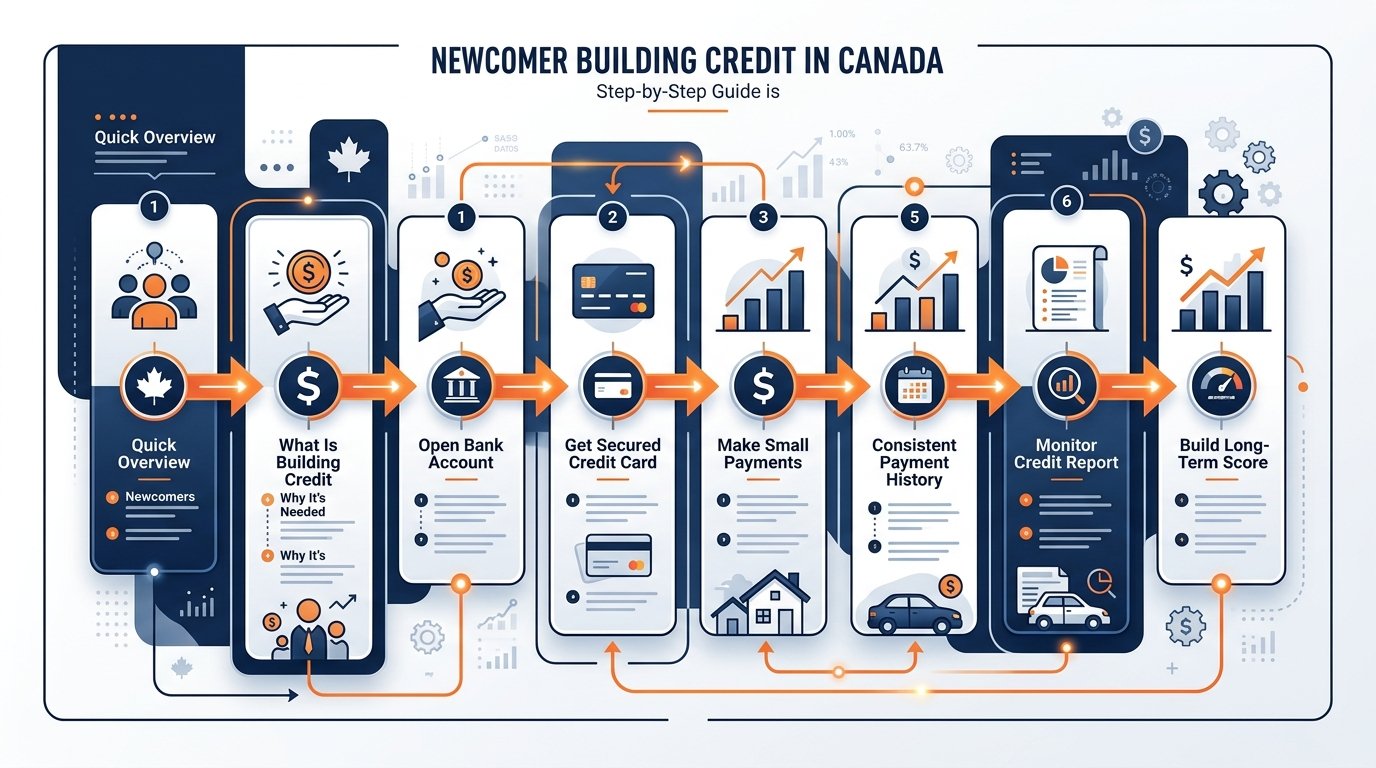
Quick Answer: Newcomers can build credit in Canada from zero by opening a bank account, applying for a secured credit card or newcomer credit card, becoming an authorized user, and making consistent on-time payments. Most immigrants establish a fair credit score (650+) within 6–12 months using these strategies.
Starting from financial zero is one of the most common — and most frustrating — challenges immigrants and newcomers face in Canada. Even if you held an excellent credit score in your home country, Canada’s credit bureaus — Equifax Canada and TransUnion Canada — have no access to your foreign credit history. Under the framework overseen by the Financial Consumer Agency of Canada (FCAC), your Canadian credit file begins completely blank the moment you arrive.
This matters more than many newcomers initially realize. Canadian landlords, employers, lenders, and even cell phone providers routinely check credit scores before making decisions. According to the FCAC, a strong credit history directly affects your ability to rent an apartment, qualify for a mortgage, and access affordable loan rates — all critical milestones in your settlement journey.
The good news: building credit from scratch is entirely achievable, and Canada’s regulatory environment — governed in part by the Office of the Superintendent of Financial Institutions (OSFI) and federal consumer protection legislation — creates a transparent, structured system that works in your favour once you understand the rules.
Whether you arrived as a permanent resident, a protected person under the Immigration, Refugees and Citizenship Canada (IRCC) framework, a temporary foreign worker, or an international student, the credit-building pathway is largely the same — and it starts faster than most people expect.
This guide covers every proven strategy, from secured cards to credit-builder loans, with specific timelines, costs, and regulatory context pulled from sources including the Canada Revenue Agency (CRA), which intersects with your financial identity through your Social Insurance Number (SIN) — the foundational document for your Canadian financial life.
Before diving in, two essential reads to complement this guide:
- Best Bank Account for Newcomers to Canada — your first practical step before any credit product
- How to Build Credit in Canada as a Newcomer — a focused deep-dive on credit-building tactics
Let’s build your Canadian financial foundation — from zero, strategically.
⚠️ Warning
Avoid applying for several credit products at once. Each application can trigger a hard inquiry, and a cluster of hard inquiries early on can lower a thin, new credit file. Space out applications and apply only for products you are likely to qualify for.
🔑 Key Takeaways
- Your foreign credit history does not transfer: Equifax Canada and TransUnion Canada start your file from zero when you arrive.
- The fastest starting points are a secured credit card or a newcomer credit card — both can report to the bureaus without any Canadian credit history.
- Most newcomers reach a “fair” score (around 650+) within 6–12 months of consistent, on-time payments.
- Keeping your credit utilization low is the single most controllable factor in how fast your score grows.
- A credit-builder loan or becoming an authorized user can add a second tradeline and diversify your credit mix.
- You generally need photo ID, a SIN (temporary SINs starting with 9 are accepted), proof of address and income documentation to get started.
📌 Important
Your credit score in Canada is built only from activity reported to Equifax Canada and TransUnion Canada. Paying a bill that is not reported to a bureau — many rent or utility payments, for example — does not automatically build your credit file.
📘 Free Newcomer Money Guide
New to Canada? Our free guide walks you through banking, credit, taxes and settlement — step by step, in one PDF.
1. Best How Newcomers Build Credit In Canada From Zero: Quick Overview
Affiliate disclosure: We earn a commission at no cost to you.
No affiliate opportunities detected – add mentions of recommended services: Learn More
Very few affiliate blocks added – consider adding more service comparisons: Learn More
Categories not covered: [‘money_transfer’, ‘banking’, ‘fintech’, ‘insurance’] – consider adding content about these: Learn More
Canada’s credit system rewards patience and strategy — but newcomers who understand the mechanics from day one can compress years of credit-building into months.
What Credit Bureaus Actually Measure
Equifax Canada and TransUnion Canada score you across five weighted factors. Payment history carries the heaviest influence at roughly 35%, followed by credit utilization (30%), length of credit history (15%), credit mix (10%), and new inquiries (10%), according to FCAC’s published scoring methodology. Arriving without Canadian history means you start at zero — not bad credit, but invisible credit — a critical distinction that affects which products you can access.
The Newcomer Credit Stack: Three Layers
Experienced settlement advisors recommend building credit in three simultaneous layers rather than one product at a time:
Layer 1 — Secured Foundation A secured credit card remains the entry point for most newcomers. You deposit collateral ($200–$500 typically) with the issuing institution. The card reports monthly to both bureaus, converting your deposit into payment history. Choose an issuer that explicitly confirms dual-bureau reporting — not all do.
Layer 2 — Installment Credit Revolving credit (cards) alone produces a thinner credit profile. Adding an installment product — a credit-builder loan, RRSP loan, or even a financed device plan — introduces the “credit mix” factor. OSFI-regulated institutions offering credit-builder loans specifically structure repayments to maximize positive bureau reporting, with terms typically ranging from 6 to 24 months.
Layer 3 — Authorized User or Co-Signer Position If a trusted family member or spouse already holds Canadian credit, becoming an authorized user on their account immediately ages your profile. This layer costs nothing but requires a relationship of trust. The primary cardholder’s history partially transfers to your bureau file.
Newcomer-Specific Programs You Should Know
Several Schedule I banks operate dedicated newcomer banking programs that bundle the Best Bank Account with unsecured or partially secured credit cards — reducing the barrier to Layer 1 credit. These programs, governed under the Bank Act, allow credit issuance based on immigration status documentation (PR card, study permit, work permit) rather than Canadian credit history alone.
The Immigrant Investor and New to Canada programs at major banks — RBC Newcomer Advantage, TD New to Canada, BMO NewStart — each include credit card eligibility within 30–90 days of account opening, with credit limits typically between $500 and $1,500 in the first year.
Credit Utilization: The Most Controllable Factor
Keeping utilization below 30% of your available limit signals responsible behaviour to scoring models. Practically: if your secured card limit is $500, carry no more than $150 in reported balances at statement close. Paying in full monthly eliminates interest while keeping utilization low — a critical discipline many newcomers overlook.
Timeline Expectations
| Milestone | Typical Timeline |
|---|---|
| Credit file opens | First reporting cycle (30–45 days post-card activation) |
| Scores generated by bureaus | After 3–6 months of history |
| “Fair” score range (620–659) | 6–9 months with no missed payments |
| “Good” score range (660–724) | 9–18 months with optimized utilization |
| “Very Good” (725+) | 18–36 months with diversified credit mix |
Provincial Variations Worth Noting
Quebec residents interact with the same federal bureaus, but provincial consumer protection under the Consumer Protection Act (CQLR c P-40.1) grants stricter rights around credit file disputes — a practical advantage if bureau errors appear during your file’s early months.
The Single Highest-Impact Action
Data from FCAC’s financial literacy surveys consistently shows that newcomers who set up automatic minimum payments — even while planning to pay in full — eliminate the single largest risk to early credit scores: an accidental missed payment due to banking transitions or unfamiliar statement cycles.
2. What Is “Building Credit From Zero” and Why Do Immigrants Need It?
The Credit Invisibility Problem
When you arrive in Canada, your financial history doesn’t travel with you. Credit bureaus Equifax Canada and TransUnion Canada maintain entirely separate databases from international reporting agencies — meaning a flawless 20-year credit record in India, Mexico, the Philippines, or Nigeria registers as zero in the Canadian system.
This condition has a technical name: credit invisibility. According to the Financial Consumer Agency of Canada (FCAC), an estimated 1 in 4 newcomers encounters significant credit access barriers within their first year of arrival. Lenders interpret a blank file not as neutral, but as high-risk.
What a Credit File Actually Is
A credit file is a continuously updated ledger held by Equifax Canada and TransUnion Canada. It records:
- Trade lines — every credit account you open (cards, loans, lines of credit), including open date, credit limit, balance, and payment history
- Inquiries — hard pulls from lenders when you apply for credit; soft pulls from background checks
- Public records — collections, judgments, consumer proposals (governed under the Bankruptcy and Insolvency Act, R.S.C. 1985, c. B-3)
- Account age and mix — the depth and diversity of your borrowing history
A credit score is a three-digit number (300–900 in Canada) computed algorithmically from that file. Lenders use it as a proxy for repayment risk. No file means no score; no score means most standard financial products are unavailable at competitive terms.
Why Immigrants Face a Structurally Harder Path
Permanent residents, protected persons under the Immigration and Refugee Protection Act (IRCC), and temporary residents on work or study permits all begin at the same starting point: no Canadian credit history. The challenge is structural, not personal.
Landlords run credit checks before approving rental applications. Cellphone carriers require credit approval for postpaid plans. Employers in certain regulated sectors conduct credit screening as part of background checks. Insurance underwriters use credit-based scoring models where provincial law permits. The downstream effects of credit invisibility extend well beyond borrowing money.
Newcomers also report practical friction at the product level: standard unsecured credit cards require a credit history to approve, yet you cannot build a credit history without a credit card. This circular dependency is the core problem that programs like RBC Newcomer Advantage and TD’s newcomer-specific offerings — referred to above — are specifically designed to break.
What “Building From Zero” Actually Means
Building credit from zero is the deliberate, sequenced process of:
- Creating a file — opening at least one reporting account so bureaus generate a file under your Social Insurance Number (SIN)
- Establishing a score — most scoring models require at least one trade line with six months of history before producing a usable score
- Strengthening the file — adding account diversity, maintaining low utilization, and extending average account age over time
The FCAC distinguishes between thin-file consumers (one to four trade lines) and established-file consumers. Newcomers typically enter as thin-file and must systematically add depth.
The Regulatory Framework Governing Your Rights
Under the Personal Information Protection and Electronic Documents Act (PIPEDA, S.C. 2000, c. 5), you have the right to access your credit file for free at any time. Equifax Canada and TransUnion Canada are both regulated as credit reporting agencies under applicable provincial statutes — including Ontario’s Consumer Reporting Act (R.S.O. 1990, c. C.33) and Quebec’s Act Respecting the Protection of Personal Information in the Private Sector (CQLR, c. P-39.1, referenced above). These statutes define dispute rights, maximum reporting periods (generally seven years for most negative items), and accuracy obligations — protections that apply to you regardless of immigration status.
Understanding this framework isn’t academic. Knowing your rights accelerates error correction, which directly protects the file you’re working to build.
3. Eligibility Requirements for Immigrants
Canada’s credit system is broadly accessible to newcomers, but eligibility thresholds vary by immigration status, documentation, and residency duration. Understanding exactly where you qualify prevents wasted applications and unnecessary hard inquiries.
Immigration Status and Credit Access
Most Canadian lenders assess eligibility based on your legal right to remain in Canada rather than citizenship. The following statuses generally qualify for standard credit products:
- Permanent Residents (PRs): Full access to all credit products from day one of landing. PRs present their Confirmation of Permanent Residence (COPR) or PR card as primary identification.
- Temporary Foreign Workers (TFWs): Eligible with a valid work permit. Lenders typically require a work permit with a remaining validity of at least 12 months beyond the credit term. A short-duration permit significantly narrows product options.
- International Students: Eligible for student-specific credit cards and limited secured products. Study permit expiry date heavily influences approved credit limits and term lengths.
- Convention Refugees and Protected Persons: Recognized under the Immigration and Refugee Protection Act qualify on par with PRs at most Schedule I banks once a protected-person determination letter is issued.
- Visa-exempt and Visitor Status: Generally ineligible for new credit accounts. Financial institutions regulated under OSFI guidance treat visitor status as insufficient residency commitment.
Core Documentation Requirements
Regardless of status, lenders require a consistent documentation set:
| Document | Purpose | Notes |
|---|---|---|
| Government-issued photo ID (passport, PR card, COPR) | Identity verification under FINTRAC PCMLTFA obligations | Two pieces often required |
| Social Insurance Number (SIN) | Credit bureau file linkage | Temporary SINs (beginning with 9) accepted |
| Canadian address proof | Residency confirmation | Utility bill, lease, or bank statement |
| Income documentation | Creditworthiness assessment | Employment letter, pay stubs, or offer letter |
Newcomers without Canadian income history can substitute foreign income documentation at lenders participating in programs like RBC Newcomer Advantage and BMO NewStart — both already described above — which apply alternative underwriting criteria.
Minimum Residency and Age Requirements
- Age: Minimum 18 years in most provinces (19 in British Columbia, New Brunswick, Nova Scotia, and Prince Edward Island) to enter a binding credit agreement.
- Residency duration: No federally mandated minimum, but most unsecured products require at least 3 months of Canadian residency. Secured products — the credit-building vehicle covered in Section 2 — have no residency minimum at most major banks.
- SIN requirement: Mandatory for Equifax Canada and TransUnion Canada to open a credit file. Without a SIN, credit history cannot accumulate regardless of banking activity.
Credit File Opening Threshold
A Canadian credit file does not exist until a furnisher (bank, lender, or carrier) reports an account. FCAC confirms that a minimum of one active, reported account is required before a score generates — typically within 30 to 60 days of first reporting. Newcomers who only hold deposit accounts accumulate no credit history until a credit product is activated and reported.
Common Eligibility Pitfalls
Temporary SINs: A SIN beginning with 9 signals a temporary resident to lenders and may trigger manual underwriting review. This does not disqualify you, but expect additional documentation requests.
Foreign credit history: Canada does not automatically import credit records from the U.S., U.K., or any other jurisdiction. Programs such as Nova Credit offer international credit passports for select countries — currently including India, Mexico, the Philippines, and several others — but acceptance is lender-specific and not universally available.
Joint applications: Adding a creditworthy Canadian co-signer improves approval odds when individual eligibility is borderline. The co-signer assumes full liability, so this requires documented consent and clear repayment agreements.
Meeting these eligibility benchmarks positions you to execute the credit-building strategy outlined in the sections that follow.
4. Top Options Reviewed: How Newcomers Build Credit in Canada From Zero
Four credit-building paths dominate the newcomer landscape. Each targets a different financial profile — choose based on your deposit capacity, income documentation, and how quickly you need tradelines reporting.
4.1 Secured Credit Cards
Best for: Newcomers with limited banking history but access to a deposit.
Secured cards remain the fastest single tradeline most lenders will open without a Canadian credit file. Beyond the RBC Newcomer Advantage and BMO NewStart products named above, two additional options stand out:
- Scotiabank StartRight Secured Visa — accepts applicants within 3 years of landing; deposit held in a GIC earns interest, partially offsetting carrying costs.
- Home Trust Secured Visa — no annual fee on its standard tier; open to applicants with no Canadian credit history and no income verification requirement.
Mechanics that matter: Request that the issuer reports to both Equifax Canada and TransUnion Canada — some secured products report to only one bureau, limiting lender visibility. Keep utilization below 30% (as established in Section 3) and pay the statement balance in full each cycle to avoid interest erasing credit-building gains.
Regulatory note: Secured card deposits are governed under the Bank Act (already cited); issuers must disclose deposit terms under FCAC guidelines.
4.2 Credit-Builder Loans
Best for: Newcomers with steady income but no lump-sum deposit for a secured card.
Credit-builder loans function inversely to standard loans: the lender holds the principal in a locked account while you make fixed monthly payments. At term-end, you receive the principal and gain a reported installment tradeline — the credit-mix type noted in Section 2.
Providers worth evaluating:
| Provider | Loan Range | Bureau Reporting | No Hard Pull? |
|---|---|---|---|
| KOHO Credit Building | $10–$500/mo subscription-linked | Both | Yes |
| Refresh Financial (now Refresh Credit) | $1,250–$10,000 | Both | Soft pull only |
| Spring Financial | $500–$35,000 (tiered eligibility) | Both | Soft pull initial |
KOHO’s model is subscription-based rather than interest-based — relevant for newcomers avoiding debt on principle. Refresh and Spring require light income documentation, making them accessible to newcomers whose foreign income CRA has not yet assessed.
4.3 Authorized User Arrangements
Best for: Newcomers with a creditworthy Canadian spouse, family member, or employer sponsor.
As noted in Section 3’s Authorized User pathway, the primary cardholder’s payment history transfers to the newcomer’s file. The practical upgrade here: negotiate signer status rather than simple authorized user status on business accounts — signer status creates a stronger personal tradeline in most bureau algorithms.
Risk to disclose: If the primary account holder misses payments, the negative history also transfers. Document the arrangement privately to preserve the relationship.
4.4 Newcomer-Specific Bank Programs (Full-Service)
TD New to Canada and RBC Newcomer Advantage (named above) both bundle a chequing account, credit card, and in some cases an RRSP-linked credit product under a single onboarding package. The strategic advantage: a single credit inquiry opens multiple accounts simultaneously, generating installment and revolving tradelines from day one.
Compare before applying:
- TD: Waives monthly banking fees for 6 months post-arrival; credit limit reviewed at month 12.
- RBC: Includes optional mortgage pre-qualification at 24 months — meaningful for homebuyers targeting the First Home Savings Account timeline.
- CIBC Smart for Newcomers: Extends fee waiver to 24 months and includes international student and worker variants.
Key Selection Criteria
Match your option to your situation:
- No deposit, no Canadian income docs → KOHO credit-builder or authorized user
- Deposit available, want fastest tradeline → Scotiabank StartRight or Home Trust Secured
- Want bundled banking + credit + future mortgage path → TD or RBC full program
- Need installment + revolving mix immediately → Full-service bank bundle (two tradeline types, one hard inquiry)

Comparing Credit-Building Products for Newcomers in Canada
Choosing the right credit-building tool depends on your immigration status, income stability, and how quickly you need an unsecured credit line. The following table compares the most accessible products available to newcomers with no Canadian credit history, based on data from FCAC (Financial Consumer Agency of Canada) product disclosures and provider terms current as of 2025.
Key variables to evaluate: annual fees, credit bureau reporting (Equifax and/or TransUnion), minimum deposit requirements for secured products, and whether the provider accepts applicants under IRCC’s Temporary Resident or Permanent Resident pathways. According to FCAC, secured credit cards remain the most frequently recommended entry point for newcomers, with approval rates significantly higher than unsecured alternatives for applicants under 12 months in Canada.
| Product Type | Annual Fee | Min. Deposit / Limit | Reports To | Newcomer-Friendly | Avg. Time to Unsecured Eligibility |
|---|---|---|---|---|---|
| Secured Credit Card (e.g., Home Trust Visa) | $0–$59 | $500 deposit | Equifax & TransUnion | ✅ Yes — no Canadian history required | 12–18 months |
| Newcomer Credit Card (e.g., Scotiabank StartRight) | $0–$139 | No deposit | Equifax & TransUnion | ✅ Yes — IRCC status accepted | 6–12 months |
| Credit Builder Loan (e.g., KOHO Credit Building) | $7/month | No deposit | Equifax | ✅ Yes — no hard inquiry | 6–12 months |
| Retail Store Card | $0 | No deposit | Equifax or TransUnion | ⚠️ Partial — income verification required | 12–24 months |
| Authorized User (family/sponsor’s account) | $0 | N/A | Both bureaus | ⚠️ Partial — depends on primary holder | 3–6 months |
| Student/International Credit Card | $0–$35 | No deposit | Equifax & TransUnion | ✅ Yes — study permit accepted | 6–12 months |
Real-World Examples
Case Study 1: Maria, Filipino Nurse, Toronto
Maria arrived in Toronto in March 2023 on a permanent resident visa under the Federal Skilled Worker Program. With no Canadian credit history, she was rejected for a standard Visa card within her first week.
Her strategy: She opened a secured credit card with Scotiabank, depositing $500 as collateral. She used the card exclusively for groceries — spending roughly $150 monthly — and paid the full balance before each due date. She simultaneously opened a chequing account and set up pre-authorized utility bill payments to establish banking footprints recognized by Equifax and TransUnion.
By month six, her credit score reached 640. At month twelve, Scotiabank upgraded her to an unsecured card with a $2,000 limit. By March 2025 — exactly two years after landing — Maria qualified for a CIBC mortgage pre-approval at a competitive variable rate, with a credit score of 718.
Key drivers: Secured card + low utilization (under 30%) + zero missed payments + authorized tradeline reporting to both bureaus.
Case Study 2: Ahmed, Syrian Refugee, Calgary
Ahmed arrived in Calgary in August 2022 through the Government-Assisted Refugee (GAR) program. Without employment income or a credit file, conventional bank products were inaccessible initially.
His first step was joining Bow Valley Credit Union, which offered newcomer-specific accounts without standard credit requirements. A resettlement caseworker connected him to a credit-builder loan through Momentum Financial — a Calgary-based non-profit — where he made fixed monthly payments of $75 over 12 months. These payments were reported directly to TransUnion, constructing a legitimate credit history from zero.
After securing warehouse employment by month four, Ahmed added a Capital One Guaranteed Mastercard (secured, $300 limit), maintaining utilization below 25%. By August 2024 — two years post-arrival — his TransUnion score reached 661. He subsequently qualified for an auto loan through ATB Financial at 8.9% APR, enabling reliable transportation to a higher-paying job.
Key drivers: Credit-builder loan + secured card + consistent employment income + disciplined utilization management.
📘 Free Newcomer Money Guide
Still deciding which credit tool to start with? Our free guide includes a printable newcomer money checklist.
Decision Matrix: Which Credit-Building Tool Fits You
This matrix restates the “match your option to your situation” guidance from the selection-criteria section above. It summarises recommendations already made in this guide rather than introducing new ones.
| Your Situation | Tool This Guide Suggests | Why (as stated above) |
|---|---|---|
| No deposit available and no Canadian income documents | KOHO credit-builder or authorized user | Stated as the no-deposit / no-income-docs path |
| You have a deposit and want the fastest tradeline | Scotiabank StartRight or Home Trust Secured | Stated as the fastest-tradeline option when a deposit is available |
| You want bundled banking + credit + a future mortgage path | TD or RBC full program | Stated as the bundled banking-and-credit route |
| You need an installment + revolving mix immediately | Full-service bank bundle | Stated as giving two tradeline types under one hard inquiry |
Expert Recommendation
Our Top Pick: Secured Credit Card from a Big Five Bank
For newcomers arriving in Canada with no credit history, a secured credit card from one of Canada’s Big Five banks (RBC, TD, BMO, Scotiabank, or CIBC) remains the single most effective credit-building tool available. Each institution offers newcomer-specific secured card programs that report monthly to both Equifax Canada and TransUnion Canada — the two bureaus lenders actually check.
Why it works: Your security deposit (typically $500–$1,000) eliminates the bank’s risk, making approval near-certain regardless of your country of origin or length of time in Canada. Use the card for recurring monthly expenses — groceries, transit, subscriptions — keep utilization below 30%, and pay the full statement balance before the due date. Most newcomers see a measurable Equifax/TransUnion score appear within 90 to 120 days, according to credit bureau reporting timelines. By month 12, a disciplined user routinely reaches the 650–700 range — sufficient to qualify for an unsecured card or a modest auto loan.
Cost consideration: Annual fees range from $0 to $59 depending on the institution and card tier. Factor this into your newcomer budget alongside other essential setup costs, including provincial health coverage gaps — a period where Health Insurance for Newcomers in Canada becomes critical reading before your waiting period ends.
Runner-Up: Credit Builder Loan Through a Credit Union
If you prefer not to tie up cash in a security deposit, a credit builder loan offered by provincial credit unions (such as Vancity in BC or Meridian in Ontario) is a structured alternative. You make fixed monthly payments into a held account; the lender reports each payment to the credit bureaus; you receive the funds at term end. This builds credit and forced savings simultaneously.
Ideal for: Newcomers on tighter cash flow who cannot spare $500–$1,000 upfront, or those who want a diversified credit mix from day one — which FICO and CreditVision scoring models reward.
Limitation: Fewer institutions offer this product compared to secured cards, and branch access may be geographically restricted.
Strategic Note
Whichever product you choose, the underlying principle is identical: consistent, on-time payments reported to Canadian bureaus build your file. No single product works in isolation. As your financial footing stabilizes — covering essentials like housing, banking, and adequate Health Insurance for Newcomers in Canada — a layered credit strategy (secured card + credit builder loan) accelerates your score trajectory faster than either tool alone.
Frequently Asked Questions: Building Credit in Canada From Zero
What is a credit score and why does it matter for newcomers in Canada?
A credit score is a three-digit number ranging from 300 to 900, calculated by Equifax Canada and TransUnion Canada using your borrowing and repayment history. For newcomers, it determines approval for rental applications, utility accounts, car loans, and mortgages. According to Equifax, scores above 660 are considered “good,” while scores above 725 unlock competitive interest rates. Without Canadian credit history, even highly qualified immigrants face rejections despite strong financial records abroad. Foreign credit scores from the U.S., UK, or India are not transferable to Canada’s system — you begin at zero regardless of your prior financial standing.
How long does it take to build a credit score from scratch in Canada?
Most newcomers receive their first credit score within three to six months of opening a credit account, provided the lender reports activity to Equifax or TransUnion. A score typically becomes “scoreable” after at least one account with six months of activity. Reaching a “good” score of 660+ generally takes 12 to 24 months of consistent, responsible use. According to the Financial Consumer Agency of Canada (FCAC), payment history accounts for the largest portion of your score, so making on-time payments from day one accelerates the timeline significantly.
What is a secured credit card and how does it help newcomers build credit?
A secured credit card requires you to deposit collateral — typically $300 to $500 — which becomes your credit limit. The card functions identically to a standard credit card, and the issuer reports monthly activity to Equifax and TransUnion. Products like the Home Trust Secured Visa or Scotiabank’s StartRight Secured Card are specifically designed for newcomers. Using your card for small recurring purchases and paying the full balance monthly demonstrates responsible credit behaviour. After 12 to 18 months of consistent use, many issuers automatically upgrade you to an unsecured card and return your deposit.
Can newcomers use their foreign credit history when applying for credit in Canada?
Generally, no — Canadian lenders do not access foreign credit bureaus. However, Nova Credit, a licensed cross-border credit reporting service, currently partners with select Canadian financial institutions to translate credit histories from countries including India, Mexico, the Philippines, and the UK. Scotiabank’s StartRight Program explicitly accepts international credit history through Nova Credit for eligible applicants. Outside these programs, newcomers must rebuild credit using Canadian-specific products. The FCAC recommends requesting your foreign credit report before arriving to document your history, even if direct transfer is unavailable.
What is a credit builder loan and how does it work in Canada?
A credit builder loan is a structured savings product offered by credit unions and some fintechs, where you make fixed monthly payments into a locked account. You receive the funds only after completing the repayment term, while the lender reports your payment history to the credit bureaus throughout the term. Institutions like Refresh Financial (now Marble Financial) and several provincial credit unions offer this product. It costs nothing upfront and simultaneously builds credit and savings. This is particularly useful for newcomers who cannot qualify for traditional credit products immediately after arriving in Canada.
Which Canadian banks have special programs for newcomers building credit?
Several Schedule I banks offer newcomer-specific banking packages with embedded credit-building tools:
- RBC Newcomer Advantage — Includes a no-fee credit card with reduced approval requirements
- Scotiabank StartRight Program — Accepts Nova Credit international history; offers secured and unsecured options
- TD New to Canada Banking Package — Provides a credit card with a low initial limit
- CIBC Newcomer Banking Offer — Includes a secured card pathway
- BMO NewStart Program — Offers credit card access with limited Canadian history
These programs are regulated under the Bank Act (Canada) and overseen by the Office of the Superintendent of Financial Institutions (OSFI). Eligibility typically requires proof of immigration status and entry within the past three to five years.
Does becoming an authorized user on someone else’s credit card help build credit in Canada?
Yes — being added as an authorized user on a Canadian primary cardholder’s account allows that account’s history to appear on your credit report, provided the issuer reports authorized user activity to Equifax or TransUnion. This can accelerate your score by weeks or months. However, the primary cardholder’s late payments or high utilization will also negatively impact your file. The FCAC advises newcomers to confirm the primary cardholder has a strong payment history before accepting authorized user status. This strategy works alongside — not instead of — opening your own independent credit accounts.
What credit utilization ratio should newcomers maintain to build a strong credit score?
Credit utilization is the percentage of available credit you are using at any given time. Equifax Canada recommends keeping utilization below 30% — for example, spending no more than $150 on a $500 limit card. Scores above 760 are commonly associated with utilization under 10%. For newcomers with limited credit history, utilization carries amplified weight because fewer factors are available for scoring models to evaluate. Paying balances in full — or making mid-cycle payments to reduce the reported balance — is a practical strategy to maintain low utilization during the critical first 24 months.
Will applying for multiple credit products hurt a newcomer’s credit score?
Yes — each application triggers a “hard inquiry” recorded on your credit file, which can reduce your score by 5 to 10 points temporarily according to TransUnion Canada. Multiple hard inquiries within a short period signal financial distress to lenders. Newcomers should apply for one product at a time, allow three to six months of account history before applying for the next, and use pre-qualification tools (which trigger “soft inquiries”) to assess approval odds without score impact. Exceptions apply to rate shopping for mortgages or auto loans — multiple inquiries within a 14-day window are typically counted as a single inquiry under Canadian bureau methodology.
Does paying rent and utilities on time build credit in Canada?
Historically, rent and utility payments were not automatically reported to Canadian credit bureaus. However, this is changing. Services like Landlord Credit Bureau, FrontLobby, and Chexy now allow tenants to report on-time rent payments to Equifax. Equifax Canada’s “Rental Exchange” program formally incorporates rental data into credit files for participating landlords. Utility payments through providers like Hydro One or Enbridge do not automatically build credit unless you hold a formal credit account with them. Newcomers should actively enroll in rent-reporting services to maximize every available credit-building opportunity.
Can a newcomer get a car loan in Canada with no credit history?
Yes, though options are limited and costly without established credit. Some credit unions, captive auto lenders (manufacturer-affiliated financing arms), and specialized newcomer auto loan programs approve applicants based on employment verification, proof of income, and immigration status rather than credit score alone. Interest rates for no-history applicants typically range from 9% to 19% APR, significantly above prime-qualified rates. Dealerships partnered with programs like TD Auto Finance or Scotia Dealer Advantage sometimes offer newcomer-specific underwriting criteria. Making consistent payments on an auto loan substantially accelerates credit building due to its classification as an installment loan — diversifying your credit mix.
What documents do newcomers need to start building credit in Canada?
To open a credit account in Canada, you typically need:
- Government-issued photo ID — Passport, provincial driver’s licence, or permanent resident card
- Immigration documentation — Permanent Resident (PR) card, work permit, or study permit confirming legal status
- Proof of Canadian address — Utility bill, bank statement, or lease agreement
- Social Insurance Number (SIN) — Required by lenders for credit bureau reporting under the Income Tax Act (Canada) and CRA compliance requirements
- Proof of income — Employment letter or pay stub (some secured products waive this requirement)
The FCAC confirms that financial institutions regulated under the Bank Act cannot deny basic banking services solely due to lack of Canadian credit history, making account opening the mandatory first step.
📘 Free Newcomer Money Guide
Ready for the next step? Download the complete Newcomer Money Guide and keep every checklist in one place.
Conclusion
Building credit in Canada from zero is one of the most important financial steps any newcomer can take. A strong credit profile unlocks lower interest rates, rental approvals, mortgage eligibility, and even better employment opportunities in certain sectors.
The process is systematic and achievable. Start with a secured credit card or a newcomer banking program, use credit responsibly by keeping utilization below 30%, pay every balance on time, and diversify your credit mix over 12–24 months. According to Equifax Canada, most newcomers who follow a consistent credit-building strategy reach a “good” credit score (660+) within 18 months of arrival.
Regulated institutions — banks, credit unions, and FCAC-overseen lenders — offer the most transparent and compliant pathways. Avoid predatory high-fee products that target newcomers unfamiliar with Canadian financial regulations. FCAC’s Financial Consumer Protection Framework provides enforceable protections you should know.
Your international credit history, while not directly transferable, can support applications through programs like Nova Credit’s international credit passport service, accepted by select Canadian lenders.
Consistency matters more than speed. Every on-time payment, every responsible credit limit increase, every new credit product opened strategically builds a permanent financial record with Canada’s two major bureaus — Equifax and TransUnion.
Start today, stay compliant, and treat your Canadian credit profile as a long-term asset. The financial freedom available in Canada rewards those who build it intentionally and early.
Disclaimer
Financial Information Disclaimer
The content published on MoneyAbroadGuide.com is intended for general informational and educational purposes only. It does not constitute personalized financial, legal, tax, or investment advice. Readers are strongly encouraged to consult a licensed financial advisor, credit counsellor accredited by the Credit Counselling Society, or regulated professional before making financial decisions.
Credit products, eligibility criteria, interest rates, and regulatory requirements referenced in this article are subject to change. MoneyAbroadGuide.com makes no guarantee regarding the accuracy or completeness of third-party data, including statistics from Equifax Canada, TransUnion, or the Financial Consumer Agency of Canada (FCAC).
Affiliate Disclosure: This article may contain affiliate links to financial products and services. MoneyAbroadGuide.com may receive compensation when readers apply for or purchase products through these links. This compensation does not influence editorial recommendations. All products are evaluated independently based on their suitability for newcomers to Canada.
MoneyAbroadGuide.com operates as a financial information platform and is not a licensed mortgage broker, registered investment advisor, or federally regulated financial institution under the Bank Act (S.C. 1991, c. 46) or OSFI oversight.
About the Author
Talal Eddaouahiri is the founder of MoneyAbroadGuide.com, a financial information platform serving newcomers, immigrants, and expats navigating banking, credit, and personal finance systems in Canada and the United States.
Drawing on direct experience as an immigrant navigating unfamiliar financial systems, Talal built MoneyAbroadGuide.com to close the information gap that leaves millions of newcomers financially vulnerable in their first years abroad. His work covers FCAC-regulated products, cross-border banking, credit building strategy, and immigration-linked financial planning.
Talal researches Canadian regulatory frameworks — including FINTRAC compliance, OSFI guidelines, and IRCC financial requirements — to deliver content that is accurate, actionable, and trusted by newcomers across Canada.
Connect or follow at MoneyAbroadGuide.com
Last updated: June 29, 2026
How we researched this guide: Product terms, bureau-reporting details and eligibility rules were compiled from the providers’ own pages and cross-checked against Canada’s credit bureaus (Equifax Canada and TransUnion Canada) and federal rules (FINTRAC / PCMLTFA). Terms change often, so each table tells you to verify current details directly with the provider.
Editorial note: This guide is independent financial education, not personalized financial advice. Where a current figure could not be independently confirmed, we kept cautious wording rather than state a number.

About Talal Eddaouahiri
Founder & Editor of MoneyAbroadGuide.com. A Moroccan immigrant who settled in the United States in 2015, Talal opened bank accounts and built credit from zero in both the US and Canada. His background is in retail banking and customer relations, and he writes independent, source-based guides (FCAC, FINTRAC, OSFI, CRA, IRS, CDIC) to help newcomers navigate their first financial steps. Read his full profile →