
How to Rent an Apartment Without SSN or Credit: Complete Guide for USA Immigrants (2026)
Quick Answer: You can rent an apartment in the USA without an SSN or credit history by offering a larger security deposit, using an ITIN, providing proof of income or employment, securing a co-signer, or applying through immigrant-friendly landlords and housing programs. Many newcomers secure housing within weeks using these strategies.
Securing your first apartment in the United States is one of the most urgent financial challenges immigrants face — and one of the least documented. Without a Social Security Number (SSN) or a U.S. credit history, standard rental applications immediately flag you as “unverifiable,” leaving many landlords to reject your application before reviewing your actual financial stability.
Yet millions of immigrants, visa holders, DACA recipients, and undocumented residents successfully rent housing across the country each year. The legal framework matters here: under the Fair Housing Act, landlords cannot discriminate based on national origin — a protection enforced by HUD’s Office of Fair Housing and Equal Opportunity that directly benefits immigrants navigating this process.
This guide draws on U.S. Department of Housing and Urban Development (HUD) guidelines, USA.gov tenant rights resources, and real-world strategies reported by newcomers to show you exactly how to qualify for rental housing without conventional American credentials.
You’ll learn how to use an Individual Taxpayer Identification Number (ITIN) as an SSN substitute, how to document alternative creditworthiness, which states and cities have the most immigrant-friendly rental markets, and when federal rental assistance programs may apply to your situation.
Whether you arrived last month on an F-1 visa, hold a work permit, or are in the early stages of building your U.S. financial profile, the strategies here are practical, legally grounded, and actionable in 2026.
Also planning to rent in Canada? See our companion guide: How to Rent Without Credit History in Canada 2026: No Credit Check Options
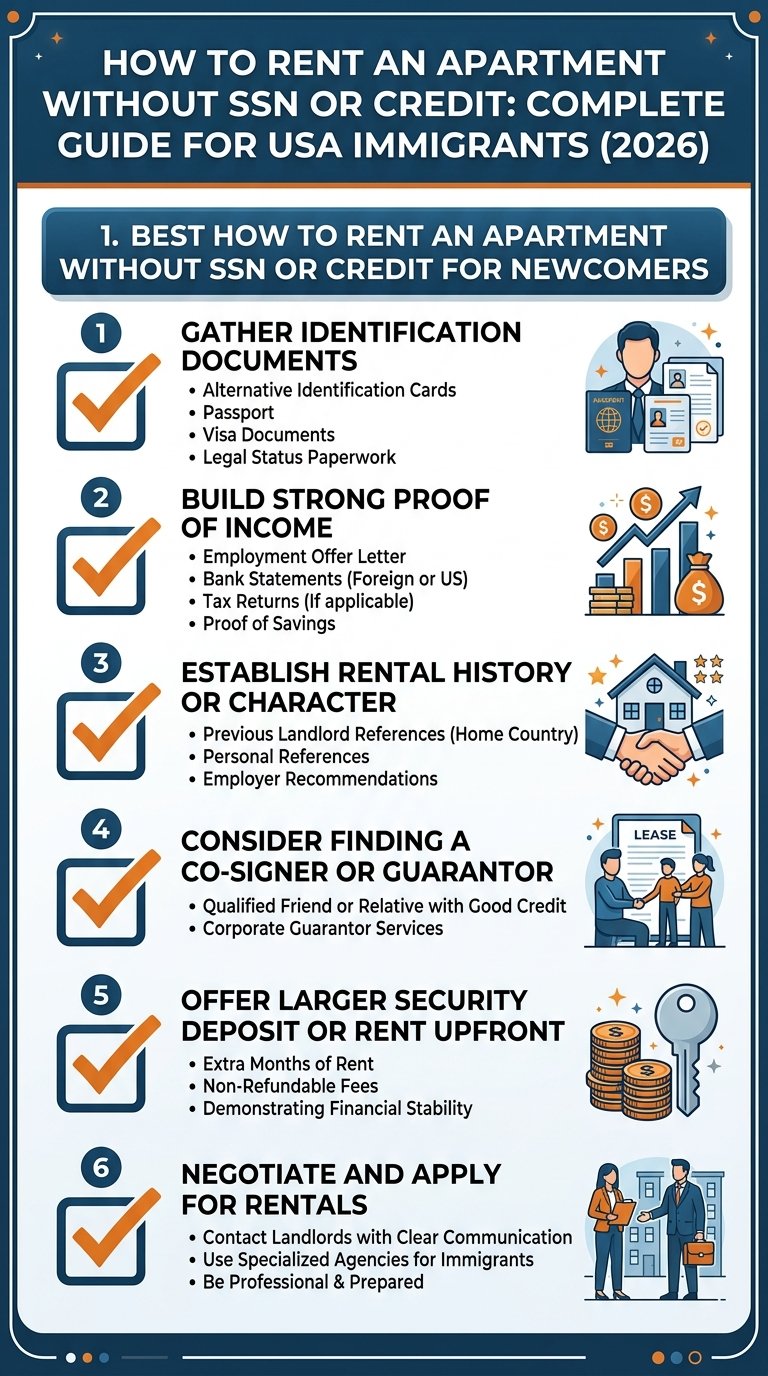
1. Best How To Rent An Apartment Without SSN Or Credit for USA Immigrants in 2026: Quick Overview
Securing housing as a newcomer without a Social Security Number or U.S. credit history is genuinely achievable — landlords across the country regularly work with immigrants, visa holders, and international students who fall outside the conventional screening model. What separates successful applicants is preparation: arriving with the right substitute documents and understanding which rental markets are most accessible.
What Actually Works in 2026
Private landlords and smaller property management companies remain the most flexible entry point. Unlike large institutional landlords who rely on automated credit screening software, independent owners can weigh your full financial picture. Bring documented proof of income or savings — bank statements showing three to six months of reserves, an employment offer letter, or proof of overseas income converted to USD — and you immediately reduce the perceived risk you represent.
Key substitutes landlords accept in lieu of SSN or credit:
- ITIN (Individual Taxpayer Identification Number): As noted above, an ITIN is accepted by a growing number of landlords for identity verification and, in some cases, tenant screening services now run alternative-data reports against ITINs.
- International credit reports: Landlords using services such as Nova Credit can receive a translated credit report from your home country (currently supported for Canada, Mexico, India, UK, Australia, and several others), converting your foreign credit score into a U.S.-equivalent format.
- Larger security deposit: Offering one to three additional months of deposit — where state law permits — signals financial commitment. Note that some states cap security deposits (California limits them to two months’ rent for unfurnished units), so verify local rules before negotiating.
- Co-signer or guarantor: A U.S.-based co-signer with established credit formally backs your lease. Guarantor services like Insurent or TheGuarantors operate in major metros as a paid alternative when no personal co-signer is available.
- Prepaid rent: Offering to prepay two to six months upfront is legal in most states and is among the strongest signals of reliability a landlord can receive.
Where to Focus Your Search
Corporate housing, extended-stay properties, and furnished short-term rentals operate on a different approval model entirely and rarely require SSN or credit checks —useful as a 30-to bridge while you establish U.S. credit. Nonprofit housing organizations and HUD-assisted properties (HUD Rental Assistance) have income-based eligibility criteria rather than credit-based ones, making them accessible to qualifying newcomers regardless of credit history.
Know Your Protections Before You Apply
According to HUD’s Fair Housing and Equal Opportunity office, landlords cannot reject applicants based on national origin — one of seven protected classes under the Fair Housing Act. If a landlord refuses solely because you are a non-citizen or foreign national, that refusal may constitute illegal discrimination. Victims can pursue remedies through a complaint filed with HUD (within 1 year of the last alleged act, per HUD’s complaint process) or seek relief in federal or state court under the enforcement framework described at HUD’s Fair Housing Act overview.
For example, a newcomer on an H-1B visa who lacks U.S. credit but can show six months of bank statements and an employer offer letter from a recognizable company typically faces far less resistance than one who arrives with no documentation — the financial evidence substitutes for the credit score in the landlord’s risk assessment.
2. What Is How To Rent An Apartment Without SSN or Credit and Why Do Immigrants Need It?
Renting without an SSN or established U.S. credit history refers to the collection of alternative documentation strategies, landlord types, and legal protections that allow foreign nationals, recent arrivals, and visa holders to secure housing before they have built a traditional American financial footprint.
The Core Problem Immigrants Face
Standard U.S. rental applications assume two things: a Social Security Number for identity verification and a FICO credit score pulled from Equifax, Experian, or TransUnion. Most newcomers have neither on arrival. Without a U.S. credit file, automated screening software used by large property management companies returns a “no file found” result — functionally identical, from the algorithm’s perspective, to a poor credit score. This immediately disqualifies applicants at corporate-managed complexes that rely on algorithmic tenant scoring.
The practical impact is significant. Immigrants are disproportionately concentrated in high-cost metro areas where rental competition is fierce, yet they face documentation barriers that native-born applicants never encounter. According to USA.gov’s housing help guidance, federal rental assistance programs exist, but eligibility often requires lawful permanent resident status or specific visa categories — leaving many visa holders in a documentation gap during their first months.
Why “No SSN, No Lease” Is a Myth
Landlords are not legally required to demand an SSN; they use it as a convenient identity and credit-check proxy. An ITIN, passport, visa documentation, and foreign credit reports (via services noted above) can satisfy the same underlying need: confirming identity and financial reliability. Private landlords — particularly individuals who own one to four units — exercise personal discretion and are far more likely to evaluate an application holistically.
For example, a newcomer arriving on an H-1B visa with an employment offer letter from a U.S. employer and three months of bank statements can credibly demonstrate rent-to-income ratios that exceed standard 3× monthly rent thresholds, even without a single U.S. credit tradeline.
The Legal Framework That Matters
National origin is a protected class under the Fair Housing Act — meaning a landlord cannot reject an applicant solely because they are foreign-born or lack a U.S. credit history attributable to their national origin. According to HUD’s Fair Housing and Equal Opportunity office, discrimination complaints can be filed directly with HUD; victims may also pursue remedies through federal or state courts. Complaints must be filed within one year of the alleged discriminatory act — file directly through HUD’s complaint portal.
Who This Guide Addresses
This framework is most relevant to:
- F-1, H-1B, L-1, O-1 visa holders with no U.S. credit history
- Green card applicants in adjustment-of-status limbo
- Refugees and asylees whose documentation differs from standard applicants
- DACA recipients navigating state-by-state landlord policies
Each group faces a variation of the same barrier — and each has specific documentation tools available, detailed in the sections that follow.
3. Eligibility Requirements for Immigrants
Qualifying to rent without an SSN or established U.S. credit depends on your immigration status, available documentation, and what individual landlords are willing to accept. Requirements are not federally standardized — they vary by state, city, and property type.
Immigration Statuses Landlords Typically Accept
Most private landlords can legally rent to any individual regardless of citizenship or immigration status. Practically, the following statuses encounter the fewest barriers:
- Lawful Permanent Residents (Green Card holders): Strong position — most documentation requirements parallel those for U.S. citizens
- Visa holders (H-1B, L-1, F-1, J-1, O-1): Generally accepted; landlords may request a copy of your visa and I-94 arrival record
- DACA recipients: Accepted in most states; some landlords apply additional scrutiny
- Asylum seekers and refugees: Eligible for most private rentals; may also qualify for HUD Rental Assistance programs
- Undocumented immigrants: Legally permitted to rent under the Fair Housing Act (as noted above); practical barriers remain higher, particularly for large corporate landlords
Acceptable Identification Documents
Without an SSN, landlords typically accept combinations of:
| Document Type | Examples |
|---|---|
| Government-issued photo ID | Passport, consular ID (Matrícula Consular), state ID |
| Tax identification | ITIN (as noted above), foreign tax ID |
| Immigration documents | Visa, I-94, EAD (Employment Authorization Document), Green Card |
| Proof of funds | varies by provider — confirm directly |
For example, a newcomer on an F-1 visa with no U.S. credit history can substitute a combination of their passport, I-20, university enrollment letter, and of home-country bank statements —many university-adjacent landlords accept exactly this package.
Financial Eligibility Benchmarks
Landlords screening without a credit report shift their evaluation to income and asset verification:
- Income threshold: Most landlords require gross monthly income of 2.5–3× the monthly rent
- Bank balance alternative: Demonstrating of rent reserves in a U.S. or foreign account compensates for income gaps
- Increased security deposit: Many landlords accept security deposit in lieu of a credit check; confirm state-specific deposit caps at USA.gov – Tenant Rights, as some states limit total deposits regardless of circumstances
- Co-signer: A U.S.-based co-signer with established credit substantially improves approval odds for applicants with no credit footprint
What Disqualifies Applicants
Even without credit screening, landlords may reject applicants based on:
- Prior eviction records (searchable through tenant-screening databases independently of credit bureaus)
- Criminal background findings (subject to state-level restrictions on their use)
- Inability to verify income or assets to meet the income ratio threshold
- Expired or insufficient immigration documentation
According to HUD’s Fair Housing and Equal Opportunity guidance, landlords may apply objective, consistently applied financial criteria — but those criteria cannot function as a pretext for national-origin discrimination, one of the seven protected classes under the Fair Housing Act.

Comparing Your Options: Renting Without SSN or Credit
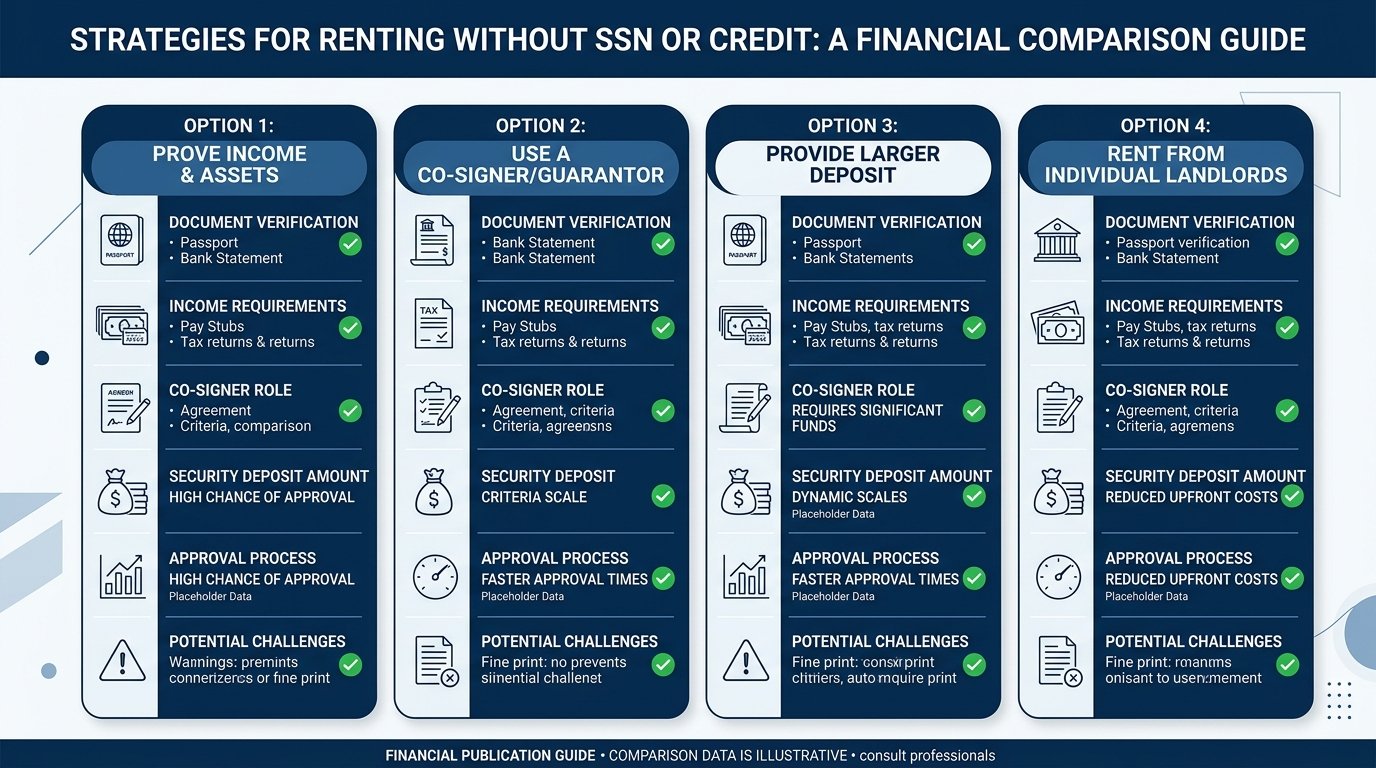
Newcomers quickly discover that no single strategy works for every situation — a recent arrival with cash savings faces different constraints than a work-visa holder with foreign credit history. The table below maps the most practical routes side by side so you can match your circumstances to the strongest available option.
| Strategy | Who It Suits Best | Typical Landlord Acceptance | Key Requirement | Approximate Cost/Effort | Main Limitation |
|---|---|---|---|---|---|
| ITIN as SSN substitute | Any immigrant eligible for an ITIN | Medium — growing awareness among independent landlords | Valid ITIN + proof of income | Low — no extra fees | Large corporate landlords may still reject |
| Nova Credit international report | Arrivals from supported countries (e.g., India, Mexico, UK) | Medium-high at participating properties | Foreign credit account history | Low — free for tenants | Limited country coverage; not universally accepted |
| Larger upfront deposit | Immigrants with savings but no credit file | High — most landlords respond positively | varies by provider — confirm directly | Moderate — significant cash tied up | Varies by state rent-deposit caps |
| Co-signer / guarantor | Students, new arrivals with a creditworthy contact | High | Co-signer must meet landlord’s income/credit threshold | Low direct cost; relationship risk | Requires a willing, qualified individual |
| Individual lease rooms / private landlords | Budget-conscious newcomers, those in major cities | High — private owners more flexible | Proof of employment or income | Low | Fewer tenant protections; inspect carefully |
| Employer or university housing letters | Work-visa holders, international students | Medium-high | Formal letter on official letterhead | Low | Only available to specific visa categories |
Discrimination based on national origin remains prohibited under the Fair Housing Act. If a landlord refuses solely because of your country of origin, you may file a complaint with HUD or pursue the matter independently in court — details at HUD’s fair housing overview.
Illustrative Scenarios
The following are illustrative scenarios, not real testimonials or case studies of specific individuals.
Illustrative Scenario: Recent Work Visa Holder, Urban Rental Market (Illinois)
A newly arrived professional on a work visa presents an ITIN, employer verification letter, and three months’ upfront rent. The landlord accepts these in lieu of a domestic credit report, approving the lease without an SSN.
Expert Recommendation: Best Ways to Rent Without SSN or Credit in the USA
Top Pick: Private Landlords + ITIN + Offer Letter Package
Independent landlords — particularly those managing small portfolios of two to ten units — remain the most accessible entry point for immigrants who lack both an SSN and a U.S. credit file. Unlike institutional property management companies, private landlords have discretion to evaluate applications holistically.
Why it works: A well-prepared application packet combining your ITIN, three to six months of bank statements, a formal offer letter from your employer, and two to three personal or professional references gives a private landlord the financial assurance that a credit score would otherwise provide. Where available, a credit passport service such as Nova Credit — which translates foreign credit histories from select countries into a U.S.-readable format — strengthens this package considerably.
Practical tip: Offer two to three months of upfront rent where your finances allow. This single gesture resolves most landlord hesitation faster than any document. Pair this with a professionally written cover letter explaining your immigration status plainly and framing your financial reliability in concrete terms.
Best for: Newcomers, work-visa holders, DACA recipients, and recent green card holders who have verifiable income but no U.S. credit history. If you’re navigating a similar challenge in Canada, How to Rent Without Credit History in Canada 2026: No Credit Check Options covers parallel strategies for the Canadian rental market.
Runner-Up: HUD-Assisted Housing and Nonprofit Immigrant Housing Programs
For immigrants with limited savings who cannot front several months of upfront rent, HUD-assisted housing programs and nonprofit resettlement organizations offer a structured alternative. These programs typically do not require an SSN at the application stage and apply need-based rather than credit-based criteria.
Why it works: Eligibility is assessed on income level and household composition rather than creditworthiness, removing the primary barrier immigrants face in the private market.
Limitation: Waitlists are common in high-demand urban areas, making this a medium-term rather than immediate solution.
Know your rights throughout the process: Landlords cannot lawfully reject applications based on national origin or immigration-adjacent characteristics — the Fair Housing Act prohibits discrimination across seven protected classes. If you believe you have faced unlawful rejection, you can file a complaint with HUD within one year of the incident, or separately pursue remedies through federal or state courts — HUD’s fair housing overview explains both enforcement paths.
Frequently Asked Questions
Can I rent an apartment in the USA without a Social Security Number?
Yes. Many landlords accept alternative identification, including an ITIN, foreign passport, or government-issued ID from your home country. The SSN requirement is a landlord preference, not a federal law. Private landlords and smaller property management companies tend to be more flexible than large corporate apartment complexes. Strengthening your application with extra documentation — proof of income, a larger security deposit, or a creditworthy co-signer — significantly improves approval odds even without an SSN on file.
What documents can replace an SSN on a rental application?
Acceptable substitutes typically include your ITIN, foreign passport, Employment Authorization Document (EAD), visa, consular ID (matrícula consular), or national identity card. Pair these with supporting financial documents: recent bank statements, employer offer letters, pay stubs, or a letter from an international employer. The stronger your financial evidence, the less weight the landlord places on any single identifier. Some landlords use services like Nova Credit, which translates foreign credit histories into U.S.-readable reports.
How do I build a rental application without U.S. credit history?
Compensate with documentation that demonstrates financial reliability. Provide bank statements showing consistent savings — typically covering several months of rent — along with proof of stable income. Offer character or landlord references from your home country, translated if necessary. A co-signer with established U.S. credit provides additional security for the landlord. Some newcomers also use rent-reporting services after moving in to begin building a U.S. credit file for future applications.
Will a landlord illegally discriminate against me because of my immigration status?
Discrimination based on national origin is prohibited under the Fair Housing Act, which covers seven protected classes including race, color, religion, sex, familial status, national origin, and disability. However, landlords may legally ask for documentation confirming your ability to pay. If you believe you were rejected specifically because of your national origin rather than your financial profile, that may constitute unlawful discrimination. Victims can file a complaint with HUD or pursue the matter through the courts.
How long do I have to file a housing discrimination complaint?
You must submit your complaint to HUD within one year of the most recent discriminatory act — though acting sooner preserves evidence and strengthens your case. File directly at HUD’s complaint portal. Document all interactions with the landlord — emails, application rejections, and verbal statements — before filing. HUD investigates complaints at no cost to you and can mediate or refer the matter for enforcement action if discrimination is substantiated.
Can DACA recipients rent apartments in the USA?
Yes. DACA recipients typically present an EAD as primary identification. Many landlords in immigrant-dense cities routinely accept EAD holders. The same strategies apply: compensate for limited credit history with income documentation, references, and a higher upfront deposit if needed. DACA status does not disqualify you under the Fair Housing Act, and discrimination based on national origin remains illegal regardless of your immigration category.
Is a larger security deposit a reliable strategy?
It is one of the most consistently effective tools. Offering two to three months’ rent upfront signals financial reliability and reduces the landlord’s perceived risk when you lack a U.S. credit score. Note that many states cap security deposits by law — typically between one and three months’ rent — so verify your state’s limit before negotiating. The deposit offer works best alongside other supporting documents rather than as a standalone strategy.
What is Nova Credit and how does it help immigrant renters?
Nova Credit is a credit-reporting service that translates credit histories from select countries — including Canada, India, Mexico, the UK, and others — into a U.S.-compatible format. Participating landlords and property managers can request this report directly. If your home country is supported, a strong foreign credit history can substitute for a U.S. FICO score during the application process. Coverage varies by country and landlord participation, so confirm availability before relying on it as your primary strategy.
Are there rental assistance programs available to immigrants?
HUD-funded programs vary significantly by state, city, and immigration status. Lawful Permanent Residents and certain visa holders may qualify for federally assisted housing, while undocumented individuals are generally ineligible for federal programs but may access state or nonprofit alternatives. Local immigrant services organizations often maintain updated lists of assistance programs specific to your region. Eligibility rules change frequently, so contact your local housing authority directly for current requirements.
Can I get a co-signer if I have no U.S. contacts?
A co-signer must typically be a U.S. resident with verifiable credit and income, which can be challenging for recent arrivals. Some options: a colleague, employer, or sponsor familiar with U.S. credit systems; a relocation-assistance organization that provides co-signer guarantees; or third-party co-signer services (sometimes called lease guarantor companies) that charge a fee — often a percentage of annual rent — in exchange for guaranteeing your lease. This option adds cost but can unlock apartments that would otherwise reject your application outright.
Comparison Table: Strategies for Renting Without SSN or Credit
| Strategy | Effectiveness | Cost | Best For |
|---|---|---|---|
| ITIN as ID substitute | High | Free (if already held) | Most visa categories |
| Foreign passport + income docs | High | Free | All newcomers |
| Nova Credit foreign report | High (where available) | Varies by provider | Supported countries only |
| Larger security deposit | High | varies by provider — confirm directly | Those with savings |
| U.S. co-signer | Very high | Relationship-dependent | Those with U.S. contacts |
| Lease guarantor service | High | Fee (typically % of annual rent) | No U.S. contacts available |
| Rent-to-own / furnished rentals | Moderate | Often premium pricing | Short-term bridging |
| Character/employer references | Moderate | Free | Strengthens overall file |
Costs and availability vary by state and provider. Deposit limits are governed by state law.
Expert Recommendation
Lead with documentation volume, not explanation. Licensed tenant advocates consistently advise immigrants to over-document rather than explain their situation verbally. Assemble a single application packet containing: government-issued photo ID (passport or EAD), ITIN confirmation letter, three months of bank statements, income verification, and at least two references — one from a prior landlord (domestic or international) and one from an employer or professional contact. If Nova Credit covers your home country, include that report. This approach repositions your file from “high-risk unknown” to “well-documented, financially capable applicant” — which is the landlord’s actual concern. If discrimination based on national origin occurs during this process, your documented application trail becomes evidence for a HUD complaint or legal action.
Conclusion
Securing housing as a newcomer without an SSN or established U.S. credit history is genuinely challenging — but far from impossible. The strategies covered throughout this guide — from obtaining an ITIN and gathering alternative documentation to approaching independent landlords and leveraging co-signers — collectively give you a practical roadmap that thousands of immigrants have already used successfully.
A few priorities are worth reinforcing as you move forward:
Document everything. Bank statements, employment letters, international credit reports via services like Nova Credit, and reference letters from employers or previous landlords can substitute meaningfully for a FICO score in many negotiations.
Target the right landlords. Corporate property management companies tend to rely heavily on automated screening systems. Smaller, independent landlords generally have more flexibility and are often more willing to evaluate your full financial picture.
Know the legal floor. Regardless of immigration status, the Fair Housing Act prohibits discrimination on the basis of national origin and other protected characteristics. If you believe a landlord has violated these protections, you have recourse: complaints can be submitted to HUD within one year of the incident, or you may pursue a private legal action in court.
Build credit from day one. The sooner you establish a U.S. credit profile — through a secured card, credit-builder loan, or rent-reporting service — the faster future rental applications become straightforward.
Your immigration journey is already evidence of resilience. With the right preparation and the protections the law affords you, finding a home in the U.S. is an achievable next step.
Disclaimer
For Informational Purposes Only
The content published on MoneyAbroadGuide.com, including this article, is provided solely for general educational and informational purposes. It does not constitute legal, financial, immigration, or tax advice. Rental laws, landlord requirements, and immigration regulations vary significantly by state, city, and individual circumstance. Always consult a licensed attorney, certified financial advisor, or accredited immigration consultant before making decisions based on information presented here.
Regulatory Note
Housing discrimination complaints and tenant rights referenced in this article are governed by federal law. Official guidance is available directly through HUD and the U.S. Department of Justice. MoneyAbroadGuide.com is not affiliated with any government agency.
Affiliate Disclosure
This article may contain affiliate links or references to third-party products and services. If you click a link and make a purchase or sign up, MoneyAbroadGuide.com may receive compensation at no additional cost to you. Affiliate relationships do not influence editorial recommendations. All provider comparisons reflect independent editorial assessment based on publicly available information.
Information is current as of the publication date and is subject to change without notice.
About the Author
Talal Eddaouahiri is the founder of MoneyAbroadGuide.com, an independent financial information platform for immigrants and newcomers in the United States and Canada. Originally from Morocco, he settled in the U.S. in 2015 and built his own credit history and banking relationships from scratch in both countries. His background is in retail banking and customer relations, and he draws on that firsthand experience to write independent, source-based guides — citing regulators including the FCAC, FINTRAC, OSFI, CRA, IRS, and CDIC — to help newcomers navigate financial systems with confidence.
Learn more about our Fact-Checking Process and our How We Test when researching this guide.
Last Updated: July 2026

About Talal Eddaouahiri
Founder & Editor of MoneyAbroadGuide.com. A Moroccan immigrant who settled in the United States in 2015, Talal opened bank accounts and built credit from zero in both the US and Canada. His background is in retail banking and customer relations, and he writes independent, source-based guides (FCAC, FINTRAC, OSFI, CRA, IRS, CDIC) to help newcomers navigate their first financial steps. Read his full profile →