
Best International Students in Canada Money Checklist: Complete Guide for Canada Immigrants (2026)
Quick Answer: International students in Canada need to open a no-fee bank account, obtain a Social Insurance Number (SIN), understand tax residency obligations, and build credit from day one. This checklist covers every financial step — from pre-arrival to your first tax return — so you avoid costly mistakes and stay compliant.
Arriving in Canada as an international student means managing tuition, rent, groceries, and an entirely unfamiliar financial system — simultaneously. The stakes are high: a missed tax filing, an unnecessary bank fee, or a delayed SIN can set back your finances by months and create compliance problems with the Canada Revenue Agency or Immigration, Refugees and Citizenship Canada.
The good news is that Canada’s regulatory framework actively protects newcomers. Under rules overseen by the Financial Consumer Agency of Canada (FCAC), banks are required to offer low-cost and no-cost account options — meaning you can establish a fully functional Canadian bank account without a job offer or an immediate deposit. Under FCAC guidelines, you have the legal right to open a personal bank account even if you are unemployed or not yet depositing funds.
Your Social Insurance Number (SIN) is equally foundational — required to work legally in Canada and to access most government benefits and services. And as soon as you establish Canadian residency, you become subject to Canadian tax rules: newcomers typically become residents for tax purposes on their date of arrival and may need to file a return, as outlined by the CRA’s newcomers guidance.
This guide delivers a practical, step-by-step money checklist — structured by timeline — so every international student in Canada can move from financially vulnerable to financially stable, fast.
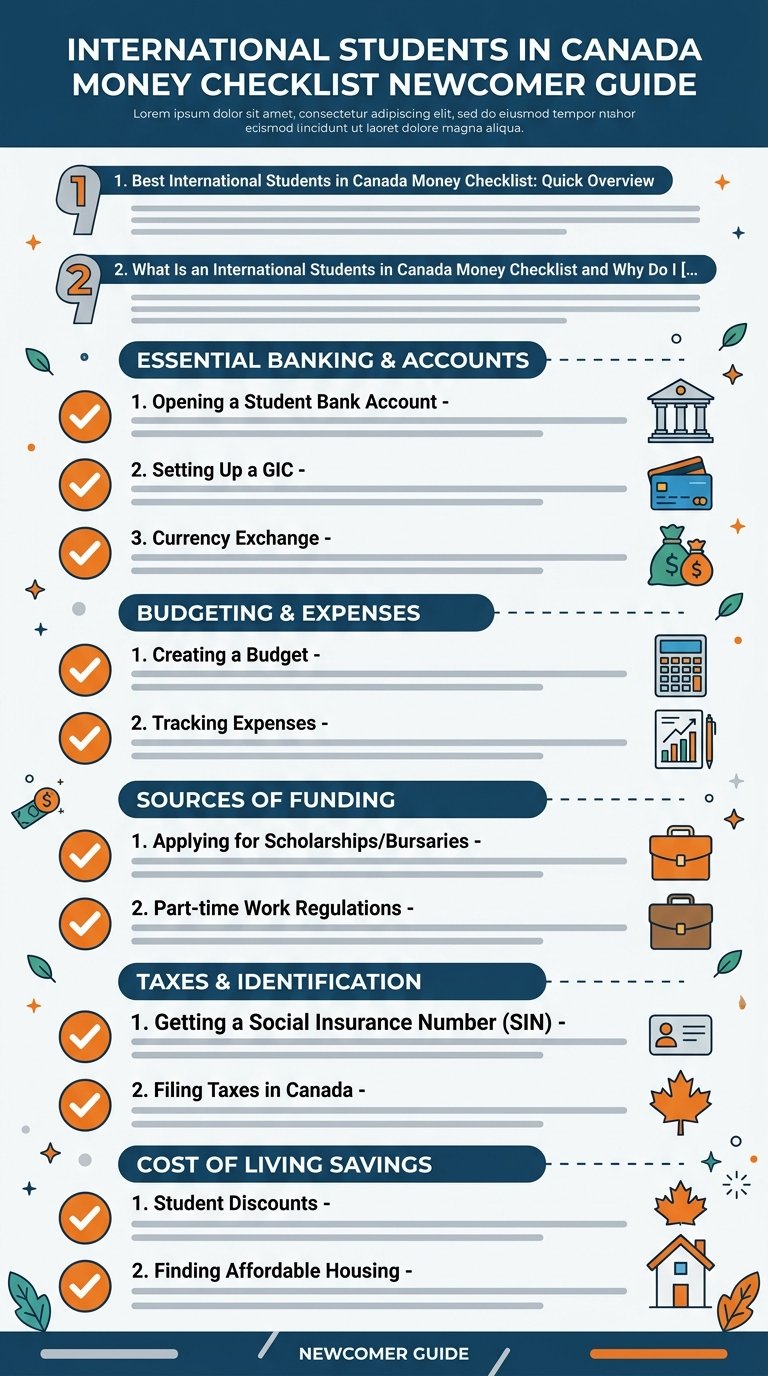
1. Best International Students in Canada Money Checklist: Quick Overview
Arriving in Canada as an international student means navigating a financial system that is regulated by bodies including FCAC, CRA, and FINTRAC — simultaneously, often within days of landing. This checklist condenses the critical steps so nothing gets missed during that high-pressure window.
Core Financial Tasks: First
1. Open a no-cost bank account According to the FCAC, newcomers in their first year are eligible for $0/month bank accounts under the FCAC commitment. Priority institutions: the Big Five (RBC, TD, Scotiabank, BMO, CIBC) and credit unions all offer newcomer packages. Bring your study permit, passport, and proof of Canadian address.
2. Understand your SIN obligations As noted above, your SIN is required to work and access government benefits. For a non-interest-bearing chequing account, FCAC confirms you may decline to provide it solely as identification — useful if your SIN hasn’t arrived yet.
3. Register with CRA According to the CRA newcomers page, you become a Canadian tax resident on the date you arrive, which triggers filing obligations. Register for a CRA My Account as soon as your SIN is issued — this unlocks access to GST/HST credits and tuition tax credits (T2202) that many students leave unclaimed.
4. Set up a budget tracking system For example, a newcomer student on a typical monthly stipend would allocate roughly: rent, groceries and transit, academic supplies, and savings/emergency fund. No invented figures — adjust proportions against your actual study permit conditions and your institution’s cost-of-attendance disclosure.
5. Understand credit-building from Day 1 Canada’s credit bureaus — Equifax and TransUnion — are separate from your home country’s system. Your foreign credit history does not transfer. Starting a secured credit card or a student credit card within the first month is the fastest compliant path to building a Canadian credit file, which affects future rental applications, phone plans, and post-graduation financial products.
6. Verify provincial health coverage eligibility Coverage varies by province and waiting periods apply in some (e.g., Ontario’s OHIP has a wait). Confirm with your provincial health authority immediately and arrange supplemental insurance through your institution’s student union plan if needed.
Priority Order at a Glance
| Week | Action |
|---|---|
| 1 | Apply for SIN; open no-cost bank account |
| 1–2 | Register mailing address with CRA |
| 2–3 | Apply for student or secured credit card |
| 3–4 | Confirm provincial health coverage; enroll in student insurance if gap exists |
| Month 2 | Set up CRA My Account; track first tuition tax credit (T2202) |
Completing these steps in sequence prevents the most common financial errors reported by newcomer students: missed tax credits, delayed credit history, and uninsured medical gaps.
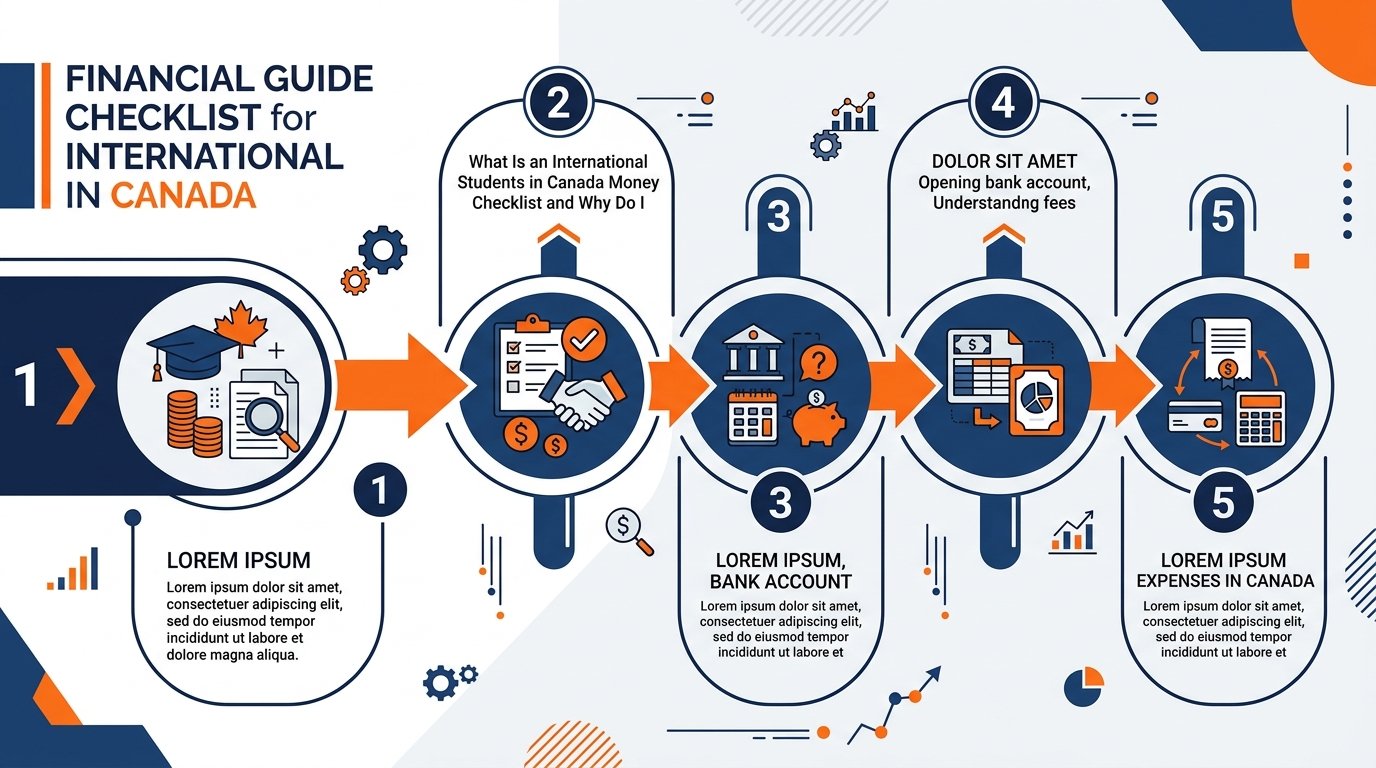
2. What Is an International Students in Canada Money Checklist and Why Do Immigrants Need It?
A money checklist is a sequenced action plan that maps every financial obligation a newcomer must complete—from opening a bank account to filing taxes—in the correct order. Without one, international students routinely miss deadlines that trigger penalties, lose access to fee waivers, or build no credit history during the critical first year in Canada.
Why the Sequence Matters
Canada’s financial system is interdependent. Each step unlocks the next:
- Banking is required before you can receive a tuition refund, pay rent by e-transfer, or set up direct deposit for any government benefit.
- Your SIN (covered above) must exist before an employer can pay you legally or a financial institution can report interest income to the CRA.
- Credit history starts at zero on arrival. Without a Canadian credit file, students pay larger damage deposits, face rental rejections, and cannot qualify for a student line of credit. According to the Financial Consumer Agency of Canada (FCAC), credit reports are built from Canadian account activity only—foreign credit history does not transfer.
- Tax residency begins on the date you land. The CRA treats newcomers as Canadian residents for tax purposes from arrival, meaning income earned even in your first partial year may require a return.
What the Checklist Adds That a Generic Finance Guide Does Not
General personal finance advice assumes an established resident: existing credit, a stable income, provincial health coverage, and familiarity with Canadian institutions. International students face four compounding gaps simultaneously:
- No credit file — lenders cannot assess risk, so secured cards or credit-builder products are required first.
- Limited banking access — without proper documentation, students may be turned away; however, according to the FCAC, you have the right to open a personal bank account even without a job or an initial deposit.
- Fee exposure — newcomer no-cost accounts are available but time-limited; according to FCAC, eligible newcomers can access $0/month bank accounts during their first year, a window that closes if you don’t act early.
- Regulatory unfamiliarity — FINTRAC anti-money-laundering rules, OSFI-regulated deposit insurance thresholds, and provincial tax credits (such as tuition carryforwards) are invisible to most new arrivals.
A Concrete Example
For example, a newcomer who opens a bank account in month three instead of week one may miss two months of eligible no-cost banking, lack an account for direct deposit of any bursary, and start building a credit file later than a peer who followed a structured checklist. That two-month gap compounds: a thinner credit file at year-end means fewer lending options when lease renewal requires a co-signer or when an emergency expense arises.
The Core Function
The checklist converts a complex, unfamiliar system into a time-ordered task list with deadlines, eligibility windows, and regulatory anchors—so students act before opportunities close rather than after penalties apply.
3. Eligibility Requirements for Immigrants
Understanding who qualifies for which financial products—and when—prevents wasted applications and unnecessary credit inquiries.
Who Qualifies as a “Newcomer” for Financial Purposes
Canadian financial institutions generally extend newcomer privileges to individuals holding valid immigration status: study permit holders, work permit holders, permanent residents, and protected persons. Visa type matters because it determines SIN eligibility, tax residency status, and provincial health coverage timelines—each of which unlocks a different layer of the checklist.
According to the Financial Consumer Agency of Canada, newcomers in their first year are eligible for $0/month bank accounts, provided they present acceptable identification at the branch. Most institutions accept a foreign passport plus one of: study permit, IMM 5292, provincial photo ID, or student card. A SIN is required to work and access government benefits, but as the FCAC confirms, you may decline to provide it when opening a non-interest-bearing account without losing your right to that account.
Study Permit Holders: Specific Conditions
International students represent the largest newcomer segment in Canada. Eligibility checkpoints specific to study permit holders include:
- Banking: Eligible immediately upon arrival with a valid study permit and passport.
- SIN: Issued to study permit holders with a condition code allowing on-campus or off-campus work. Students whose permits do not authorize work are generally ineligible for a SIN until that condition changes.
- Tax residency: According to the Canada Revenue Agency, newcomers become Canadian residents for tax purposes on the date of arrival, which means a partial-year tax return may be required even in the first year—even on limited student income.
- Provincial health insurance: Eligibility and waiting periods vary by province; for example, Ontario’s OHIP imposes a three-month waiting period, while British Columbia activates MSP coverage on the first day of the third month after arrival.
Credit History: The Eligibility Gap
No Canadian credit history is the single most common eligibility barrier. Without it, approval for a standard credit card, rental application, or phone plan requires a co-signer or security deposit. For example, a newcomer student with strong finances abroad still starts with a blank Canadian credit file—which is why applying for a secured credit card or a newcomer credit card (products specifically underwritten without Canadian history) belongs on the checklist in month one, not month six.
Documents Needed Across All Eligibility Steps
| Financial Task | Minimum Documents Required |
|---|---|
| Bank account (basic) | Passport + study permit |
| SIN application | Study permit authorizing work + passport |
| Credit card (newcomer product) | Passport + study permit + proof of enrollment |
| Tax filing | SIN + T4/T2202 slips + arrival date |
| Provincial health enrollment | Proof of immigration status + provincial application form |
Gathering these documents before arrival eliminates the most common cause of delayed financial setup reported by international students.

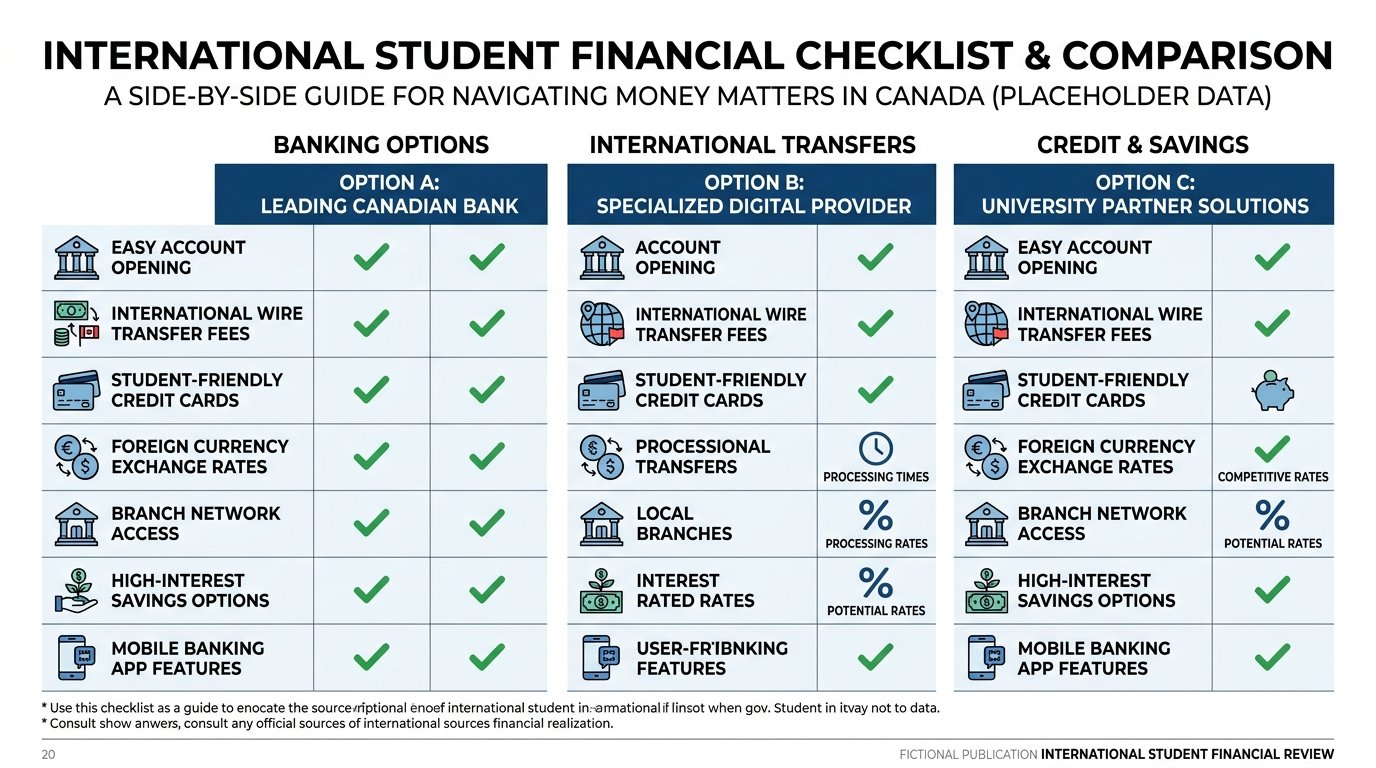
Comparison Table: International Student Financial Setup in Canada
Choosing the right financial products early shapes your entire stay. The table below maps the core tasks every international student must complete, ranked by urgency, along with the key requirements, costs, and regulatory context.
Under federal financial consumer protection rules, newcomers arriving in Canada are entitled to a no-fee bank account during their first year — see the FCAC low-cost account commitment for qualifying institutions. Even without employment or an initial deposit, you retain the right to open a personal account, as outlined by FCAC’s banking rights guidance. For non-interest-bearing accounts, providing a Social Insurance Number as identification is optional under those same rules. Once income begins, registration with the CRA as a newcomer tax resident is required from the date of arrival — timing varies by province and individual circumstance.
| Task | Urgency | Key Requirement | Typical Cost | Regulatory / Official Reference |
|---|---|---|---|---|
| Open a no-fee chequing account | Immediate (Week 1) | Valid study permit + passport | $0/month (newcomer rate) | FCAC no-cost accounts |
| Apply for a Social Insurance Number (SIN) | Week 1–2 | Study permit with work authorization | No fee | FCAC banking & SIN guidance |
| Register with CRA as a tax resident | Upon first income or by tax season | SIN + arrival date | No fee to register | CRA newcomers page |
| Enroll in provincial health coverage | varies by provider — confirm directly | Study permit + proof of address | Varies by province | Provincial health authority websites |
| Apply for a secured or student credit card | Month 1–3 | Bank account + SIN (usually) | Annual fee varies by issuer | Regulated under federal Bank Act (OSFI oversight) |
| Set up international money transfers | As needed | Bank account established | Fee varies by provider | FINTRAC-registered MSBs recommended |
Illustrative Scenarios
The following are illustrative scenarios, not real testimonials or case studies of specific individuals.
Illustrative Scenario: International Student, Engineering Program
An international student on a study permit opens a no-cost account eligible under the FCAC newcomer commitment, then registers with the CRA ahead of their first filing deadline.
Expert Recommendation
Navigating Canadian banking and tax obligations as an international student is genuinely complex — the right account and the right sequence of actions can save you hundreds of dollars and weeks of frustration.
Top Pick: No-Fee Newcomer Bank Account (Big Five Banks)
For most incoming students, a no-cost newcomer chequing account from one of the Big Five banks (RBC, TD, BMO, CIBC, or Scotiabank) is the strongest first move. Under the Financial Consumer Agency of Canada’s low-cost and no-cost account framework, eligible newcomers can access accounts with zero monthly fees during their first year — a commitment backed by federal regulation. Pair this with early CRA registration so that any eligible credits (GST/HST, provincial top-ups) flow to a Canadian account from your first eligible filing period onward.
Why it wins: Branch accessibility, integrated credit-building pathways, and regulated deposit protection under CDIC all matter when you are establishing financial history from scratch. For newcomers who need to receive tuition refunds, scholarship disbursements, or part-time employment income, having a domestic account on day one is non-negotiable.
Best suited for: Students arriving with a valid study permit who want a regulated, federally supervised institution and a straightforward path to a first credit product within.
Runner-Up: Digital-First or Credit Union Account
If the Big Five’s branch model does not match your lifestyle — or if you study in a province where a regional credit union offers superior rates on student lines of credit — a digital bank or credit union is a credible alternative. These institutions typically carry lower foreign transaction fees, which matters if you regularly receive funds from abroad. Confirm that any provider is federally or provincially regulated and that deposits are insured before opening.
Limitation to know: Some digital-only institutions have stricter identity verification workflows that can delay account activation for newcomers who arrive without a Canadian credit file. Build in extra time if choosing this route.
Bottom Line
Open your account within your first week of arrival, register for a SIN as soon as you hold an eligible work permit or are authorised to work, and connect your banking details to your CRA My Account before your first tax season. That three-step sequence — account, SIN, CRA registration — is where most students who face financial delays went wrong.
Frequently Asked Questions
Do international students need a job offer to open a Canadian bank account?
No. Under FCAC guidance, you have the right to open a personal bank account without employment, without an initial deposit, and even if you are unemployed — as confirmed by the FCAC. Bring government-issued photo ID and your study permit. Most Big Five banks (RBC, BMO, CIBC, TD, Scotiabank) have dedicated newcomer banking packages that can be opened within days of arrival, sometimes before you land via online pre-registration.
Are there truly free bank accounts for international students in Canada?
Yes. During your first year in Canada, you are eligible for no-fee bank accounts under a formal commitment overseen by FCAC — see the low-cost/no-cost account framework here. These accounts carry a monthly fee and include core transaction features. After your first year, confirm whether your account converts to a paid tier and compare options before accepting automatic fee charges.
Do I need a Social Insurance Number (SIN) to open a bank account?
You need a SIN to work legally in Canada and to access most government benefits. However, for a non-interest-bearing chequing account, you are permitted to decline providing your SIN as identification — per FCAC’s account-opening rules. If your account earns interest, the bank is legally required to collect your SIN for CRA reporting purposes. Apply for your SIN through Service Canada promptly after receiving your study permit, as it is required for any on-campus or co-op employment.
When do international students become liable for Canadian taxes?
You generally become a Canadian tax resident for CRA purposes from the date you arrive and establish residential ties — such as a lease, bank account, or provincial health card. This means income earned in Canada during the tax year must be reported. The CRA newcomers page outlines filing obligations, applicable credits, and how to handle income from your home country during the transition year.
Can international students receive the GST/HST credit?
Yes, if you file a Canadian tax return and meet CRA income thresholds, you may qualify for the GST/HST credit — a quarterly, tax-free payment. Eligibility is assessed automatically when you file, so submitting your return even in a low-income year is worthwhile. Foreign students with limited Canadian income often qualify. Check your CRA My Account after filing to confirm enrollment. Provincial credits, such as Ontario’s Trillium Benefit, may also apply depending on where you study.
What documents do international students typically need to open a bank account?
Most banks accept a combination of: your valid passport, your study permit (IMM document), and proof of Canadian address (a lease agreement or university acceptance letter). A SIN is helpful but not always mandatory for a basic account. Some institutions accept a secondary ID such as a foreign driver’s licence. Requirements vary by bank and province, so confirm with your chosen branch before visiting. Students report the process taking under an hour when documents are complete.
How should international students handle provincial health insurance waiting periods?
Provincial health coverage timelines differ significantly. British Columbia’s MSP and Ontario’s OHIP both impose waiting periods before coverage activates — meaning you are responsible for all medical costs during that gap. Purchase private international student health insurance to bridge this window. Your university’s student union often offers a default plan upon enrollment; review its coverage limits and exclusions against your provincial health authority’s timeline before relying solely on it.
Is it safe to send money internationally from a Canadian student bank account?
Sending money abroad from Canada is legal and straightforward, but the provider you choose affects cost significantly. Banks typically charge higher wire fees and less competitive exchange rates than regulated Money Service Businesses (MSBs). All MSBs operating in Canada must be registered with FINTRAC under the Proceeds of Crime (Money Laundering) and Terrorist Financing Act. Verify any remittance provider’s FINTRAC registration before transferring funds. Compare total cost — fee plus exchange rate margin — not just the advertised transfer fee.
What happens if an international student overstays their study permit — does it affect banking?
Banking access is tied to your identity documents, not your immigration status per se, but an expired study permit affects your ability to legally work (and thus earn income) and may complicate future applications for government benefits or credit products. IRCC enforces status compliance separately from financial institutions. Maintain valid status by applying for renewals well in advance. An expired permit does not immediately close your bank account, but it creates cascading issues across employment authorization, SIN validity, and CRA residency determinations.
How do international students start building a Canadian credit history?
Credit history in your home country does not transfer to Canada. Start by opening a secured credit card — you deposit collateral and spend within that limit — which most banks offer to newcomers without a local credit score. Use it for small, recurring purchases and pay the balance in full each month. OSFI-regulated lenders report payment behaviour to Equifax and TransUnion Canada, gradually building your profile. A thin but clean credit file within your first year improves eligibility for unsecured cards, student lines of credit, and eventually rental applications.
Conclusion
Managing money as an international student in Canada involves navigating banking, taxes, credit-building, and provincial health coverage — often simultaneously and under tight deadlines. The checklist structure in this guide exists precisely because sequence matters: opening a no-fee bank account first creates the foundation every subsequent step depends on.
A few priorities worth carrying forward:
Banking access is a protected right. Even without Canadian employment or an immediate deposit, newcomers can open a personal account — and during the first year, fee-free options are available under the FCAC’s no-cost account commitment.
Tax residency begins on arrival. Becoming a Canadian tax resident triggers CRA obligations that many students underestimate. The CRA newcomers page outlines what filing may be required, including eligibility for refundable credits that can meaningfully offset living costs.
Credit history takes time — start early. A secured card or credit-builder product opened in month one will have months of positive history by the time you need it for a lease or phone plan.
Provincial health coverage gaps are real. Understand your province’s waiting period and arrange private interim coverage accordingly.
The financial system in Canada is accessible to international students, but it rewards those who act promptly and in the right order. Use this checklist as a living document: revisit it at the, and one-year marks as your status and needs evolve.
Disclaimer
For informational purposes only. The content on MoneyAbroadGuide.com is intended to provide general financial information for newcomers and international students in Canada. It does not constitute financial, legal, tax, or immigration advice. Readers should consult a licensed financial advisor, a regulated immigration consultant (RCIC), or a qualified tax professional before making decisions based on information found here.
Regulatory accuracy. We make reasonable efforts to keep information current with guidance from FCAC, CRA, OSFI, and provincial health authorities. However, regulations, eligibility criteria, and product terms change. Always verify details directly with the relevant government body or licensed institution.
Affiliate disclosure. MoneyAbroadGuide.com may receive compensation when you apply for or open financial products through links on this site. This compensation does not influence editorial rankings or recommendations. Our editorial team operates independently of commercial partnerships, in accordance with standard affiliate disclosure practices.
External links. Links to government sources (canada.ca, CRA, IRCC) are provided for convenience. We are not responsible for the content or accuracy of third-party or government websites after publication.
Last reviewed: 2025. Content subject to change.
About the Author
Talal Eddaouahiri is the founder of MoneyAbroadGuide.com, an independent financial information platform for immigrants and newcomers in the United States and Canada. Originally from Morocco, he settled in the U.S. in 2015 and built his own credit history and banking relationships from scratch in both countries. His background is in retail banking and customer relations, and he draws on that firsthand experience to write independent, source-based guides — citing regulators including the FCAC, FINTRAC, OSFI, CRA, IRS, and CDIC — to help newcomers navigate financial systems with confidence.
Learn more about our Fact-Checking Process and our How We Test when researching this guide.
Last Updated: July 2026

About Talal Eddaouahiri
Founder & Editor of MoneyAbroadGuide.com. A Moroccan immigrant who settled in the United States in 2015, Talal opened bank accounts and built credit from zero in both the US and Canada. His background is in retail banking and customer relations, and he writes independent, source-based guides (FCAC, FINTRAC, OSFI, CRA, IRS, CDIC) to help newcomers navigate their first financial steps. Read his full profile →