
Best International Students Money Setup Checklist USA: Complete Guide for USA Immigrants (2026)
Quick Answer: International students in the USA need a U.S. bank account, ITIN or SSN, a basic credit profile, and a clear understanding of tax obligations. Completing this financial setup early prevents payment delays, limits fees, and protects your legal status throughout your studies.
Arriving in the United States on an F-1 or J-1 visa means managing your finances across two countries, often for the first time, without the credit history, documentation, or institutional knowledge that domestic students take for granted. The financial decisions you make in your first 60 to 90 days on campus will shape your ability to rent housing, receive financial aid disbursements, send money home, and build the credit foundation that follows you far beyond graduation.
The regulatory environment for international students is layered. Your visa status — governed by DHS Study in the States — directly affects which financial products you can access and what employment income you’re legally permitted to earn. Your tax obligations are shaped by IRS rules specific to nonresident aliens, detailed under IRS guidance for foreign students and scholars. Your access to federal financial aid is limited and conditional, as outlined by Federal Student Aid for non-U.S. citizens. And your long-term financial health depends on understanding U.S. credit reporting systems — a process you can begin through USA.gov’s credit report guidance.
Newcomers consistently report the same pain points: banks rejecting account applications due to missing documentation, tax filing errors that trigger IRS notices, and missed deadlines for SEVIS compliance that jeopardize visa standing. These aren’t minor inconveniences — they carry real financial and immigration consequences.
This checklist-style guide cuts through the complexity. It organizes every essential financial step — from opening your first U.S. bank account to filing your first tax return — into a prioritized, actionable sequence built specifically for international students arriving in 2025–2026. Each section addresses regulatory requirements, practical timelines, likely costs, and the common errors that derail students who attempt to navigate this process without a clear roadmap.
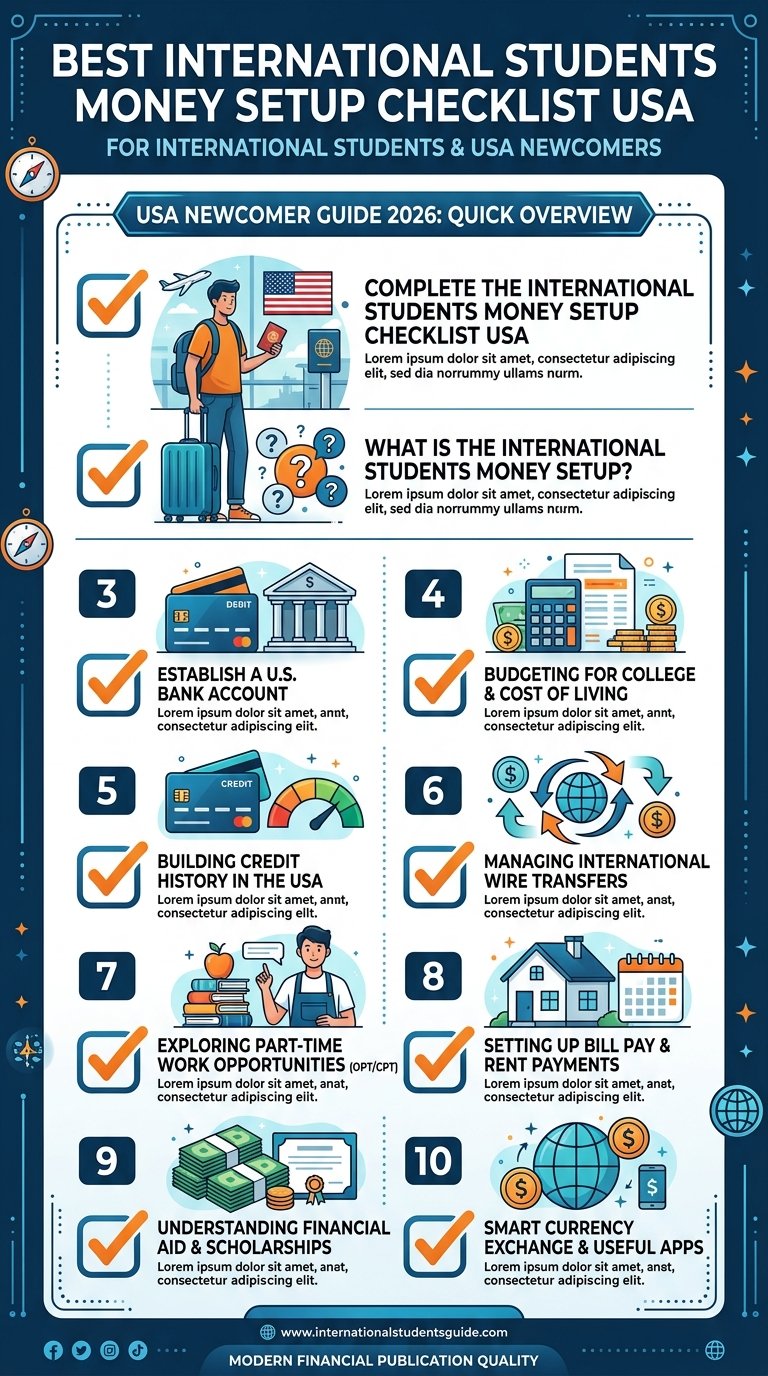
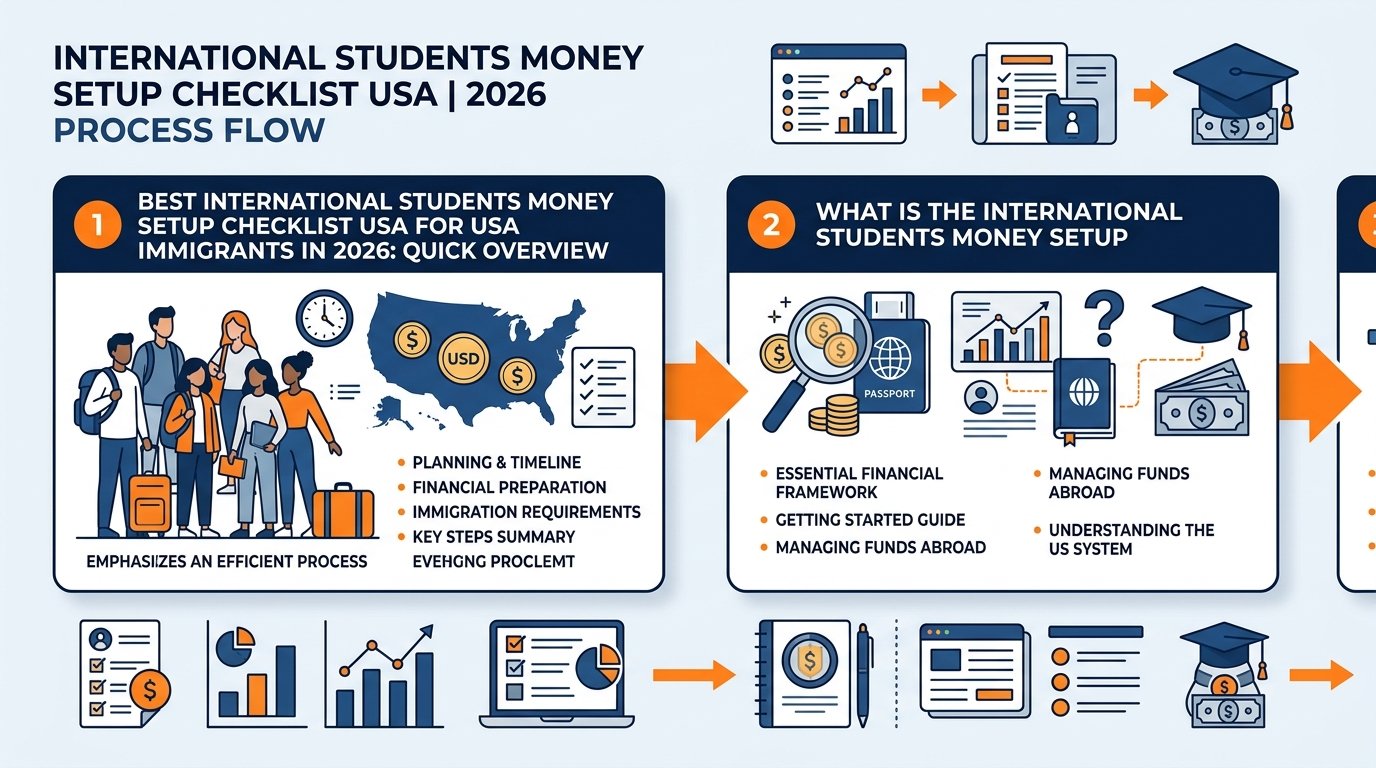
1. Best International Students Money Setup Checklist USA for USA Immigrants in 2026: Quick Overview
Arriving in the United States as an international student triggers an overlapping sequence of financial, immigration, and tax obligations that must be completed in a specific order. Missing one step delays the next. This checklist maps the critical path.
Priority Sequence: First on Campus
Week 1–2: Identity and Status Foundation
- Confirm SEVIS record is active with your Designated School Official (DSO)
- Pay the I-901 SEVIS fee (amount varies; verify the current figure at ice.gov/sevis/i901) before any financial account applications
- Apply for a Social Security Number if you have qualifying on-campus employment authorization — eligibility rules and the application process are outlined at usa.gov/social-security-card
Week 2–4: Banking
- Open a checking account at a bank that accepts a passport plus I-20 (many campus credit unions do)
- Set up a debit card for immediate spending; defer credit card applications until your SSN is confirmed
- Register for online transfers
Week 4–8: Tax Registration
- Determine whether you need an SSN or an ITIN (as noted above) for tax filing
- Locate your tax treaty eligibility: according to the IRS, the United States has tax treaties with dozens of countries that may reduce or eliminate withholding on fellowship and scholarship income
- File Form 8233 with your employer or university payroll office if a treaty applies to your wages
Work Authorization: Know Your Limits Before You Earn
According to USCIS, on-campus employment is limited to 20 hours per week while school is in session — exceeding this threshold jeopardizes F-1 status and, by extension, every financial account tied to that status (USCIS OPT page).
Post-graduation, USCIS may authorize up to 12 months of Optional Practical Training, extended by an additional 24 months for eligible STEM-degree holders (USCIS STEM OPT). For example, a computer science graduate who secures STEM OPT gains up to 36 total months of work-authorized income — enough time to build a U.S. credit file from thin to solid.
Credit Building: Start Immediately
- Apply for a secured credit card within your first semester; most require a deposit
- Pay the full balance monthly — interest charges on a student budget compound quickly
- Monitor your report at usa.gov/credit-reports; errors on new files are disproportionately common
Financial Literacy Resources
The Financial Literacy and Education Commission’s MyMoney.gov provides federally curated budgeting tools calibrated for U.S. financial products — useful for newcomers unfamiliar with American lending norms.
Checklist at a Glance
| Task | Timeline | Blocking Dependency |
|---|---|---|
| Confirm SEVIS status | Day 1 | All subsequent steps |
| Pay I-901 fee | Before banking | Bank account opening |
| Obtain SSN/ITIN | Weeks 2–6 | Tax filing, credit card |
| Open checking account | Week 2–3 | Direct deposit, transfers |
| File tax treaty form | Before first paycheck | Correct withholding |
| Apply for secured card | Month 2–3 | SSN/ITIN confirmed |
| Begin credit monitoring | Month 3 onward | Ongoing |
2. What Is the International Students Money Setup Checklist USA and Why Do Immigrants Need It?
The international students money setup checklist USA is a sequenced financial action plan specifically designed for non-citizen, non-permanent-resident students navigating the U.S. banking, tax, and credit systems under visa-constrained conditions. Unlike generic personal finance advice, this checklist accounts for regulatory friction points unique to F-1, J-1, and M-1 visa holders — including SEVIS compliance obligations, restricted work authorization, and limited access to federally backed financial products.
Why Standard Financial Advice Fails International Students
Most mainstream U.S. personal finance guidance assumes a Social Security Number exists on arrival, that employment is unrestricted, and that credit history begins at adulthood. For international students, none of these assumptions hold. According to the Financial Literacy and Education Commission via MyMoney.gov, financial capability gaps disproportionately affect populations with limited prior exposure to U.S. systems — a category that encompasses virtually every newly arrived international student regardless of home-country wealth or education level.
The structural barriers compound quickly. Without a prior U.S. credit file, students are denied standard credit cards. Without employer-issued payroll documentation, opening certain bank accounts requires alternative identity verification. Without understanding IRS residency classifications for tax purposes — distinct from immigration status — students may misfile or face withholding errors that delay refunds.
The Regulatory Layer That Makes This Checklist Necessary
International students operate within a layered compliance environment. Immigration status governs work authorization; tax law governs income reporting; consumer financial law governs banking access. These three systems do not communicate automatically — students must actively satisfy each one independently.
For example, an F-1 student who begins on-campus employment without first confirming their work authorization is properly documented with their Designated School Official risks both SEVIS compliance issues and payroll withholding errors. The checklist sequences these steps deliberately so that each regulatory requirement is met before the next financial action is taken.
According to DHS Study in the States, maintaining valid F-1 status requires continuous enrollment and compliance with all conditions of that status — including staying within authorized employment limits. Financial decisions, from opening a bank account to accepting paid research positions, must be evaluated against this status baseline first.
Who This Checklist Is Built For
This guide is structured for:
- F-1 visa holders at U.S. colleges and universities, the largest international student population
- J-1 exchange visitors with program-specific financial restrictions
- Students transitioning to OPT or STEM OPT, whose banking and tax profile changes materially upon authorization
- Dependents on F-2 status who face different — and more restrictive — financial limitations
The checklist approach matters because sequence errors are costly. Students who attempt to build credit before establishing a bank account, or who open accounts before resolving their tax identification status, encounter unnecessary rejections that generate hard inquiries or administrative delays. A structured checklist eliminates that sequencing risk by aligning financial setup milestones with immigration and enrollment timelines — ensuring each step is both legally permissible and practically executable at the moment it is taken.
3. Eligibility Requirements for Immigrants
Eligibility for the financial products and authorizations on this checklist varies significantly by visa classification, enrollment status, and timeline. Meeting general requirements is not sufficient — each category below carries distinct conditions that determine what you can access and when.
Visa Classification and Status Conditions
F-1 visa holders form the primary audience for this checklist. Eligibility for every financial step — banking, SSN, work authorization — depends on maintaining active SEVIS registration and full-time enrollment status as confirmed by your DSO. A status violation (unauthorized employment, dropping below full-time credits without a DSO-approved exception) immediately affects your eligibility for subsequent steps, including SSN applications and OPT authorization.
J-1 exchange visitors follow a parallel but distinct track. Their work authorization comes through the sponsoring exchange program rather than USCIS OPT, which changes which financial documentation employers will accept and which bank account types are accessible at opening.
Work Authorization Thresholds That Control Income Eligibility
Work eligibility directly determines whether a student can open certain income-linked accounts or meet minimum deposit requirements through earned income rather than family transfers.
According to USCIS, on-campus employment is limited to 20 hours per week while school is in session — a ceiling that caps annual income well below thresholds some premium banking products require. USCIS may also authorize of post-completion OPT, and eligible STEM-degree holders may apply for a 24-month extension —both of which expand income eligibility windows materially after graduation.
For example, a newcomer on STEM OPT has a combined potential authorization window of up to 36 months of U.S.-sourced employment income —long enough to build a two-year credit history before any visa transition, a meaningful advantage when applying for credit products later.
Federal Financial Aid Restrictions
According to Federal Student Aid, most international students on F-1 or J-1 status are not eligible for federal student aid programs. This means the checklist’s credit-building steps and banking setup cannot rely on federal disbursements as an account-seeding source — an important distinction when a DSO or financial aid office gives advice calibrated to domestic students.
Eligibility for institutional aid, scholarships, and private loans varies by school and lender. Some lenders require a U.S. co-signer; others accept an international student’s enrollment verification and visa status alone. Confirm co-signer requirements before counting private loan proceeds as a liquidity source in your first semester.
ITIN vs. SSN Eligibility Gate
Not every student qualifies for an SSN immediately upon arrival. SSN eligibility requires an employment offer or authorization — on-campus work authorization, CPT approval, or OPT authorization. Students who have no immediate employment must use an ITIN (as noted earlier) for tax-related purposes until SSN eligibility is established. This gate affects which financial products — particularly credit cards requiring a government ID number — you can access and when.
SEVIS Fee Status
Maintaining payment of the I-901 SEVIS fee is a baseline eligibility condition for all downstream steps. Fee compliance must be verified before a visa interview and again when confirming SEVIS status with your DSO — a lapse creates documentation gaps that delay banking and employment authorization.

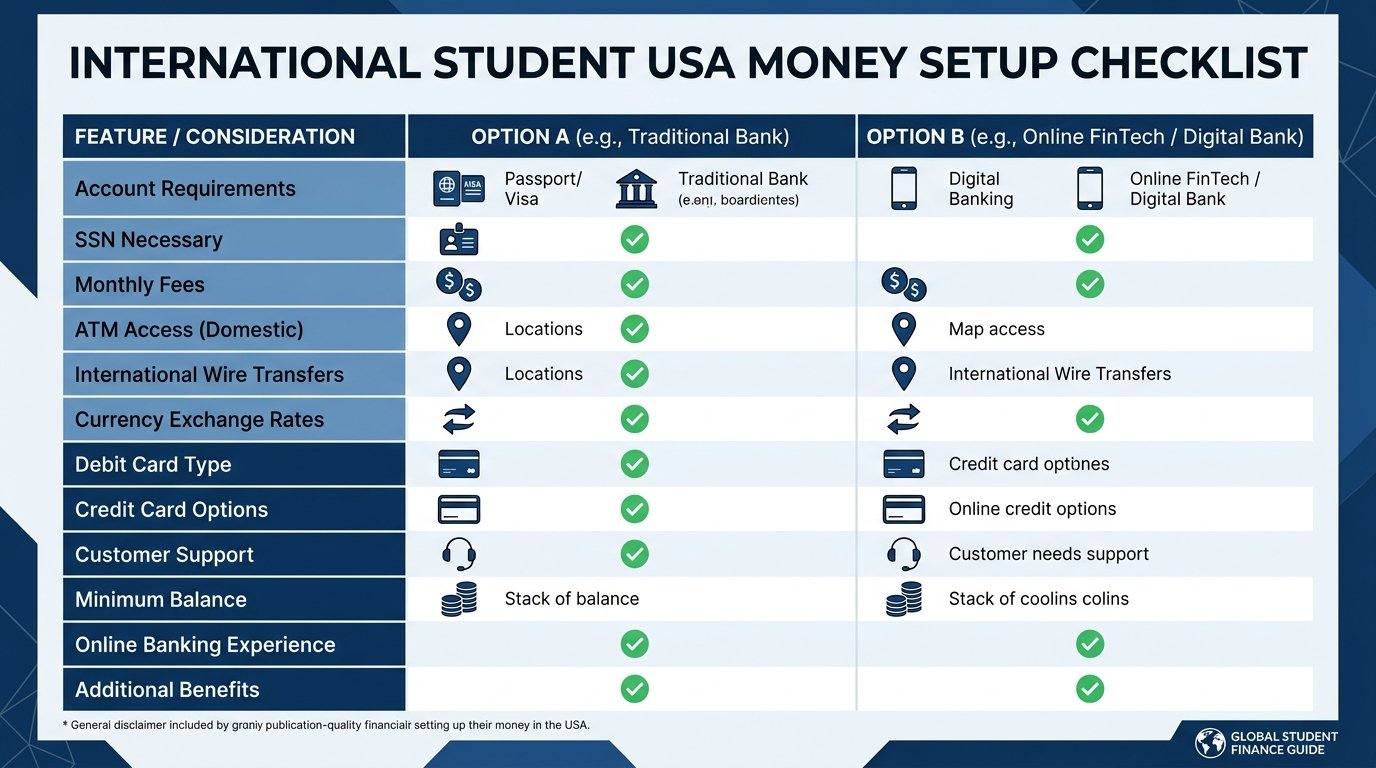
How Key Financial Setup Tasks Compare: International Students in the USA
Understanding which financial setup steps are urgent, costly, and consequential helps you allocate time and money effectively. The table below maps each core task across four dimensions — urgency, typical cost, regulatory body, and common pitfall — so you can prioritize without guesswork.
| Setup Task | Urgency | Typical Cost | Governing Body / Regulation | Common Pitfall for Students |
|---|---|---|---|---|
| SEVIS Registration & I-901 Fee | Immediate (pre-arrival) | Qualitative only — fee varies; check current amount at ice.gov/sevis/i901 | DHS / ICE under SEVIS mandate | Paying through unofficial third-party sites; always use the official portal |
| Campus Bank Account Opening | First week on campus | Generally free for student accounts | FDIC-regulated commercial banks | Bringing insufficient identity documents; banks typically require passport + I-20 + enrollment letter |
| Social Security Number (SSN) Application | After receiving employment offer or OPT authorization | No government fee | Social Security Administration | Applying before authorization is confirmed — SSA will reject premature applications |
| ITIN Application (if SSN ineligible) | Before first U.S. tax filing deadline | No government fee | IRS / Form W-7 | Using an uncertified CAA (Certifying Acceptance Agent); always verify agent credentials on IRS.gov |
| On-Campus Employment Setup | Once enrolled and before starting work | No fee | USCIS — capped at 20 hours per week during term | Exceeding the weekly hour limit, which can jeopardize F-1 status |
| OPT / STEM OPT Authorization | File 90 days before to 60 days after program end date — strict USCIS deadline | USCIS filing fee — amount varies; confirm current fee at USCIS.gov | USCIS — up to 12 months OPT; 24-month STEM extension available | Missing the application window — late filing forfeits eligibility |
| Credit-Building Product (secured card or credit-builder loan) | Within first semester | Deposit requirement varies by issuer | CFPB-regulated financial institutions | Choosing products that do not report to all three major credit bureaus — defeats the purpose |
Treat SEVIS compliance and SSN/ITIN acquisition as non-negotiable foundations; every downstream task — employment, banking, tax filing, and credit — depends on these being correct. Students who skip or delay the ITIN step routinely face penalties at tax time, while those who misread OPT work authorization rules risk status violations. Address regulatory steps first, then layer on credit and savings products once your legal financial identity is established.
Illustrative Scenarios
The following are illustrative scenarios, not real testimonials or case studies of specific individuals.
Illustrative Scenario: International Student, STEM Graduate Program (Midwest)
A visa-compliant F-1 student completes their degree and pursues the post-completion OPT period, then applies for the 24-month STEM extension, using that extended authorization window to build U.S. credit history and transition from a student checking account to a fuller banking relationship — all before needing to reconsider visa status.
Expert Recommendations: Best Accounts and Tools for International Students in the USA
Top Pick: Checking Account at a Large National Bank with Student Waived Fees
For most F-1 students arriving in the USA, opening a checking account at a major national bank — Chase, Bank of America, or Wells Fargo — remains the strongest foundation for a workable money setup. These institutions maintain dedicated student account tiers that typically waive monthly maintenance fees with proof of enrollment, accept a passport and I-20 in lieu of an SSN at account opening, and offer extensive ATM networks that reduce cash-handling friction during your first weeks on campus.
The practical advantage here is integration: a large national bank connects directly to federal payroll systems, university direct-deposit pipelines, and most domestic bill-pay platforms. When work authorization begins — whether through on-campus hours capped at 20 per week during the academic term or through post-completion OPT, for which USCIS may authorize up to 12 months — your employer’s payroll team will almost always require a domestic routing and account number. Delays in getting one translate directly into delayed pay.
Credit-building potential is the second decisive factor. Many of these banks offer a secured credit card or a student credit card accessible to non-SSN holders via ITIN, letting you begin accumulating a US credit history from day one — a timeline advantage that compounds significantly by the time you seek housing or financing for post-graduation transitions.
Best for: Students at large or mid-sized universities who need immediate direct-deposit capability and plan to build US credit in parallel.
Runner-Up: FDIC-Insured Online-First Bank (Wise, Revolut, or Similar Licensed MSB)
For students managing regular transfers from home-country family support, or those enrolled at institutions in smaller cities with limited branch infrastructure, a licensed online-first provider operating as a registered Money Services Business (MSB) under FinCEN oversight offers a compelling secondary layer.
These platforms typically offer multi-currency holding, competitive mid-market exchange rates, and low or zero foreign transaction fees — reducing the real cost of receiving international support funds. They are not deposit institutions, so they should complement, not replace, your primary checking account. Crucially, eligible STEM graduates can extend OPT by an additional 24 months, meaning international students may spend several years in the US — long enough that minimizing currency conversion drag on recurring transfers produces meaningful savings over time.
Best for: Students receiving regular remittances from abroad, or those prioritizing low-cost international transfers alongside a primary domestic bank account.
Frequently Asked Questions: International Students Money Setup in the USA
What bank account type should international students open first?
Most newcomers benefit from opening a checking account before anything else — it receives direct deposits, pays bills, and connects to mobile payment apps. Look for student checking accounts at major banks or credit unions that waive monthly fees with a qualifying student ID or minimum balance. Some institutions, including fintech options like Wise or Revolut, accept a passport and student visa in place of a Social Security Number during initial setup. Avoid accounts with foreign transaction fees if you’ll receive funds from home. Confirm your chosen institution is FDIC-insured before depositing.
Do international students need an SSN or ITIN to open a bank account?
Neither is strictly required to open a basic bank account — most institutions accept a valid passport, F-1 visa, and university enrollment letter. However, an SSN becomes necessary once you begin on-campus employment or authorized practical training, and an ITIN is needed to file a U.S. tax return if you have U.S.-sourced income but no SSN eligibility. Contact your Designated School Official (DSO) early; they can confirm your work authorization status and advise on the correct identification path for your situation.
When can international students start working, and how many hours are allowed?
F-1 students may begin on-campus work as soon as they maintain valid F-1 status (see USCIS OPT page). Off-campus employment requires separate authorization such as Curricular Practical Training (CPT) or Optional Practical Training (OPT). Exceeding authorized work limits jeopardizes your F-1 status, which in turn affects your banking, credit-building timeline, and any future visa applications. Always verify current authorization with your DSO before accepting any paid role.
How does Optional Practical Training affect my financial setup?
Approved post-completion OPT allows up to 12 months of authorized employment after degree completion, giving you access to full-time income and a legitimate basis to apply for an SSN. This unlocks employer direct deposit, credit card eligibility, and stronger loan applications. Students in qualifying STEM programs may apply for a 24-month OPT extension, substantially extending the window to build U.S. credit history and financial standing before needing to transition visa status.
What is the SEVIS fee and how does it affect my budget?
The I-901 SEVIS fee is a mandatory government charge paid before your student visa interview; the current amount varies and may be updated, so always verify the latest figure directly at ice.gov/sevis/i901 rather than relying on third-party sources. This fee is separate from your university application costs and visa application fees. Factor it into your pre-departure financial plan — it must typically be paid and confirmed before the U.S. consulate schedules your interview, making it a non-negotiable early expense.
How should international students build a U.S. credit history with no prior record?
Start with secured credit cards, which require a cash deposit as collateral and report payment activity to the major bureaus. Some issuers, including certain fintechs, use alternative underwriting that considers your university enrollment rather than a traditional credit score. Credit-builder loans offered by community credit unions are another effective tool. Make all payments in full and on time — payment history is typically the most heavily weighted factor in U.S. scoring models. Even several months of consistent activity meaningfully improves your profile compared to a blank file.
Are international students required to file a U.S. tax return?
Yes — if you received any U.S.-sourced income (wages, scholarships exceeding tuition, stipends) during the tax year, you are generally required to file with the IRS. Even students with no income may need to file Form 8843 to document their exempt individual status under applicable tax treaty provisions. Your country of origin may have a bilateral tax treaty with the United States that reduces withholding on certain income types. Consult a tax professional familiar with nonresident alien filing obligations, or use IRS-approved software that supports Form 1040-NR before each April deadline.
What happens to my bank accounts and credit cards if my visa status changes or expires?
U.S. bank accounts and credit cards are not automatically closed when a visa expires — they remain open as long as the account is in good standing and you maintain the institution’s residency requirements. However, if your status lapses or you depart the country, some banks may restrict certain account features or flag accounts as dormant. Before any change in status, notify your financial institutions, set up international wire transfer access, and download statements for records. Maintaining continuity protects your credit history and simplifies re-entry financial setup if you return on a different visa category.
Can international students send money home from a U.S. bank account?
Yes — international wire transfers are available through most U.S. banks, though fees and exchange rate markups vary significantly by provider. Dedicated money transfer services often offer more competitive rates than traditional bank wires for common corridors. The Financial Crimes Enforcement Network (FinCEN), operating under the Bank Secrecy Act, requires U.S. financial institutions to report large or suspicious transactions, so large transfers may prompt identity verification requests. Keep documentation of the source of funds (pay stubs, scholarship letters) readily available to avoid delays during compliance checks.
What financial documents should international students keep organized throughout their studies?
Maintain a secure digital and physical file containing: your passport and visa stamp, I-20 or DS-2019 form, SEVIS confirmation, SSN or ITIN correspondence, all bank account agreements, tax returns and Form 8843 copies, scholarship award letters, and any employment authorization documents. These records are frequently requested during apartment rental applications, credit card underwriting, employment verification, and future visa or immigration applications. Losing access to these documents — particularly SEVIS and DSO correspondence — can create costly delays. Cloud-encrypted storage with a local backup is the recommended approach for long-term document security.
Conclusion
Building a solid financial foundation as an international student in the United States requires navigating overlapping regulatory systems—immigration, banking, tax, and employment authorization—simultaneously, often within your first weeks on campus.
The checklist covered in this guide reflects the practical reality that standard financial advice rarely accounts for F-1 visa constraints. Work authorization boundaries matter: campus employment carries strict weekly hour limits during the academic term (USCIS), and post-degree work through OPT is time-bound, with eligible STEM graduates able to pursue a longer extension beyond the standard authorization period (USCIS STEM OPT).
Getting your status infrastructure right—SEVIS compliance, your DSO relationship, ITIN or SSN acquisition, and IRS filing obligations—is not optional. These steps unlock access to banking, legitimate income, and long-term credit history in the U.S.
Newcomers who treat financial setup as a secondary concern often face avoidable setbacks: frozen accounts, missed tax deadlines, or gaps in credit history that complicate future visa transitions. Those who prioritize the sequence outlined here typically enter their post-graduation phase with a functioning U.S. credit profile, a compliant tax record, and clear earnings documentation.
Start early, verify every step with your Designated School Official, and consult a licensed tax professional familiar with nonresident obligations. Your financial future in the United States is built on the groundwork you lay in the first semester.
Disclaimer
For Informational Purposes Only
The content published on MoneyAbroadGuide.com, including this guide, is intended solely for general informational and educational purposes. It does not constitute legal, immigration, tax, or financial advice. Immigration and tax regulations governing F-1 students—including SEVIS requirements, ITIN procedures, OPT authorization (USCIS), and STEM OPT eligibility (USCIS)—are subject to change. Always verify current requirements directly with official government sources, your Designated School Official, or a licensed immigration attorney and qualified tax professional.
Affiliate Disclosure
MoneyAbroadGuide.com may receive compensation when readers open accounts or purchase products through links on this site. This financial relationship does not influence editorial content, rankings, or recommendations. Our editorial team operates independently of commercial partnerships.
Accuracy
We make reasonable efforts to ensure accuracy at time of publication; however, we make no guarantees regarding completeness or currency of information. Readers rely on this content at their own discretion.
About the Author
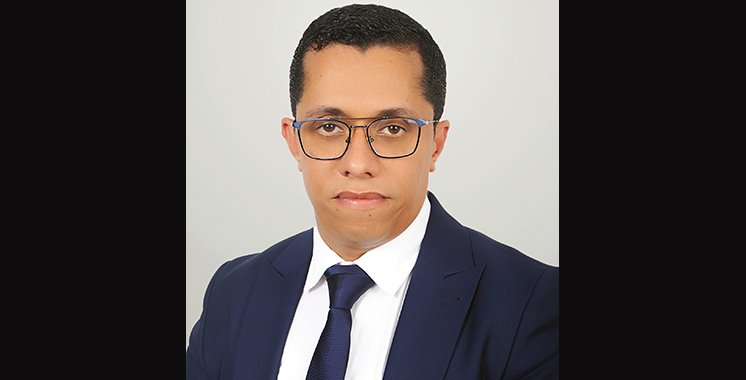
Talal Eddaouahiri is the founder of MoneyAbroadGuide.com, an independent financial information platform for immigrants and newcomers in the United States and Canada. Originally from Morocco, he settled in the U.S. in 2015 and built his own credit history and banking relationships from scratch in both countries. His background is in retail banking and customer relations, and he draws on that firsthand experience to write independent, source-based guides — citing regulators including the FCAC, FINTRAC, OSFI, CRA, IRS, and CDIC — to help newcomers navigate financial systems with confidence.
Learn more about our Fact-Checking Process and our How We Test when researching this guide.
Last Updated: July 2026
About Talal Eddaouahiri
Founder & Editor of MoneyAbroadGuide.com. A Moroccan immigrant who settled in the United States in 2015, Talal opened bank accounts and built credit from zero in both the US and Canada. His background is in retail banking and customer relations, and he writes independent, source-based guides (FCAC, FINTRAC, OSFI, CRA, IRS, CDIC) to help newcomers navigate their first financial steps. Read his full profile →