
Best Wise vs Xe vs OFX vs Remitly: Complete Guide for USA Immigrants (2026)
Quick Answer: For most USA immigrants, Wise leads on transparency and mid-market exchange rates, Remitly wins on speed to key corridors, OFX suits larger transfers, and Xe offers broad currency coverage. Your best choice depends on amount, destination, and urgency.
Sending money internationally is one of the most financially consequential decisions immigrants in the United States make regularly. Whether you’re supporting family back home, paying overseas rent, or repatriating savings, the provider you choose directly affects how much arrives on the other side.
The U.S. remittance market is among the largest in the world, and the stakes are high enough that federal regulators at the Consumer Financial Protection Bureau (CFPB) maintain dedicated resources to protect senders — covering everything from required disclosures to dispute rights. Before comparing providers, it’s worth knowing that under the Electronic Fund Transfer Act (Regulation E), you have the right to cancel a remittance transfer for a full refund within 30 minutes of payment (CFPB Regulation E §1005.34).
This guide cuts through marketing noise to compare Wise, Xe, OFX, and Remitly on the metrics that matter most to immigrants: exchange rate markup, fees, transfer speed, supported corridors, and regulatory standing. All four providers operate as licensed Money Services Businesses (MSBs) registered with FinCEN (Financial Crimes Enforcement Network) under the Bank Secrecy Act.
Newcomers frequently report being surprised by hidden costs that weren’t visible at checkout — a problem federal consumer protections specifically address. Senders also navigating the Canadian market will find our Wise vs Remitly Canada 2026: Best Alternative for Newcomers (Fees Compared) a useful companion.
The sections below cover fees, speeds, limits, and real-world use cases — everything you need to make a confident, cost-effective choice in 2026.
1. Best Wise Vs Xe Vs OFX Vs Remitly for USA Immigrants in 2026: Quick Overview
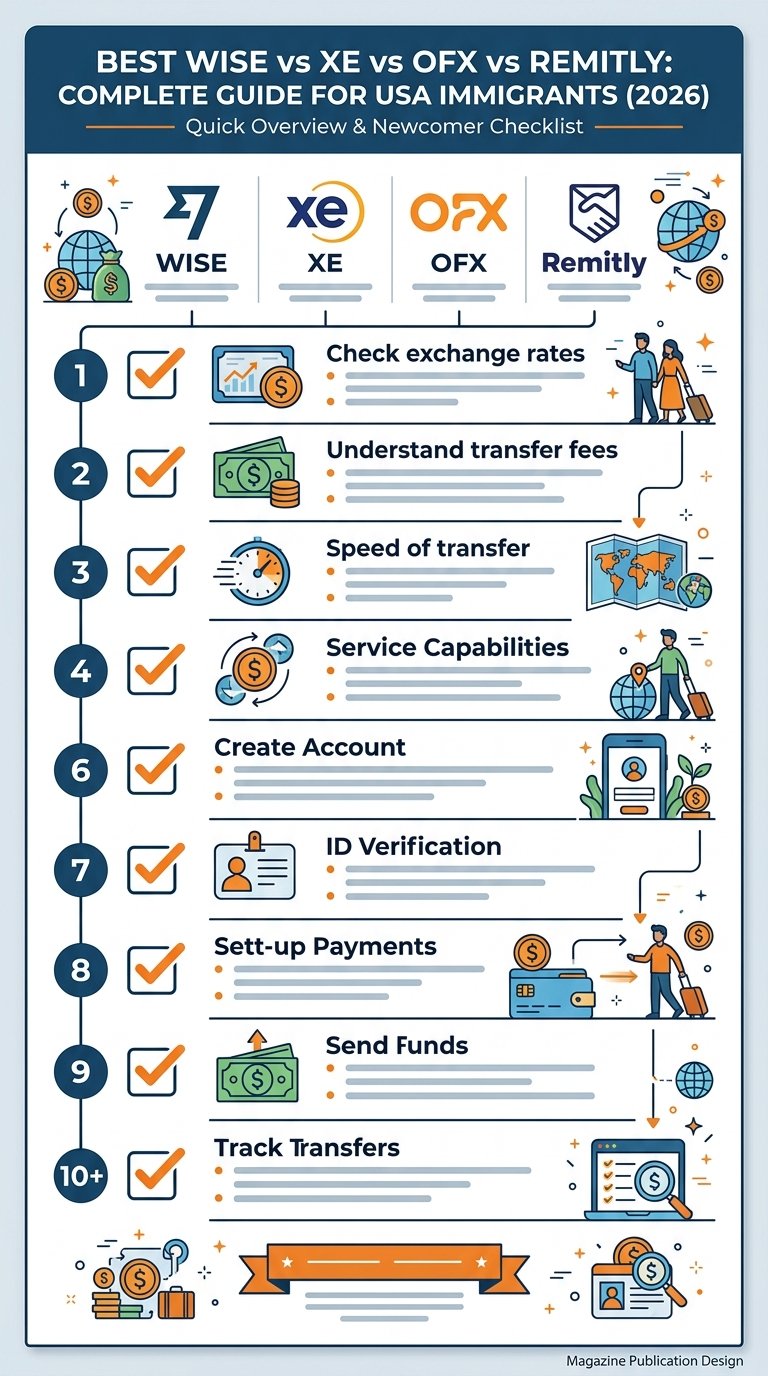
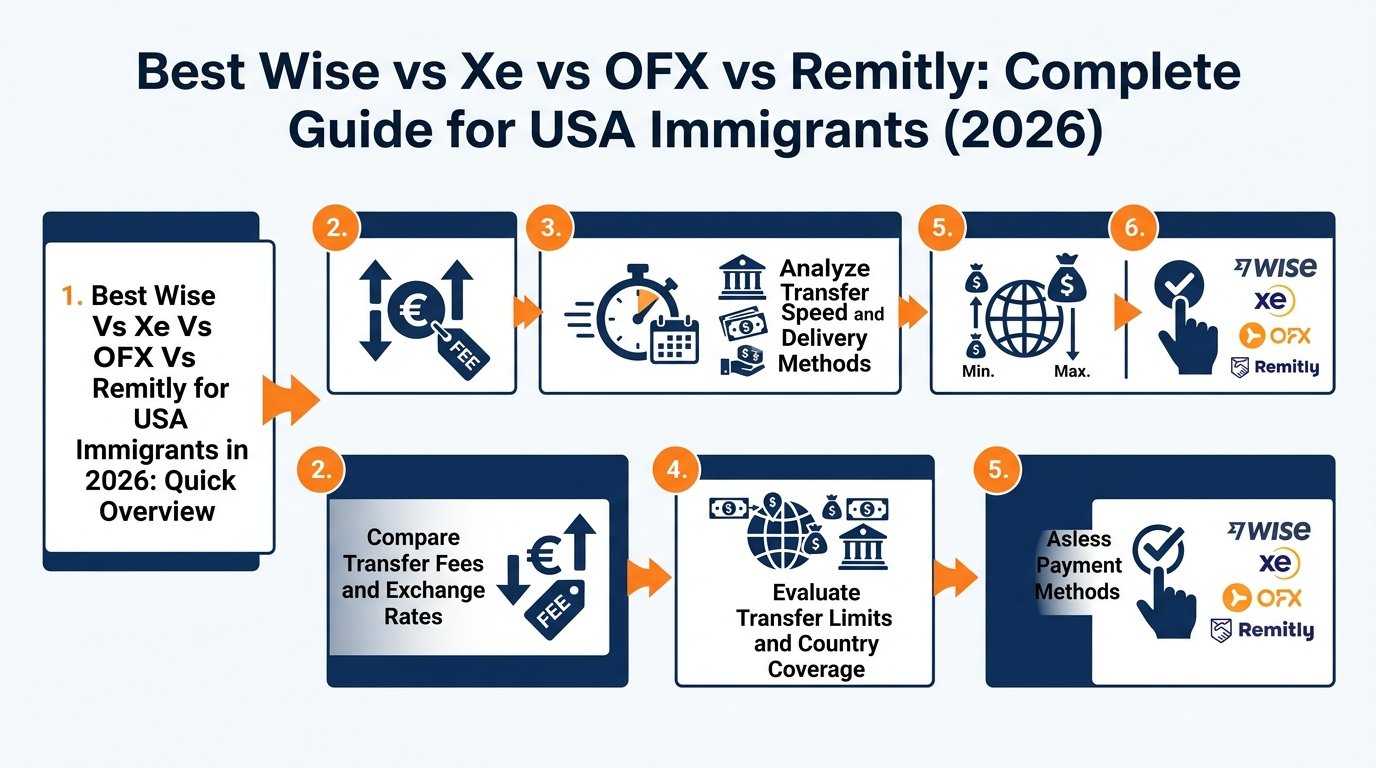
Four platforms dominate international money transfers for immigrants living in the United States: Wise, Xe, OFX, and Remitly. Each targets a different user profile, and choosing the wrong one can cost you meaningful money on every transfer.
What Sets Each Platform Apart
Wise operates on the mid-market exchange rate with transparent, percentage-based fees. It suits immigrants who send varying amounts regularly and want a multi-currency account alongside transfers.
Xe is best known for its real-time rate data and functions as a transfer service for larger amounts with fees that shrink as transfer size grows.
OFX targets higher-value transfers, offering rate-lock contracts and dedicated relationship managers for frequent senders. It is regulated under the Bank Secrecy Act and registered with FinCEN as a Money Services Business.
Remitly is designed for the immigrant corridor market — fast delivery options, mobile-first interface, and promotional rates for first-time senders. It’s particularly competitive for transfers to Latin America, the Philippines, India, and parts of Africa.
Why This Comparison Matters in 2026
According to the CFPB’s sending money tools, consumers frequently underestimate the total cost of a transfer by focusing on the stated fee while missing exchange rate markups. The real cost is the combination of both. For example, a newcomer sending monthly to family abroad could pay anywhere to in effective total costs depending on which platform and delivery speed they choose —a difference that compounds to annually.
All four providers must comply with CFPB Regulation E requirements for remittance transfers, meaning each must provide upfront disclosures showing the fees, exchange rate, and the exact amount the recipient will receive before you pay.
User Profile Match at a Glance
| Profile | Best Fit |
|---|---|
| Frequent small-to-mid transfers | Wise |
| Large, one-off transfers | OFX or Xe |
| Speed-priority corridor transfers | Remitly |
| Rate transparency above all | Wise or Xe |
Key Regulatory Baseline
All four platforms are registered with FinCEN and subject to the Bank Secrecy Act, as noted above. Immigrants without a Social Security Number can still use most of these services with an ITIN or valid passport — though identity verification requirements vary by transfer amount and destination.
The sections that follow compare fees, exchange rate markups, transfer speeds, and eligibility requirements in detail so you can match the right platform to your specific sending pattern.
2. What Is Wise vs Xe vs OFX vs Remitly and Why Do Immigrants Need It?
These four platforms are licensed money service businesses (MSBs) registered with the Financial Crimes Enforcement Network (FinCEN) and regulated under the Bank Secrecy Act (as noted above). Each offers a distinct approach to moving money across borders — a need that affects virtually every immigrant in the United States.
Why International Transfers Are a Distinct Financial Problem
Traditional U.S. bank wire transfers typically cost per transaction, apply wide exchange rate margins, and can take two to five business days. For immigrants supporting families abroad, paying international rent, or repatriating savings, these costs accumulate into thousands of dollars annually. According to FDIC Consumer Resource Center data, a significant share of U.S. adults — disproportionately immigrants and the foreign-born — remain underserved by conventional banking products, making low-cost transfer alternatives especially critical.
How Each Platform Fits a Different Immigrant Use Case
Wise operates a multi-currency account and uses the mid-market exchange rate, charging a transparent percentage fee per transfer. It suits immigrants who hold money in multiple currencies, pay international subscriptions, or receive foreign income.
Xe (owned by Euronet Worldwide) caters primarily to larger, less frequent transfers — relocation funds, international property payments, or business invoices — where rate negotiation and dedicated support have more value.
OFX (as noted above) similarly targets high-value transfers, with no transfer fee above threshold amounts and rate locks for currency risk management — relevant to immigrants purchasing real estate abroad or moving significant assets.
Remitly is engineered for recurring, smaller remittances — a pattern common among workers sending money to Latin America, South Asia, and the Philippines. Its Express vs. Economy delivery options let senders trade speed against cost.
For example, a newcomer sending money monthly to family abroad will find Remitly’s economy tier meaningfully cheaper than a bank wire, while an immigrant wiring a down payment for overseas property would benefit from OFX’s rate-lock facility.
Key Consumer Protections Specific to MSBs
Beyond the cancellation rights already covered, federal Regulation E requires that providers give you a clear disclosure — showing fees, the exchange rate applied, and the precise amount the recipient will receive — before you authorize any transfer (CFPB). If something goes wrong after sending, you have up to 180 days to report the error; the provider generally has 90 days to investigate and report results (CFPB Regulation E §1005.33). These federal-level protections apply uniformly across Wise, Xe, OFX, and Remitly — a meaningful advantage over informal transfer methods.
Immigration Status and Access
None of these platforms require a Social Security Number as a primary identifier; an ITIN (as noted above) or foreign passport is typically sufficient for identity verification, making them accessible during the early months of U.S. residency before formal credit history is established.
3. Eligibility Requirements for Immigrants
Qualifying to use Wise, Xe, OFX, or Remitly in the United States depends on identity verification standards set by the Financial Crimes Enforcement Network (FinCEN) under the Bank Secrecy Act — the anti-money-laundering framework already referenced above. Each platform operates as a licensed Money Services Business (MSB), which means federal and state-level compliance requirements apply uniformly.
Identity Documentation: What Each Platform Actually Accepts
All four platforms require government-issued photo ID. The practical difference for immigrants is which documents qualify:
Wise accepts passports, foreign national IDs, and U.S. state-issued driver’s licenses. Visa type is not screened at signup — undocumented immigrants without an SSN can apply using an Individual Taxpayer Identification Number (ITIN) or foreign passport, though functionality may be limited pending verification.
Xe accepts passports and government-issued IDs. Because Xe targets larger business-scale and individual transfers, it sometimes requests supplementary proof of address (utility bill, bank statement) for higher-value transactions.
OFX follows a more structured Know Your Customer (KYC) process given its focus on high-value transfers. Applicants typically provide a passport plus proof of U.S. address. OFX may request source-of-funds documentation for transfers above certain thresholds.
Remitly has among the most accessible onboarding for new arrivals: it accepts foreign passports, foreign driver’s licenses, consular IDs (including the Mexican Matrícula Consular), and ITINs. For example, a recently arrived newcomer without a U.S. credit history or SSN can open a Remitly account using only a foreign passport and a linked debit card —making it the most accessible option during the first of U.S. residency.
Immigration Status and Platform Access
No federal law restricts international money transfers based on immigration status. DACA recipients, TPS holders, visa holders (F-1, H-1B, L-1, O-1), lawful permanent residents, and naturalized citizens are all eligible to use these platforms provided they satisfy KYC requirements.
According to the CFPB’s money transfer resources, consumers are entitled to clear, upfront information about transfer terms — a protection that applies regardless of immigration status. The provider must also supply pre-payment disclosures showing fees, the exchange rate, and the exact amount the recipient receives before payment is made.
State Licensing: Why It Matters for Eligibility
MSB licensing is state-specific. All four platforms hold money transmitter licenses across most U.S. states, but coverage gaps exist. OFX, for instance, does not currently operate in certain states. Verify your state before completing registration —using an unlicensed provider in your state creates unresolved recourse problems if a transfer error occurs within the error-reporting window noted previously.
Minimum Requirements Summary
| Requirement | Wise | Xe | OFX | Remitly |
|---|---|---|---|---|
| SSN required | No | No | No | No |
| ITIN accepted | Yes | Varies | Rarely | Yes |
| Foreign passport accepted | Yes | Yes | Yes | Yes |
| Consular/foreign national ID | Yes | Limited | No | Yes |
| Proof of U.S. address needed | Sometimes | Sometimes | Usually | Rarely |
Remitly’s document flexibility makes it the strongest entry point for immigrants in early-settlement stages; Wise and OFX suit those with more established U.S. identity documentation.

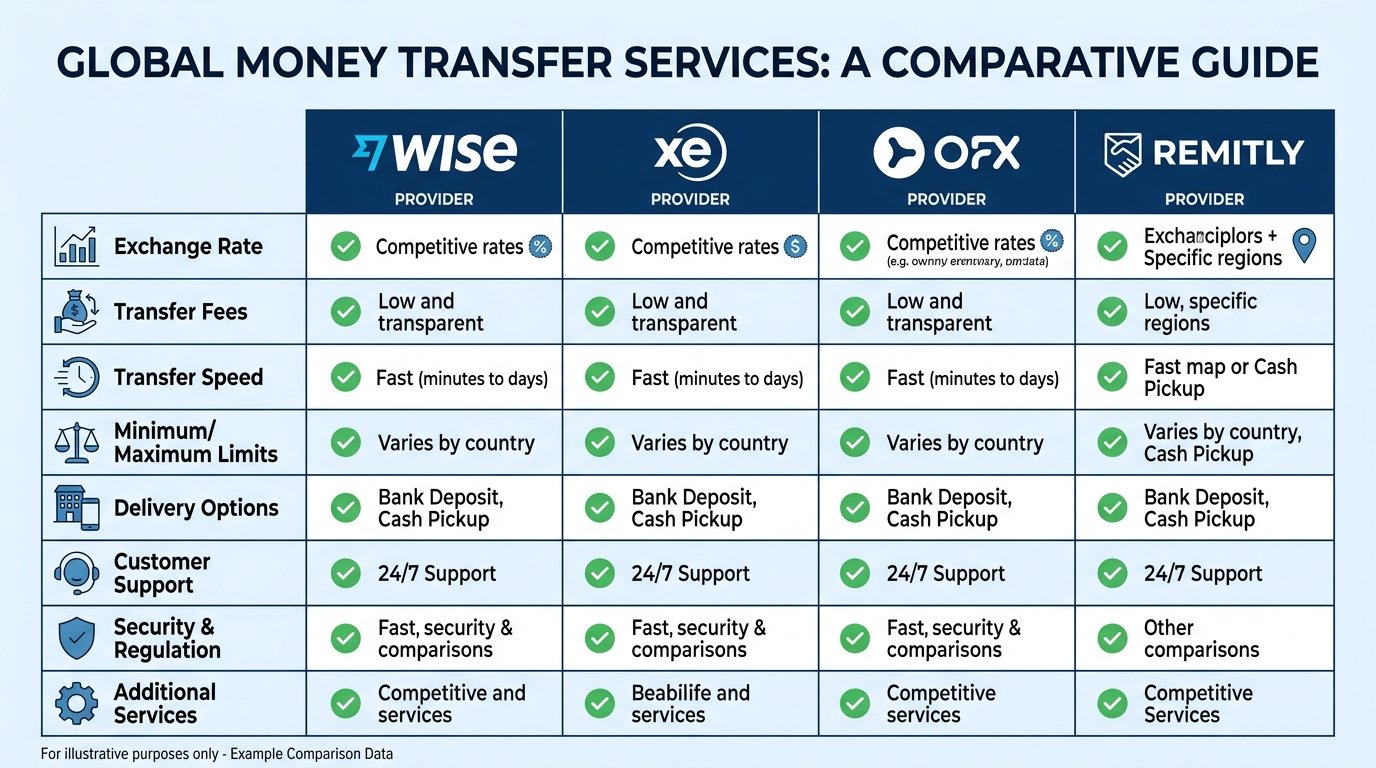
4. Side-by-Side Comparison: Wise vs Xe vs OFX vs Remitly (USA)
Choosing between these four platforms requires looking beyond headline exchange rates. Each provider structures costs, speed, and access differently — and for immigrants sending money regularly, those differences compound over time. Before any transfer is initiated, providers regulated under the Electronic Fund Transfer Act must show you the fees, the applicable exchange rate, and the precise amount your recipient will collect — all before you authorize payment (CFPB). If something goes wrong, you have up to 180 days to file a dispute (CFPB Reg E §1005.33).
| Feature | Wise | Xe | OFX | Remitly |
|---|---|---|---|---|
| Exchange Rate Model | Mid-market rate + transparent fee | Competitive rate, margin varies by corridor | Negotiated rate (margin built in) | Two tiers: Economy (lower rate) vs Express (near mid-market) |
| Transfer Fees | Percentage-based + small fixed fee | No stated transfer fee; margin in rate | No transfer fee; margin in rate | Fee varies by speed tier and destination |
| Transfer Speed | varies by provider — confirm directly | varies by provider — confirm directly | varies by provider — confirm directly | varies by provider — confirm directly |
| Minimum Transfer | No meaningful minimum | Varies by corridor | Typically higher minimums (suited to larger transfers) | Low minimums; accessible for small sends |
| ITIN Accepted | Yes | Yes | Varies by state and KYC tier | Yes |
| Best For | Frequent senders wanting fee transparency | Mid-to-large transfers with no flat fee | Large, recurring business or personal transfers | Remittances to Latin America, South Asia, Philippines |
| CFPB-Regulated MSB | Yes | Yes | Yes | Yes |
| Cancel Window | 30 min for full refund (CFPB §1005.34) | 30 min for full refund | 30 min for full refund | 30 min for full refund |
Key takeaway: Wise suits immigrants who prioritize knowing exactly what they pay in fees separately from the rate. Remitly wins on accessibility and corridor depth for common immigrant destinations. OFX is strongest for larger, less-frequent transfers where negotiating the rate matters. Xe occupies the middle ground — no flat fee, reasonable rates, but less granular cost disclosure than Wise.
Illustrative Scenarios
The following are illustrative scenarios, not real testimonials or case studies of specific individuals.
Illustrative Scenario: Temporary Work Visa Holder, Cross-Border Family Support
A visa holder sending regular support payments abroad compares platforms side by side, reviewing upfront disclosures on transfer costs and destination amounts—as providers are required to show under federal rules—before confirming each transfer.
Expert Recommendation: Which Platform Should USA Immigrants Choose?
After evaluating fees, exchange rate transparency, eligibility flexibility, and regulatory standing, two providers stand out for most immigrant use cases in 2026.
Top Pick: Wise
Wise earns the top position for immigrants who prioritize cost clarity and multi-currency flexibility. Its mid-market exchange rate pricing and itemized fee structure mean you see precisely what the transfer costs — and what lands in your recipient’s account — before committing, as required under CFPB remittance transfer disclosure rules. For immigrants managing regular remittances to Canada, a Wise multi-currency account also reduces the need to initiate separate transfers each time exchange conditions shift.
Wise accepts ITIN in addition to SSN, making it accessible to immigrants who have not yet obtained a Social Security Number — a meaningful advantage over platforms with stricter identity requirements. DACA and TPS holders report consistent account approval, provided KYC documentation requirements are met.
For a detailed cost comparison on the Canada corridor specifically, see Send Money from USA to Canada 2026: Cheapest Ways to Transfer (Wise vs Remitly vs Bank Wire).
Runner-Up: Remitly
Remitly is the stronger choice for immigrants sending to Latin America, South Asia, or other high-volume remittance corridors where speed is the priority. Its Express tier delivers faster settlement, and its straightforward mobile experience suits users who send smaller amounts frequently rather than large one-off transfers.
Remitly’s promotional rates for first-time users can meaningfully reduce the cost of an initial transfer — though standard pricing applies thereafter, so compare rates on subsequent transactions before defaulting to habit.
One practical note applicable to both picks: under the Electronic Fund Transfer Act as implemented through CFPB Regulation E, you have a 30-minute cancellation window for a full refund after payment. If a rate moves unfavorably or you entered recipient details incorrectly, act within that window.
When to Consider Xe or OFX Instead
Xe suits immigrants comfortable tracking mid-market rate movements who want to time transfers manually. OFX becomes cost-competitive on larger transfers — typically above amounts where its zero-fee, adjusted-spread model undercuts per-transaction fee structures — and its dedicated support line appeals to users who prefer human assistance over app-only service.
Frequently Asked Questions
Which provider offers the best exchange rate among Wise, Xe, OFX, and Remitly?
Wise consistently tracks closest to the mid-market rate, applying a transparent percentage-based fee instead of embedding profit in the spread. Xe and OFX both mark up the interbank rate, though OFX margins narrow on larger transfers. Remitly’s rate depends heavily on the destination corridor and delivery speed—Express transfers often carry a wider spread than Economy. For any single transfer, run a side-by-side quote on all four platforms at the same moment, since rates fluctuate in real time and corridor pricing varies significantly.
Do I need a Social Security Number to use these platforms?
Requirements differ by provider. Wise and Remitly accept an Individual Taxpayer Identification Number (ITIN) as an alternative to an SSN for identity verification under Know Your Customer (KYC) rules. Xe may accept passport-only verification for lower transfer amounts. OFX typically requires stronger documentation for account approval. Immigration statuses such as DACA or TPS do not automatically disqualify applicants, but each platform sets its own internal compliance thresholds as licensed Money Services Businesses (MSBs).
How quickly does each platform deliver funds internationally?
Remitly’s Express service often reaches major corridors within minutes when funded by debit card. Wise typically settles in one to two business days for most routes, though some currency pairs clear faster. OFX generally targets one to three business days and suits non-urgent, larger transfers. Xe speed depends on the payment method and destination bank; bank-funded transfers run slower than card-funded ones. Delivery estimates shown at checkout reflect business banking hours, not calendar days.
What upfront disclosures am I entitled to before I pay?
Before you authorize any transfer, each provider must show you the applicable fees, the exchange rate being applied, and the precise amount the recipient will receive at their end—as required under federal consumer protection rules (CFPB). Review this disclosure screen carefully before confirming, since the locked rate and fee total shown there are the figures that govern your transaction legally.
Can I cancel a transfer if I change my mind?
Under federal remittance regulations, you may cancel and receive a full refund within 30 minutes of payment, regardless of whether the provider’s customer service is open at that moment (CFPB Regulation E, 12 CFR 1005.34). After that window closes, cancellation depends on whether funds have already been credited abroad. Wise and Remitly surface a cancel button in-app during the eligible period; OFX and Xe require you to contact support directly.
What happens if something goes wrong with my transfer?
You have up to 180 days from the transfer date to report an error, and the provider generally must complete its investigation and communicate the outcome within 90 days (CFPB Regulation E, 12 CFR 1005.33). Covered errors include funds not arriving, incorrect amounts delivered, and unauthorized transactions. Document your confirmation number, the disclosed amounts from your receipt, and any correspondence—this strengthens your error-resolution claim with whichever platform you used.
Is Remitly or Wise better for sending money to Latin America?
Remitly is purpose-built for high-volume consumer corridors and tends to offer competitive pricing to Mexico, Colombia, Guatemala, and other Latin American destinations, particularly for smaller, frequent transfers. Wise covers many of the same corridors with mid-market-rate transparency but may cost more on express timelines. For larger amounts—typically above several thousand dollars—OFX’s relationship-based pricing can undercut both. The best answer depends on transfer size, recipient country, and how urgently funds are needed.
Are these platforms regulated and safe to use in the USA?
All four operate as registered MSBs with the Financial Crimes Enforcement Network (FinCEN) and hold state-level money transmission licenses required by each jurisdiction they serve. They comply with the Bank Secrecy Act for anti-money-laundering obligations and are subject to CFPB oversight on consumer-facing transfer disclosures. Neither Wise’s multi-currency account nor the other platforms’ holding balances carry FDIC deposit insurance, since they are not chartered banks—a meaningful distinction for immigrants holding significant balances on-platform.
Which platform works best for large transfers above several thousand dollars?
OFX is specifically structured for higher-value transfers, offering dedicated dealer support and potentially tighter exchange rate margins as transfer size increases. Xe also positions itself for larger amounts, particularly for business clients. Wise imposes per-transaction and daily limits that vary by verification tier, so high-volume senders should confirm their account limit before initiating. Remitly’s send limits are generally lower and better suited to regular household remittances than to large one-time transfers.
Can undocumented immigrants or those with temporary status use these services?
Eligibility is determined by each platform’s internal KYC and compliance policies, not by immigration status alone. Holders of Temporary Protected Status (TPS) and certain other non-permanent statuses can often open accounts where a valid government-issued ID and ITIN satisfy verification requirements. Platforms are legally prohibited from discriminating solely on national origin under federal consumer protection frameworks, but they retain discretion to apply risk-based identity thresholds. Applicants who are declined by one provider should try another, as policies differ materially across the four platforms.
Conclusion
Choosing between Wise, Xe, OFX, and Remitly ultimately depends on your sending pattern, destination country, and immigration status.
Wise suits immigrants who value mid-market rate transparency and send frequently to major corridors. Remitly is the practical choice for first-time senders and those supporting family in Latin America or South Asia, particularly when speed matters. OFX rewards higher-volume senders with competitive margins and no per-transfer fee structure. Xe fits those who prioritize corridor breadth and the backing of Euronet Worldwide’s established infrastructure.
All four platforms operate as licensed Money Services Businesses under U.S. federal oversight, giving immigrants meaningful protections regardless of which provider they choose. Before committing to any transfer, confirm that the provider has shown you the fees, the exchange rate, and the precise amount your recipient will collect upfront — as required under CFPB rules at consumerfinance.gov. If something goes wrong, the error-resolution window runs to 180 days per Regulation E §1005.33.
Practically, run a live quote on all four platforms before each large transfer — spreads and promotions change frequently. For DACA and TPS holders, Remitly and Wise remain the most accessible entry points given their ITIN acceptance policies.
No single provider wins every category. Match the platform to your specific corridor, amount, and timeline.
Disclaimer
Not Financial Advice. The content on MoneyAbroadGuide.com is provided for general informational purposes only and does not constitute financial, legal, immigration, or tax advice. Always consult a licensed financial advisor, immigration attorney, or tax professional before making decisions that affect your financial situation.
Accuracy & Changes. Fee structures, exchange rate policies, eligibility requirements, and regulatory statuses change frequently. While we strive to maintain current information, MoneyAbroadGuide.com makes no warranty — express or implied — regarding the completeness or accuracy of any figures cited. Verify current rates and terms directly with each provider before initiating a transfer.
Affiliate Disclosure. MoneyAbroadGuide.com may receive compensation when you click on links to, or sign up with, providers featured in this article. This compensation may influence which providers are highlighted; however, it does not influence our editorial assessments, star ratings, or recommendations. Our editorial team operates independently of our commercial relationships in accordance with standard content-integrity practices.
Regulatory Oversight. Consumer rights referenced in this article derive from the Electronic Fund Transfer Act and CFPB Regulation E. Official protections are described at consumerfinance.gov.
About the Author
Talal Eddaouahiri is the founder of MoneyAbroadGuide.com, an independent financial information platform for immigrants and newcomers in the United States and Canada. Originally from Morocco, he settled in the U.S. in 2015 and built his own credit history and banking relationships from scratch in both countries. His background is in retail banking and customer relations, and he draws on that firsthand experience to write independent, source-based guides — citing regulators including the FCAC, FINTRAC, OSFI, CRA, IRS, and CDIC — to help newcomers navigate financial systems with confidence.
Learn more about our Fact-Checking Process and our How We Test when researching this guide.
Last Updated: July 2026

About Talal Eddaouahiri
Founder & Editor of MoneyAbroadGuide.com. A Moroccan immigrant who settled in the United States in 2015, Talal opened bank accounts and built credit from zero in both the US and Canada. His background is in retail banking and customer relations, and he writes independent, source-based guides (FCAC, FINTRAC, OSFI, CRA, IRS, CDIC) to help newcomers navigate their first financial steps. Read his full profile →