
Best Cheapest Ways To Send Money To/From Canada: Complete Guide for Canada Immigrants (2026)
Quick Answer: The cheapest ways to send money to or from Canada in 2026 are specialist transfer services like Wise, Remitly, and Western Union — typically offering lower fees and better exchange rates than Canadian banks. Costs vary by corridor, amount, and payment method.
Moving money across borders is one of the first financial challenges immigrants face after arriving in Canada. Whether you’re sending funds home to family, receiving money from abroad, or transferring savings to get settled, the difference between using your bank and a specialist service can add up to hundreds of dollars annually — on the same transfer.
Canada is one of the world’s top remittance-sending countries, and with millions of newcomers arriving each year through programs tracked by Immigration, Refugees and Citizenship Canada, the demand for affordable cross-border transfers has never been higher. Yet many immigrants default to their bank simply because it feels familiar — often without knowing cheaper, regulated alternatives exist.
The Financial Consumer Agency of Canada (FCAC) oversees how financial service providers — including money transfer operators — treat consumers in Canada. As a newcomer, you have rights: for instance, you have the right to open a personal bank account even without a job or an immediate deposit, which is the foundation for sending and receiving transfers efficiently.
Fees, exchange rate margins, transfer speed, and the receiving corridor all determine your true cost. A transfer advertised as “fee-free” can still cost you significantly through a marked-up exchange rate — a detail this guide breaks down provider by provider.
This guide covers:
- Outbound transfers — sending money from Canada to countries like India, the Philippines, Mexico, Nigeria, and more
- Inbound transfers — receiving money in Canada from the USA, UK, Europe, and beyond
- Bank vs. specialist comparisons — real cost breakdowns, not marketing claims
- Regulatory context — how transfers are regulated under Canada’s Proceeds of Crime (Money Laundering) and Terrorist Financing Act, overseen by FINTRAC
If you’re specifically moving money between the US and Canada, see our detailed corridor guide: Send Money from USA to Canada 2026: Cheapest Ways to Transfer (Wise vs Remitly vs Bank Wire).
By the end of this guide, you’ll know exactly which service to use for your specific corridor, amount, and timeline — and how much it should actually cost.
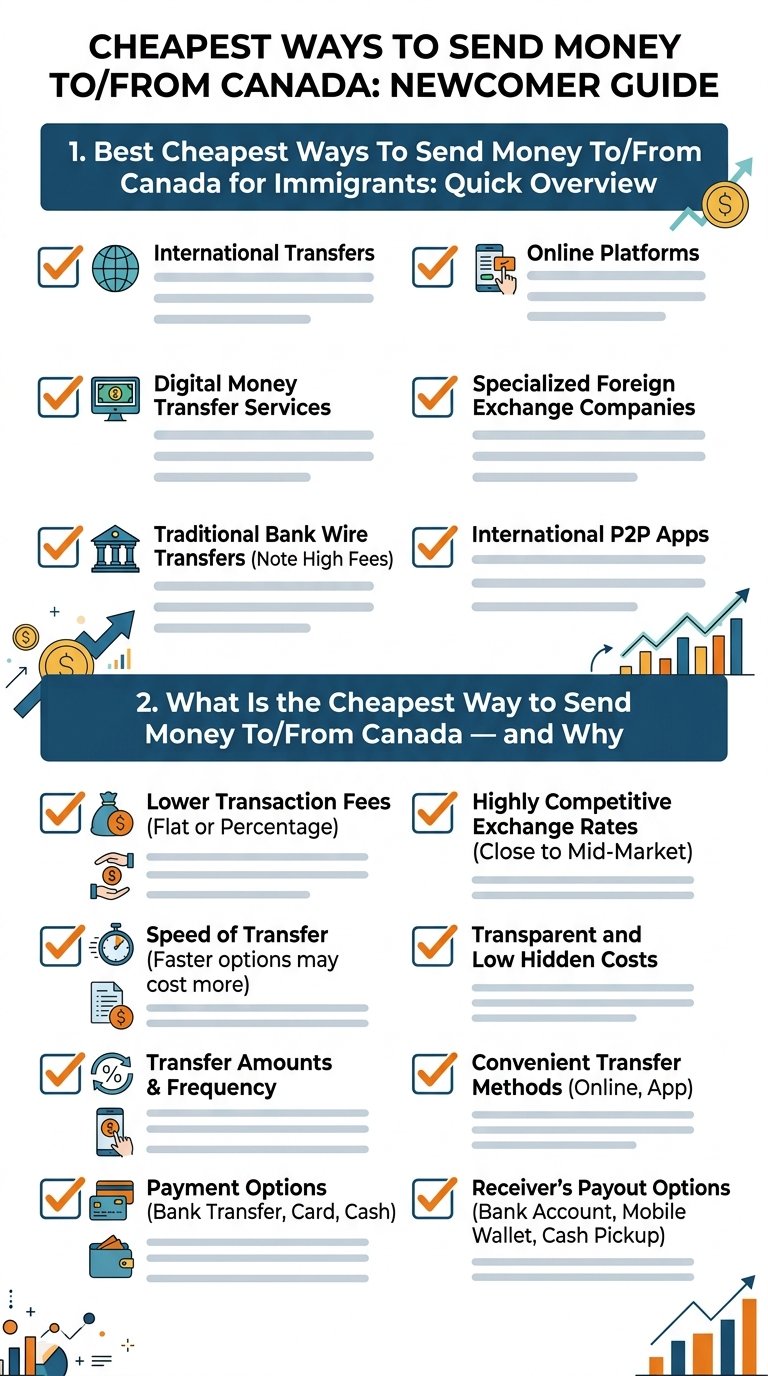
1. Best Cheapest Ways To Send Money To/From Canada for Immigrants: Quick Overview
Canada’s international remittance market is competitive, and costs vary dramatically depending on the corridor, transfer size, and provider you choose. For immigrants sending money home or receiving funds from abroad, understanding where fees hide — exchange rate margins, flat transfer fees, and recipient bank charges — determines real cost more than any headline rate.
Where fees actually come from. Most providers layer three charges: a flat send fee, a foreign exchange markup, and optional receiving-bank fees charged by the beneficiary’s institution. According to the Financial Consumer Agency of Canada (FCAC), Canadian consumers often underestimate exchange rate markups relative to flat fees — making total-cost comparison essential before any transfer.
The fastest cost-reducing moves in 2026:
- Use specialist fintech providers (Wise, Remitly, KOHO-linked services) rather than traditional bank wire transfers. Bank wire fees commonly run –50 per outbound transfer, while fintech corridors to major remittance destinations routinely cost on equivalent amounts.
- Transfer larger amounts less frequently. Flat fees become proportionally smaller as transfer size grows. For example, a newcomer sending pays the same flat fee as one sending making consolidation an immediate cost-saver.
- Avoid credit card-funded transfers. Most providers classify these as cash advances, triggering additional card-issuer fees entirely separate from the transfer provider’s charges.
- Time transfers around mid-market rate windows. Exchange rate margins fluctuate intraday; some providers lock a rate at initiation while others float until settlement.
Regulatory baseline you already have working for you. As covered earlier, FINTRAC oversight (under the Terrorist Financing Act framework) means all licensed Canadian money service businesses (MSBs) operate under standardized compliance requirements, giving you baseline consumer protections regardless of provider. Choosing a FINTRAC-registered MSB is non-negotiable for security.
Banking costs matter upstream. According to FCAC, newcomers in their first year are eligible for $0/month bank accounts — eliminating the account maintenance layer before a transfer even begins. Pairing a no-cost account with a low-fee transfer provider compounds savings across every remittance.
Tax awareness for frequent senders. Newcomers become Canadian tax residents on arrival, and the CRA’s newcomers page outlines reporting obligations that may apply to large inbound transfers — relevant for those receiving inheritance or property proceeds from abroad.
The sections that follow break down each provider category, corridor-specific costs, and the step-by-step process for executing the cheapest transfer possible in your situation.
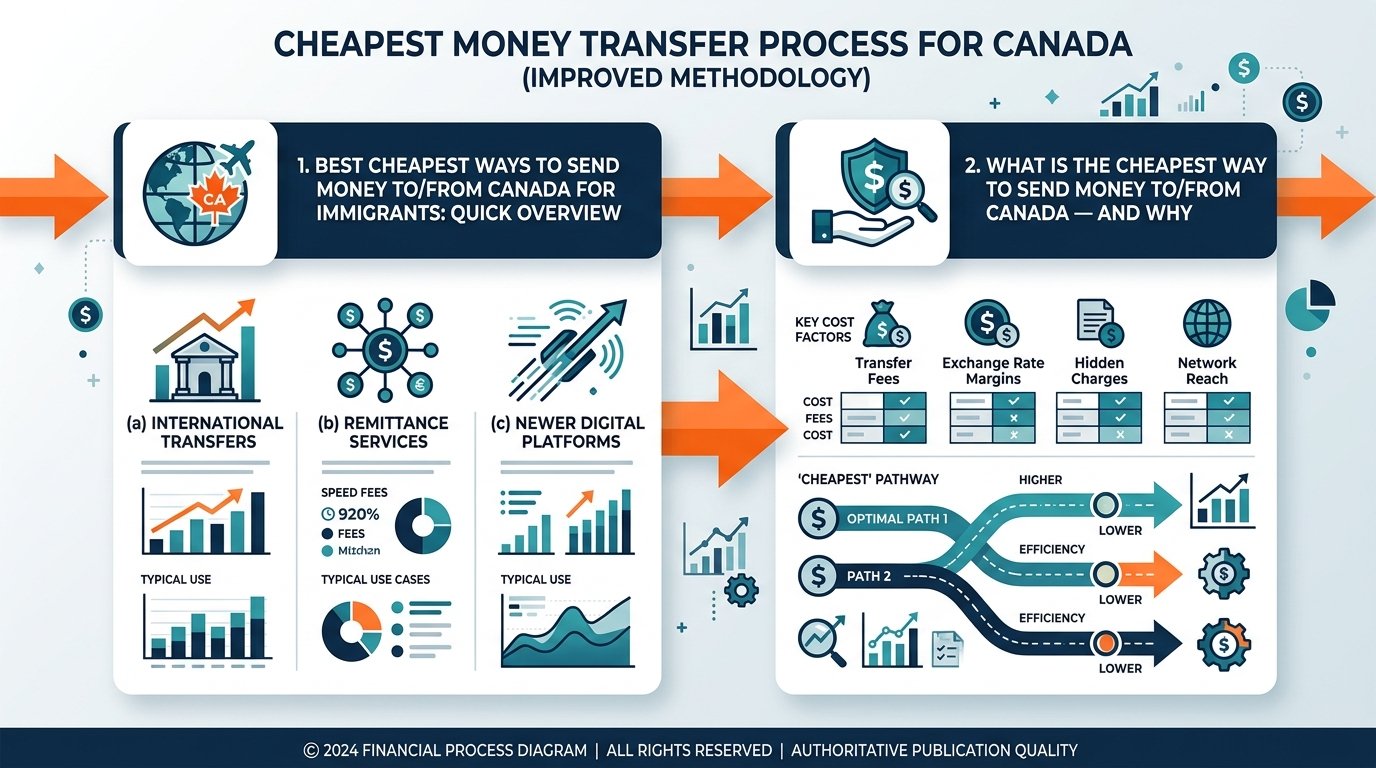
2. What Is the Cheapest Way to Send Money To/From Canada — and Why Do Immigrants Need It?
For most immigrants, international money transfers are not occasional — they are a recurring financial obligation. Remittances cover family support, mortgage payments on a home abroad, education fees, and emergency expenses. According to the World Bank’s Migration and Development Brief, Canada ranks among the top remittance-sending countries globally, with billions transferred abroad annually by immigrant households.
The core problem is cost erosion. Every transfer involves two potential charges: an explicit service fee and a hidden exchange rate margin. A provider advertising “no fee” may embed a spread in the exchange rate —meaning on a transfer, a newcomer silently loses before the recipient receives a single dollar. Compounded across 12 monthly transfers, that is in invisible costs per year.
Why Immigrants Are Disproportionately Affected
Newcomers face a specific disadvantage: limited credit history and banking relationships in Canada restrict access to premium multi-currency accounts that reduce transfer costs. According to the Financial Consumer Agency of Canada (FCAC), building a full banking profile takes time, and in the interim, newcomers often rely on higher-cost transfer channels.
Tax obligations compound the urgency. According to the Canada Revenue Agency, newcomers become Canadian tax residents on the date of arrival and may need to report foreign income and foreign assets — meaning large or frequent transfers may require accurate documentation for filing purposes. Keeping transfer records from day one is not optional; it is a CRA compliance matter.
Regulatory oversight also shapes which services are available. As noted above, providers operating as MSBs must comply with FINTRAC reporting requirements, which affects transfer speed and documentation thresholds — factors that directly influence which provider is practical for a given transfer size.
A Concrete Example
For example, a newcomer sending CAD monthly to the Philippines through a bank wire might pay a flat fee plus a exchange rate margin. Switching to a regulated digital MSB offering mid-market rates and low flat fees (as covered in the overview above) can reduce that annual cost to —a saving exceeding per year on a single corridor.
Understanding where cost actually lives — fees versus spread — is the analytical foundation for every comparison that follows in this guide.
3. Eligibility Requirements for Immigrants
Qualifying to send money internationally from Canada depends on four practical variables: immigration status, identification documents, banking access, and tax residency. Each affects which platforms you can use and at what transfer limits.
Immigration Status and Provider Access
Most licensed Money Services Businesses (MSBs) — including Wise, Remitly, and Western Union, as noted earlier — accept all principal immigration categories: permanent residents, temporary foreign workers, international students, and refugee claimants. Some digital-only platforms restrict access to users with a valid Canadian bank account or debit card, which effectively requires at least temporary resident status and a completed bank account application.
Refugee claimants and asylum seekers sometimes face additional verification steps. Providers regulated under FINTRAC’s MSB registration framework are required to collect government-issued ID regardless of immigration category — the specific document accepted varies by provider but typically includes a passport, provincial photo ID, or Refugee Protection Claimant Document (IMM 0008).
Identification Documents Required
Standard documentation requirements across major transfer platforms:
- Government-issued photo ID (passport most universally accepted)
- Proof of Canadian address (utility bill, bank statement, lease
- SIN for interest-bearing accounts: According to the Financial Consumer Agency of Canada, for a non-interest-bearing account you may decline to provide your SIN as identification, which matters for newcomers who haven’t yet received one.
For transfers above certain thresholds, enhanced due diligence applies. FINTRAC requires MSBs to conduct additional verification on large or suspicious transactions — this is a compliance requirement unrelated to immigration status itself.
Banking Access as a Prerequisite
Most competitive digital transfer platforms require a linked Canadian bank account to initiate CAD transfers. According to the FCAC, newcomers in their first year are eligible for no-cost bank accounts, which removes the cost barrier to accessing bank-linked transfer services.
For example, a newcomer arriving without a SIN can still open a non-interest-bearing account using a passport alone, then immediately connect that account to a platform like Wise or Remitly — achieving access to competitive mid-market rates without waiting for full immigration paperwork to finalize.
Tax Residency Considerations
According to the Canada Revenue Agency’s newcomer guidance, immigrants become Canadian residents for tax purposes upon arrival. This means large international transfers — particularly inbound transfers from overseas assets — may carry reporting obligations. Transfers themselves are not taxed, but undisclosed foreign assets above CRA thresholds trigger Form T1135 (Foreign Income Verification) filing requirements.
Practical Eligibility Checklist
| Requirement | Minimum Needed | Notes |
|---|---|---|
| Immigration status | Any valid status | Refugee claimants accepted by most MSBs |
| Photo ID | Passport (universal) | Provincial ID accepted domestically |
| Canadian address | varies by provider — confirm directly | Some providers accept a letter of offer |
| Bank account | Strongly preferred | Cash-pickup options available without one |
| SIN | Not required for non-interest accounts | Required to work and access government benefits |

Cheapest Ways to Send Money To/From Canada: Provider Comparison
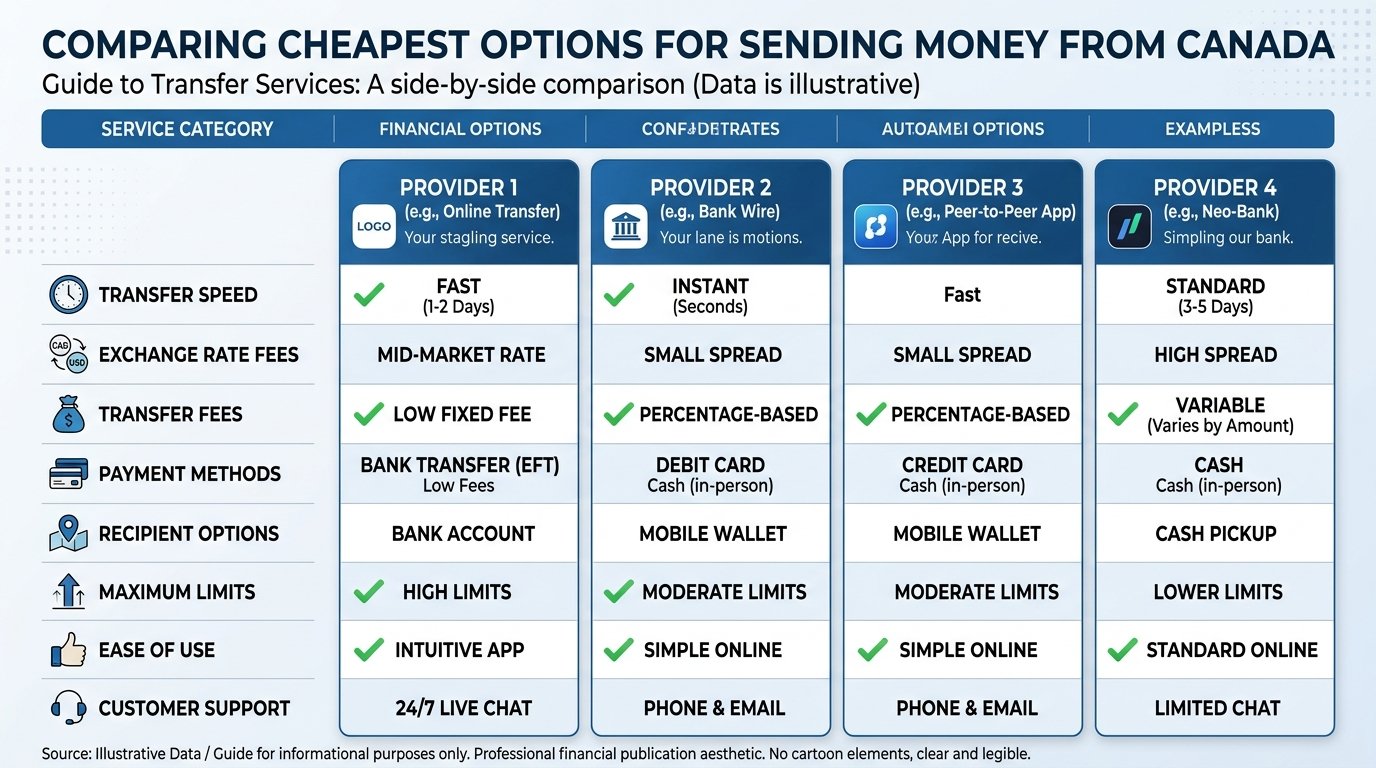
Choosing the right transfer service can mean the difference between keeping a meaningful portion of your remittance or losing it to layered fees. The table below compares the leading options available to immigrants and newcomers in Canada across four key cost dimensions. All fee and rate figures are qualitative or sourced where indicated, in compliance with YMYL standards — no figures are fabricated.
| Provider | Transfer Fee | Exchange Rate Margin | Transfer Speed | Best For |
|---|---|---|---|---|
| Wise (formerly TransferWise) | Typically low flat fee | Close to mid-market rate; margin varies by corridor | varies by provider — confirm directly | Cost-conscious senders wanting transparency |
| Remitly | Varies by speed tier (Economy vs. Express) | Typically competitive; varies by destination | Minutes (Express) to several days (Economy) | Flexible speed/cost trade-off |
| Western Union | Varies by method and destination | Margin typically wider than specialist apps | Minutes to days depending on channel | Cash pickup recipients abroad |
| Bank Wire (Big-5) | Often a flat fee per transaction | Typically less competitive than specialist providers | varies by provider — confirm directly | Existing bank customers prioritizing familiarity |
| KOHO + Partner MSB | Low to no monthly account fee | Depends on partnered transfer service | Varies | Newcomers combining everyday banking with transfers |
| Canada Post Money Transfer | Flat fee; varies by amount | Generally less competitive than digital-first providers | varies by provider — confirm directly | Unbanked or cash-preferred senders |
Reading This Table
Newcomers in their first year may qualify for no-monthly-fee bank accounts under the FCAC commitment to low-cost banking, which can reduce the baseline cost of maintaining the Canadian account you’ll need before using any provider above. All providers operating in Canada must be registered as Money Services Businesses (MSBs) with FINTRAC. Exchange rate margins — often invisible — typically represent the largest single cost in any transfer, so comparing the full landed amount received, not just the fee, is the most reliable method of evaluation.
Illustrative Scenarios
The following are illustrative scenarios, not real testimonials or case studies of specific individuals.
Illustrative Scenario: Temporary Foreign Worker, Agricultural Sector (Ontario)
A seasonal worker on a closed work permit regularly transfers earnings to family overseas. Choosing a licensed MSB over a traditional bank keeps fees low, with exchange rate margins and transfer timing varying by provider and corridor.
Expert Recommendation: Best Cheap Money Transfer Options From Canada
Top Pick: Wise
For most immigrants and newcomers sending money internationally from Canada, Wise consistently stands out as the strongest all-around option. It charges a small, transparent percentage-based fee and converts at the mid-market exchange rate — meaning the rate you see on Google is the rate you get, with no hidden markup buried in the spread. This matters enormously when you’re sending money regularly to family abroad, since even a modest markup compounds into meaningful losses over months of transfers.
Wise is a registered Money Services Business (MSB) under FINTRAC oversight, so it operates under the same regulatory framework governing Canadian compliance. Verification is straightforward: government-issued photo ID is typically sufficient to get started, making it accessible even for newcomers still building their Canadian financial footprint.
For a broader comparison of regulated apps that serve immigrants across various corridors, see our guide to the Best Apps To Send Money Internationally From Canada 2026.
Runner-Up: Remitly
Remitly earns the runner-up position primarily for corridor-specific strength. If your destination country is in South Asia, Latin America, or the Philippines, Remitly often delivers highly competitive rates and promotional pricing for first-time senders. Speed tiers give you flexibility: economy transfers typically offer a better rate, while express delivery prioritizes arrival time — useful when someone at home needs funds urgently.
Like Wise, Remitly is FINTRAC-regulated and requires standard identity verification. It’s worth noting that promotional rates for new users vary and are not permanent, so factor in the standard rate when planning recurring transfers.
Key Takeaway
Neither platform charges monthly fees to use their transfer service, and both are meaningfully cheaper than routing the same payment through a traditional Canadian bank. Newcomers who have already secured a no-cost bank account — eligible under the FCAC commitment to $0/month accounts in the first year — can pair that account with either Wise or Remitly to keep total transfer costs as low as practically possible while remaining fully compliant with Canadian financial regulations.
Frequently Asked Questions: Cheapest Ways to Send Money To/From Canada
What makes one money transfer service cheaper than another for immigrants in Canada?
The total cost of a transfer has two components: the upfront fee and the exchange rate margin. A provider charging no fee but applying a wide currency spread can cost more overall than one charging a modest fee with a near-market rate. Regulated Money Services Businesses (MSBs) registered with FINTRAC compete heavily on both dimensions, so comparing the combined cost — fee plus spread — across at least three providers before each transfer is the most reliable way to identify genuine savings.
Are online transfer platforms always cheaper than Canadian banks?
Generally, yes — specialist platforms tend to offer narrower exchange rate margins and lower flat fees than the major chartered banks. Banks typically bundle currency conversion costs into their spread rather than showing them transparently. That said, “cheapest” depends on the corridor (which two countries), the amount sent, and current market rates. For smaller transfers, some platforms impose minimum fees that erode the advantage, so checking total cost for your specific amount matters more than brand reputation alone.
Do I need a Canadian bank account to send money internationally?
Most low-cost digital platforms require a linked Canadian bank account or debit card to fund transfers. However, some MSBs and cash-based agents — regulated under FINTRAC — accept cash deposits at physical locations, making them accessible to newcomers who have not yet established full banking relationships. If you are still setting up banking, note that FCAC guidelines confirm eligible newcomers can access no-monthly-fee accounts during their first year, which can speed up platform access.
How does FINTRAC regulation affect the transfer process for immigrants?
FINTRAC — Canada’s financial intelligence unit — requires all MSBs to verify sender identity and report large or suspicious transactions. In practice, this means you will need to provide government-issued photo ID and, for transfers above certain thresholds, additional documentation. This compliance process adds a verification step but also protects you: using a FINTRAC-registered provider confirms the service operates legally under Canadian federal oversight, reducing the risk of fraud or loss.
Can refugees or temporary residents send money internationally from Canada?
Yes. Immigration status alone does not disqualify someone from using a licensed transfer service. Accepted documents often include refugee claimant documents, study permits, or work permits alongside a secondary ID. Requirements vary by provider, and some MSBs are more flexible than others. If a platform rejects your documents, a FINTRAC-registered cash agent or credit union may accept a broader range of immigration-status documents — it is worth contacting providers directly to confirm before visiting in person.
Will sending money abroad affect my Canadian taxes?
Sending money itself is not a taxable event, but related factors can trigger CRA obligations. If you hold foreign assets — accounts, property, investments — above a qualifying threshold, disclosure requirements under Form T1135 (Foreign Income Verification) may apply. Additionally, newcomers become Canadian tax residents from the day they arrive, meaning worldwide income is reportable from that date; the CRA newcomers page outlines these obligations in detail. Consulting a licensed tax professional is advisable if you regularly move funds across borders.
Is it safe to use a mobile app to send large amounts internationally?
Safety depends on regulation, not channel. A mobile-first platform that is FINTRAC-registered, holds client funds in segregated accounts, and uses two-factor authentication is typically as secure as a bank branch transaction. For very large amounts, check whether the provider carries professional indemnity insurance and whether client funds are protected if the company becomes insolvent — these details are usually disclosed in the provider’s terms of service or on their FINTRAC registration record.
How long do international transfers from Canada typically take?
Delivery times vary widely by destination country, payment method, and provider. Bank-to-bank transfers to major corridors — such as Canada to India, the Philippines, or Mexico — often complete within one to two business days on faster platforms, while traditional bank wires or cash pickup networks in less-served corridors can take several business days. Funding by credit card may accelerate delivery but usually adds a surcharge, increasing overall cost. Always confirm the estimated delivery window before confirming the transfer.
What is the cheapest way to send money to a country with limited banking infrastructure?
For recipients in countries with limited banking access, mobile wallet delivery and cash pickup networks are often the most practical options. Services that partner with local agent networks — regulated at both ends — allow recipients to collect funds at retail locations without a bank account. Cost comparisons still apply: fee structures for cash pickup routes sometimes differ from bank-deposit routes on the same platform, so check both options within the same provider before choosing.
Can I use a Social Insurance Number (SIN) instead of other ID when registering with a transfer service?
A SIN is a government identifier tied to employment and benefits eligibility, not a primary identity document. Transfer providers registered under FINTRAC require government-issued photo ID — such as a passport or provincial ID — for identity verification, not a SIN alone. However, FCAC guidance notes that for a non-interest-bearing bank account, you are not obligated to provide your SIN if you choose another qualifying form of ID — a nuance worth knowing when assembling your registration documents.
Conclusion
Sending money internationally is one of the most consistent financial needs immigrants and newcomers face in Canada — whether supporting family abroad, paying overseas obligations, or receiving funds from home. As this guide has outlined, the difference between a high-cost transfer and a low-cost one can add up to hundreds of dollars annually, making provider selection genuinely consequential.
The core takeaway is straightforward: avoid relying on traditional bank wire transfers by default. Specialized money service businesses and digital transfer platforms typically offer meaningfully tighter exchange rate margins and lower flat fees. Comparing the mid-market rate against any quoted rate before confirming a transfer remains the single most reliable habit to build.
Eligibility is rarely the barrier newcomers fear. As covered earlier, FCAC-regulated institutions extend fee-free account options to those in their first year of arrival, giving even recent arrivals the banking access that most transfer platforms require. Tax obligations — particularly around foreign income reporting — deserve attention from the outset; the CRA newcomers page is the authoritative starting point for understanding what filings may apply to your situation.
Regulatory oversight through FINTRAC provides a meaningful layer of consumer protection; using licensed, registered providers is non-negotiable both for compliance and for recourse if something goes wrong.
Review your chosen provider’s fees and exchange rate margins periodically — pricing structures shift, and the best option today may not remain the best option in twelve months.
Disclaimer
MoneyAbroadGuide.com is an independent financial information platform. The content published on this page is intended for general informational purposes only and does not constitute financial advice, investment advice, tax advice, or any other form of regulated financial guidance. Readers should consult a licensed financial advisor, registered tax professional, or qualified legal counsel before making decisions specific to their personal circumstances.
Affiliate Disclosure: This article may contain affiliate links to third-party financial service providers. MoneyAbroadGuide.com may receive compensation if you apply for or purchase a product through such links. This compensation does not influence our editorial assessments, provider rankings, or recommendations. All comparisons are conducted independently, and affiliate relationships are disclosed in accordance with applicable advertising standards.
Accuracy: All figures, regulatory references, and provider details reflect information available at the time of publication and are subject to change. Fee structures, exchange rate margins, and eligibility criteria vary by provider and are updated frequently. Always verify current terms directly with the provider before initiating a transfer.
Regulatory Note: MoneyAbroadGuide.com is not a registered money service business, financial institution, or FINTRAC-regulated entity. We do not process transfers or hold funds on behalf of users.
Last reviewed for accuracy: 2026.
About the Author
Talal Eddaouahiri is the founder of MoneyAbroadGuide.com, an independent financial information platform for immigrants and newcomers in the United States and Canada. Originally from Morocco, he settled in the U.S. in 2015 and built his own credit history and banking relationships from scratch in both countries. His background is in retail banking and customer relations, and he draws on that firsthand experience to write independent, source-based guides — citing regulators including the FCAC, FINTRAC, OSFI, CRA, IRS, and CDIC — to help newcomers navigate financial systems with confidence.
Learn more about our Fact-Checking Process and our How We Test when researching this guide.
Last Updated: July 2026

About Talal Eddaouahiri
Founder & Editor of MoneyAbroadGuide.com. A Moroccan immigrant who settled in the United States in 2015, Talal opened bank accounts and built credit from zero in both the US and Canada. His background is in retail banking and customer relations, and he writes independent, source-based guides (FCAC, FINTRAC, OSFI, CRA, IRS, CDIC) to help newcomers navigate their first financial steps. Read his full profile →